Category Archives: main

Sermon for the Fifth Sunday of Easter: May 14, 2017

Rev’d Mark B. Stirdivant, Good Shepherd Lutheran Church, Yucaipa, California
†   sdg   †
John 14:1-14

It’s a scary world out there. Lots of trouble and worry. Violence is ever-present in our world. Are you actually informed or entertained when you watch the news? Aren’t you more often disgusted or angered when you see the news on TV or your computer screen? Have you ever had your mother call you with anxiety in her voice, telling you she hopes you’ll be safe amidst all that danger out there? Everything that used to be loved and preserved for the good of our society seems now to be ridiculed and condemned as false, superstitious, or bigoted, racist and unloving. That’s what people say about us, about you. All around us we see evil, and it does not want to share any space in peace with us. We cannot avoid problems, persecution, misunderstanding, and conflict. Even something as utterly wholesome as Mother’s Day cannot escape the taint of evil that threatens to ruin it all.

German: And He said to His disciples: Your hearts be not frightened. Believe in God, so also believe in Me.  In My Father's house are many rooms.

German: And He said to His disciples: “Your hearts be not frightened. Believe in God, so also believe in Me. In My Father’s house are many rooms.”

No matter what your age, you know what it’s like to live with uncertainty, under pressure and stress with all that is demanded of you every day. As a member of this Lutheran Church you affirm that you have been taught the faith as summarized for us in the Catechism and taught in the Bible. You have made a public confession of the faith in full unity with this congregation. You say by your presence here, Yes, I believe this Christian faith, I make it my own, and I promise to stay in the faith for the rest of my life. I am here to grow in this faith and make it strong in my heart all the way to life everlasting. That very confession of yours puts you right in the middle of this evil, difficult world that has painted a target on all our backs. Yet, in the midst of the “gloom and doom”, for us as publicly confessing Christians, there is still a bright spot to lift and cheer you all.

You can see that bright spot in the very first words of this reading – where we hear our Lord Christ tell His disciples, “Let not your heart be troubled.” These words mean a whole lot more to you than simply “Don’t Worry, Be Happy,” especially when they come from Jesus. He doesn’t stop with simply making you feel better; He is doing something real for your eternal destiny. He adds: “You believe in God, believe also in Me.” And that last part, “believe in Me” is the real answer for all of us who live here in this valley of sorrow. John wrote that Jesus came from God and was now returning to the Father, that is a short expression meaning the entire mission that He accomplished for the salvation of the world, all that we say together in the Creed about what Jesus did. Jesus explained to His disciples that soon it will be time for Him to go. He was going to the cross, then He would rise from the dead, and ascend back to His Father all so that by accomplishing this entire mission He would prepare a place for them – and for us, then He would return.

Think about that and recall it to your mind whenever you face rejection and trial in this evil world. When anything in the news frightens you or repulses you, do not be discouraged. Remember that you will always belong to the Lord. And you know that where He’s gone, there also is an eternal home reserved for you. Our Lord’s return to heavenly glory, which we will celebrate on Ascension Day, should remind us every day: we are not of this world – you live here for a very short time. Jesus raised up our sights away from all this evil around us and every day He gives us an eternal perspective – your ultimate goal in life is not to be found in grabbing for yourself all the valuable things of this world, but rather seek out the forgiveness of sins and the gift of eternal life with our Father in heaven. The only way you will have any real peace or tranquility as you endure the troubles of your life, is by looking at it the way Jesus speaks about it, and the way the Catechism teaches it. For many of you, it was one of the most important things your mother taught you.

The Jesus who ascended, will certainly also one day return for all those who are His own. He’ll raise our bodies from the dust of the ground, from the depths of the oceans, or wherever else they might be. Jesus promised you a room in His Father’s house, a spot in His eternal kingdom, and you didn’t have to do anything to earn that privilege. The door is open to your mansion! You may sometimes feel abandoned, but you haven’t been. Jesus is coming back for you – let not your heart be troubled. Jesus gave His disciples – and you as well – three important foundations for your faith to remain constant, just as you vowed to do when you joined – even in the midst of the greatest of troubles that you have to face in life. Those three foundations are: I am the Way, the Truth, and the Life.

Jesus said to him "I am the way and the truth and the life.  No one comes to the Father, except through Me."

Jesus said to him “I am the way and the truth and the life. No one comes to the Father, except through Me.”

It might be hard to predict when will be the next time you ask the question: “Why me?” But it will probably happen sometime. Well, in light of what we’ve just heard from our Lord – does it not seem crazy that any strong Christian would be so filled with doubt and confusion regarding the future? Has there ever been a time when you’ve played the role of Thomas and thought: “Lord, I don’t even know where You’re going next in my life… how can I know the way?” We know the answer, of course, we all learned it from the Bible and Catechism. But it is so easy still to fail to realize this and make it apply in our daily life. We prefer to search in some vain hope that we’ll uncover some new insight, some new truth, or some better slant on life to help us through yet another day. I can make myself a better me, so I’m told. Still our Lord’s Word and Promise for us stand. His answer is there even when we refuse to see it. As Christians, we not only know where our Lord Christ has gone, but we also know how to get there.

Jesus responded to Thomas’ desperate-sounding question and lays it out quite simply. He alone is the Way to heaven – the way of the cross with all its death and shame – the Way of the Lamb of God who takes away the sin of the world – the Way of the Good Shepherd who lays down His life for His wayward, wandering sheep – the Way of the Door of the sheepfold who lifts us over the threshold of heaven. He is the Way – and He becomes our Way when the old man of sin who lives inside us is put to death through Baptism – the “rebirth of water and the Holy Spirit.”
But not only is Jesus the Way, He’s also the Truth. He’s not simply one of many who claim to have found some truth that we were searching for, but He Himself is the Truth, whether we wanted it or not. In Him Truth has its beginning and end. In Him – the One who existed from all eternity, created all things and set it all in motion with the Word of His mouth – Truth had its beginning and its fulfillment. When you and I are tempted to doubt and wonder like Pontius Pilate did, saying what is Truth, we need look nowhere else than this One who is the Truth – to Him who was condemned to death by lying witnesses – and who often wasn’t believed even by His own followers or family. He’s our Truth, we confess Him boldly – He’s the Word of God through whom we have been forever set free from the power of sin, death, and the devil.

Finally, He’s not only the Way and the Truth, but – perhaps greatest of all – He’s the Life. Even though He would soon be handed over to the darkness death on the cross, He achieved something magnificent. Even in that moment of deep darkness He was still the Life and the Light of men. As we sometimes hear in the Liturgy, He’s the One through whom our Lord has given us the “power to become the children of God.” His death is our Life, and the one who trusts in Him – even though he die – yet shall he live. For God’s promise is that whoever places their trust in Jesus shall never die. He is the Life.

To fight those battles that will some day or another come your way, to stay true to the promises you made in your confirmation, you need those strong words of Jesus: let not your hearts be troubled; believe in God, believe also in Me. When you have faith which can sustain you through any deeply troubling time, your complete trust is in Him who is the Way, the Truth, and the Life – He who came from the Father, suffered, died, rose again, and then returned to the Father to prepare a place for you – He who is God Himself in the flesh of man – He who comes to His people even today in Word, water, bread and wine. He is the One in whom alone is all your trust and confidence. For He is coming back on the Last Day to bring into His heavenly Paradise all who belong to Him by faith. He has prepared for you and me a place in His, and our Father’s house. He is the One to whom we can confidently listen, for it’s in His Word that you admit to others is true, and in His Word alone, that true peace may – and, indeed, will be found. Let not your heart be troubled.

In the Name of the Father and of the † Son and of the Holy Spirit.
Sermon for the Fourth Sunday of Easter: May 7, 2017

Rev’d Mark B. Stirdivant, Good Shepherd Lutheran Church, Yucaipa, California

† sdg †

John 1:1-10

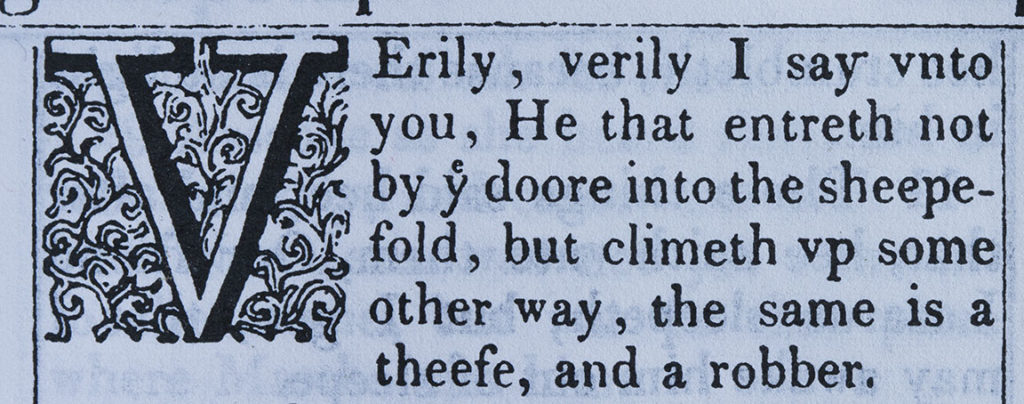
John 10:1  KJV 1611

John 10:1 KJV 1611

There’s a famous old painting of Jesus where he’s standing outside a door knocking, not banging like He’s in a rush or rage, but patiently, calmly, with a peaceful, yet intent gaze on His face. It was inspired from Revelation chapter 3 where Jesus says, Behold I stand at the door and knock. If anyone hears my voice and opens the door, I will come in to him and eat with him. But in the Gospel from John for today, Jesus says in this instance that He is the door. And this is Good Shepherd Sunday, so He is the door for the sheep. That’s why some Bibles translate the word “gate” instead of “door.” You may think it silly for me to point this out, but I must. Jesus is not like a door, as if there were something greater than He called a door and that He is patterned after it. No, He is the Door.

Thinking of Jesus as the Door is very important for Christians. After all, your Lord went through the door of His Father’s “house” of heaven in order to come to this earth and be born in a stable-manger and take on your frail human flesh. He came to live, suffer, die and rise again for your sake, in your place, and for your salvation. He came to us through that door which leads from heaven to earth, then He had that same door slammed in His face at the moment of His death on the cross. That is to say, God put His own Son there in place of those who rejected Him, He was counted as the one who rebelled against God, and so your sins required the Father to slam the door of heaven in His Son’s face – on top of all His agony and bloody suffering. Think instead of Jesus in that tranquil painting pounding on that door until His knuckles were bloody and raw, but there would be no answer – He would have to die, rejected at God the Father’s door. Christ was to be alone in the fire and the forsakenness of eternal punishment for you to have forgiveness. In the midst of torment, He would cry out from the cross: “My God, My God, why have You forsaken Me?” Our Savior would endure that torture so that you and I might be able to look forward with certainty to all the blessings of heaven.

After the door to heaven was slammed in His face, Christ then went through another door, the door of death as His torture came to an end late on Good Friday. He passed through that door to Hell and He proclaimed His victory there over Satan and his forces of darkness. Then, on Easter morning, He came back out through the door of death, with the stone rolled away from the door of the tomb, so that by going through and coming out again He would become the Door. Through Him sinners could now pass from the sheepfold of His Church out into the heavenly pastures of God’s kingdom of glory.

And here is where you see the connection between Jesus calling Himself both the Door for the Sheep, and the Good Shepherd at the same time. For He says that He who enters by the door is the Shepherd, and the sheep hear His voice. Using His voice, that is, the pastor preaching the Word of God to you and washing your sins away in the water of Baptism, that is how Christ calls you His sheep by name. Although most of the time these days you are treated as if you were nothing more than a number, but the way God sees it you are so much more than that. You are personally known to our Shepherd, and He calls you out of this desolate wasteland of sin into good, safe, grazing pasture – filled with the sweet, succulent nourishment of His Word of Life. He doesn’t just round you up and turn you loose to wander aimlessly around the countryside like sheep tend to do. He’s always there with you, calling out to you using the Voice of the called servant of the Word.

Even in the face of death, says the Psalm, your Shepherd will be there beside you. And you don’t have to fear anything because He has already gone on before you through that fearful valley of the shadow of death, when He paid for your salvation. He’s at your side no matter what you face, and He has His rod and staff to comfort and protect you – even when it would seem as if there could be no help at all. This is the promise of your Good Shepherd that cannot be taken back, and on this promise you can base all your trust and hope. You have a Good Shepherd who has come to you to give, not get. There are many thieves and robbers in this world, and their only motive is to get something from us – to milk us for all we’re worth. Not so the Good Shepherd. He hasn’t come to get, but only to give – to give His life as the purchase price for your pardon – and to give you every blessing in His name.

Jesus the Door is also Jesus the Good Shepherd because He lays down His own life for His sheep. Rather than beating you down with condemnation for your many straying ways, instead He takes the beating Himself by dying the death of the cross in your place. He’s the Good Shepherd because He takes up in resurrection the life that He laid down. In fact, the only reason you can call Him the Good Shepherd is because of Easter – for that was when He forever pulled Himself out from the mighty grip of death so that you would never have to experience what He had to go through. Now to you – His sheep – He says, “Because I live, you will live also.” No other Shepherd is out there that can match that promise. Only Christ, the Good Shepherd, can say: “I came that they may have life, and have it abundantly.”

So, as sheep there are only two things that you must now do. First of all, you must hear and listen to the Shepherd’s voice. Whenever you come to the Divine Service – whenever you sing a hymn – whenever you hear a sermon – whenever you pick up and read God’s Word – you are hearing His Voice speaking. He’s saying: “I died for you” – “I rose from the dead for you” – “Because I died and rose, your sins are gone, and you will live forever.”

But it goes even farther than that. The Shepherd’s voice invites those of you who are communicants to this Altar and partake of the Holy Supper of Christ’s body and blood that is given and shed for sinners to eat and to drink. The Lord who stands at the door and knocks is He who wishes to come and eat with you in a miraculous way. Listen when He says to you: “Do this in remembrance of Me.” The more often you “remember” Jesus by partaking of this Holy Meal, the more your sins, and the sins of those who have offended you, are placed on Jesus and cast into the depths of the sea and forgotten. You are reconciled to God and to one another, because you both heard the Shepherd’s voice, and entered forgiveness and life through the Door.

Secondly, as sheep you then follow Him – which means you go where He’s gone and do what He’s done. It happens automatically, by the power of the Holy Spirit. It isn’t something you set out to do yourself. He went to a cross, and you will go to yours. As Luther loved to point out, in all believers there must be a daily crucifixion – a daily death, if you will – of the sinful nature inside you, which he called the Old Adam. And this is what happens every time you recall your Baptism, when you remember your sins and trust that Jesus has washed them away. In Baptism the old man of sin is already drowning under the water and the Word. And although it’s hard – even impossible at times – for you to hold that sinful nature down under that water, it’s something you must daily be prepared to do. The power of God in your Baptism is there for you every day. In that flood of forgiveness every day is like Good Friday for you as your Old Adam is put to death once more. Even though sin is an ever-present reality, you still daily put that sin to death in Baptism. Because you know that on the day when you pass through your door of death into the glory of God’s eternal heavenly kingdom – you’ll be completely and permanently dead to sin, but alive in Christ.

Finally, as Jesus came out of His grave, so shall you also come out of yours. Even as you daily crucify and put to death your sin in you, you also rise anew each day to live in righteousness and holiness forever. Hear what St. Peter had to say in the Epistle: “(Christ) himself bore our sins in His body on the tree, that we might die to sin and live to righteousness . . . for you were straying like sheep, but have now returned to the Shepherd and Overseer of your souls.” For you sheep who belong to Jesus the Good Shepherd, every day is Easter. For the present think of your Baptism as your first Easter resurrection, that is renewed each day as you rise again to forgiveness and new life. But the ultimate Easter will take place on the Last Day – the day of the Resurrection of All Flesh. On that day, dear friends, you will rise to eternal righteousness. In the meantime, you’ll continue as sheep following the voice of the Good Shepherd, who is also Christ the Door, and His voice speaks through the pastor He gave you. Also in your daily life and personal calling you submit yourself to Christ’s leading, living, dying, and rising as you sacrifice yourself for the good of your neighbor. For you know God will freely grant you all of this since Jesus already promised. In fact, all that goodness is in His hands ready to give you for housewarming, you could say, as He stands there and knocks on the door of your heart.

In the Name of the Father and of the † Son and of the Holy Spirit.
SERMON for the Third Sunday of Easter April 30, 2017

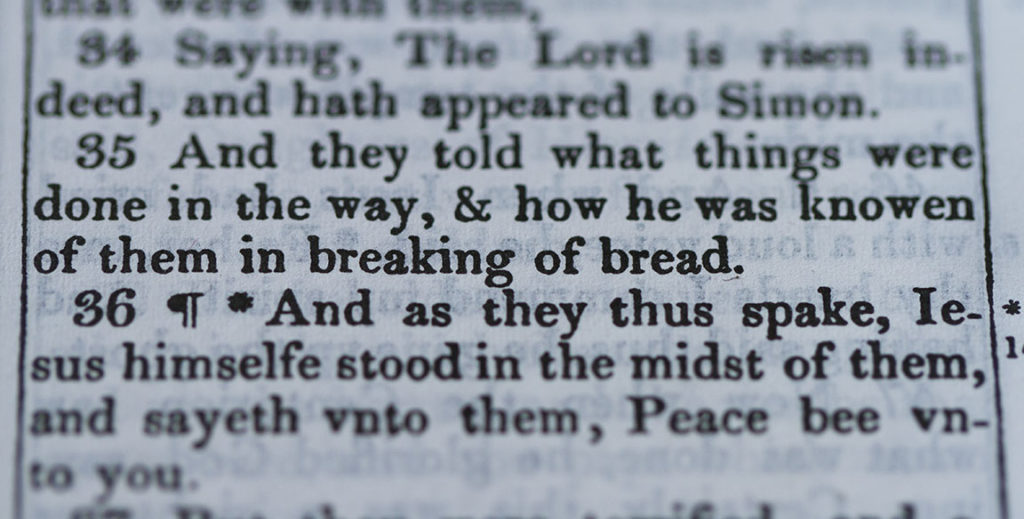
Luke 24:35  KJV 1611

Luke 24:35 KJV 1611

Luke 24:13-35

In Nomine Iesu

Thomas (remember from last Sunday) had fear and doubt. Yet even Thomas knew that all He needed from Jesus was His nail-pierced hands and spear-gashed side. He knew that Jesus died for him and that would remove his doubt and his fear. I said just last week that was true also for you. Jesus removes your fear and gives you a more confident faith in its place. Today we hear from St. Peter, though, and it’s starting to sound contradictory, if not just plain confusing when he writes something like this: “conduct yourselves with fear throughout the time of your exile” (1 Peter 1:17).

Why would this courageous leader among the apostles, speaking to newly-baptized infants in the faith, why would he tell them that they need to have fear? I thought that the good news of Easter was that there was no need for fear anymore! Why should a Christian’s journey be one of fear, especially since we know Jesus our risen Lord and in Him we have no more reason to fear those things we used to fear? To be sure, fear isn’t all of the story.

The Ten Commandments remind us that not only should we fear God, but also love and trust in Him above all things. As we read and hear the Gospels, we witness everything our merciful Savior did and said so that we may believe in Him through His Word. Yet the Gospels also have other people in the story. There are people who talk to Jesus, who respond to His Word, and we would miss out if we ignore them. These other people in the Gospels, like Thomas in the Gospel last week, are showing us pictures of ourselves as we do our spiritual traveling in this world that is not our final home.

What happens with people when God breaks in, enters their world and their lives? Sometimes we see in the Bible’s historical accounts the way things are supposed to be. Other times we see the opposite. Think about the detailed description of the two disciples walking from Jerusalem to Emmaus, about seven miles away. It took place on the very day that Jesus had risen, many were overjoyed at this point, yet these two men were sad. This is not what we would think to be a good example of the church that proclaims the resurrection. They should be glad. They should rejoice. They had already been told by the others that Jesus had risen. But like Thomas, who wasn’t in the room when the Lord appeared, these two men were not yet convinced.

That shows us a picture of ourselves. We’re traveling on a journey in this world, we have been baptized and are clothed with Christ. We hear the preaching that Jesus is risen, and we respond He is risen indeed. But still we question. Can it really be? Is it possible? Could it be true that God took on flesh, died and rose on the third day? Even so, would it matter anymore? Does all this church-talk have any benefit for me today with all that I’m going through, two thousand years later?

As we learned from Thomas, part of the sinful baggage that we carry with us as we travel is that we doubt. We grow weary on the journey. We risk losing our hope. Sin threatens to tear us and those we love away from Jesus. This is why St. Peter says in his epistle to pass the time of your exile journey here on earth in fear. The disciples would rather have had Jesus stay with them, keep on teaching and reassuring them, but Jesus told them in his last sermon to them in St. John’s gospel that he had to go away for their sake, for their good. A little while, you will not see Me, and then again, after another little while, you will see Me.

Think of yourself walking down that Emmaus road. A Stranger catches up to you, and speaks something that is at one and the same time frightening and encouraging. Law that condemns you. Gospel that forgives and strengthens you. This is the journey of the church, until the Day when our Lord Jesus will return as He promised in glorified, visible form. This is the life that Christ wants for the church to live after He ascends to heaven and sends the Holy Spirit at Pentecost. We cannot help but wonder, why did Jesus hide His true appearance from them as they walked on the road? If we look at the church and its life today, however we can give a good guess as to the reason.

They still don’t recognize Him, yet Jesus nevertheless asks a few questions and then begins to turn the table as He preaches, all from the books of the Old Testament, remember, about the crucifixion, death, and resurrection of the Messiah. What a sermon, a Bible study, an education that must have been! When you hear God’s Word in church and also read it from the Bible, that’s when Jesus is catching up with you on your journey. He comes to you hidden, shrouded in the words you hear, but He’s still there, ready to stay with you and walk with you. He has promised to be with us here today, and He most certainly is here! How often it is that when God’s Word is preached, though, we grow tired and restless. When the Gospel is read and we hear of Jesus in those words entering our ears, our slow hearts fail to see Him. Though we hear the proclamation that Jesus is risen, we still grow weary and dull even while we’re hearing that joyful good news.

We have been given such a precious gift, yet we cannot seem to fully comprehend or appreciate what it means for us as we journey in Christian life today. It is for all sins, even our sins of weariness, that Jesus died. Jesus came to suffer and die so that we may have Him with us in these hidden ways, which are called means of grace. His death poured a never-ending flood of mercy for you into simple words, water, bread and wine.

The Easter story about the two men walking to the village of Emmaus tells us a lot about how Jesus loves us and helps us. Those two disciples arrive at their destination with this supposed “stranger,” then they ask Him to come in with them and rest and have a meal. They thought they would serve Him, but instead, Jesus would end up serving them, giving them something that would greatly help them. Even though this is an ordinary meal, the words Luke wrote are the same words that are used to describe the Lord’s Supper: “He took bread and giving thanks, he broke it and gave it to them.” Sound familiar, right?

Just as Jesus instituted the Lord’s Supper in the upper room the night before his arrest, it is as though He is reminding them of this. “Do this in remembrance of me.” He had said. The amazing thing is that their eyes were opened at the moment when He broke bread and then they saw Jesus. They even told the eleven disciples that Jesus was “known to them in the breaking of bread.” This is an important detail for us to keep in our minds with this Gospel story. It’s important because we know Jesus not by something that we feel or by some truth or principle that we tell ourselves in our minds. We know Jesus when He actually comes to us and opens our minds to understand Him, to hear His Word that forgives your sins, and to eat and drink His Body and Blood in the Sacrament of the Altar. In your journey, here is where Jesus walks with you, not in your mind nor is it something you will always feel in your heart. He comes to us. He is not far away. We should be here in God’s house often so we can meet Him!

Jesus took two sad, confused, and worried men and gave them the gospel Word–He gave them Himself. They knew all the facts about what happened to Jesus. They said it back to Him accurately when this Stranger asked them what things happened in Jerusalem. But they needed Jesus to help them see, from the Bible and from His teaching from the Bible, that yes, Jesus did redeem Israel, He did pay the price for your salvation to come true. He gives you the forgiveness that you know you didn’t deserve, and the eternal life that for you had been impossible to achieve. Like those two men walking to Emmaus, God’s Word opened up to you what Jesus did for you, and He makes it clear what the whole point of your journey is—it’s to be with Him.

The whole church is on a journey. Jesus is going with us, and you’ll hear Him and receive His gifts and forgiveness. This is how you know His love is for certain. Jesus takes away our sins, our sorrows and worries, right now at this moment, and gives Himself to us. Peter reminds us in his epistle that the Word of the Lord endures forever. Yes, He does! Jesus is our victor over death because He didn’t stay dead. His victory is our victory, and when we drink the Communion cup we see Jesus. He said it’s His blood, so that’s what it is. Our eyes are opened unto Him in the bread that we eat, since He has already said, it is His body. We eat and drink and we receive Jesus; His love; His forgiveness.

He is making the journey with us, ever abiding and leading us. We still conduct our lives, and as Peter wrote we proceed in this earthly land of exile with fear, yes, there is a new kind of fear that is thankful and reverent to our Lord who loves us, but since we have Christ walking with us all the way, we need never be fearful. When the road we walk seems dark and sometimes without direction, it is Jesus who forgives us and helps us. He journeys with us through the Word that He is, through the Word that we hear in faith, even when we do not always detect that He is there. He cares for and nurtures His church along the road, as the psalm says: “For thou wilt light my candle: the Lord my God will enlighten my darkness” (Psalm 18:28).

In the Name of the Father, and of the † Son, and of the Holy Spirit.

The Rev’d Mark B. Stirdivant sdg

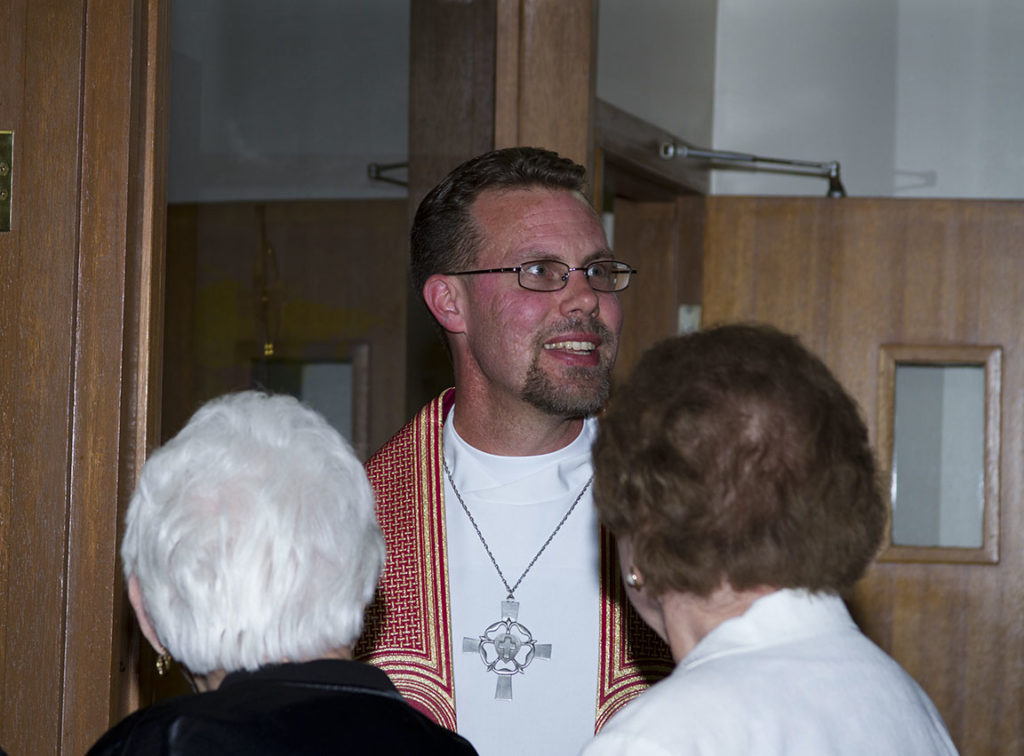
Rev. Mark Stirdivant was installed as Pastor, April 2, 2017

Pastor Mark Stirdivant was born and raised in Hemet, California, where his parents still reside. He attended college at Concordia University, Irvine, where he graduated Summa Cum Laude, and then attended Concordia Theological Seminary in Fort Wayne, Indiana. He sang and toured with the 16-voice men’s choir, the Seminary Kantorei. He served his vicarage year at St. Peter Lutheran Church in Norwalk, Connecticut, under the tutelage of Rev. Robert Beinke.
After a long-distance courtship and engagement, he married his wife Krika in 2000.
In 2002, he was ordained into the Office of the Holy Ministry and installed at Holy Cross Lutheran Church in Kansas City, Missouri.
In 2008 Pastor Stirdivant joined the Gladstone Public Safety department as a volunteer chaplain. He went on ride-alongs with the officers, attended roll-call meetings and occasionally attended to severely traumatic police calls. In June of this year, he will have completed 15 years in the Office of the Holy Ministry.
Pastor and Krika have a Boston Terrier named Poppy, and all of them are very excited to be “back home” in California, and they look forward very much to getting to know you better!

Pastor Mark Stirdivant

Pastor Mark Stirdivant

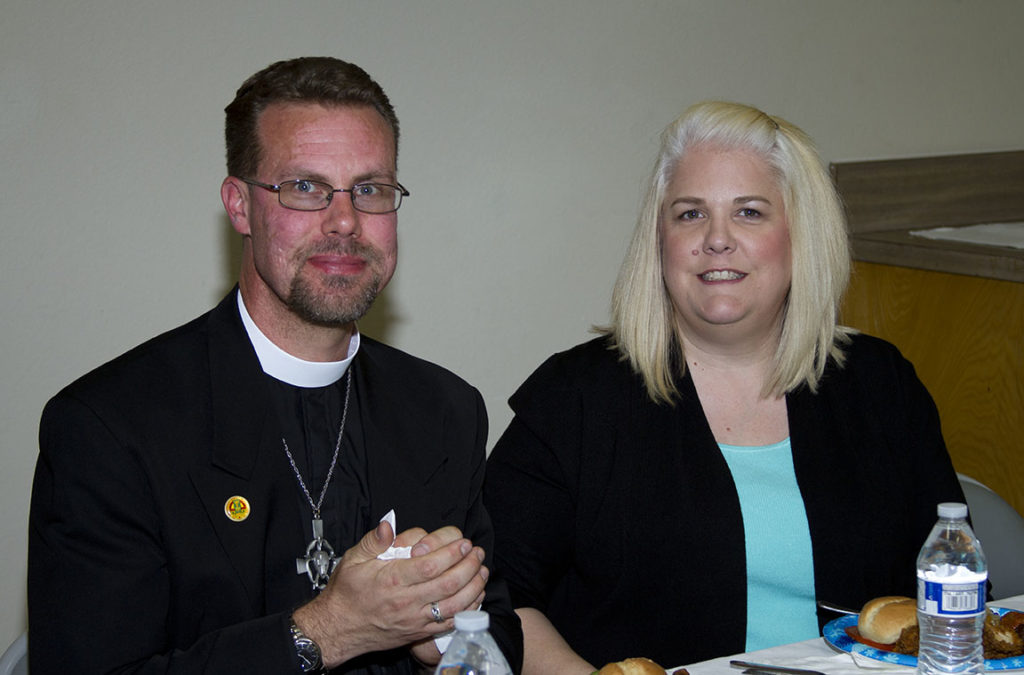
Pr. Mark and Krika Stirdivant

Pr. Mark and Krika Stirdivant

April 2, 2017

From Pr. Hendry’s sermon:

Our reading is Ezekiel 37:1-14
The Dry Bones prophesy is appointed
to be read during Lent
because
it is about the days of
the Messiah, Jesus Christ.
The Dry Bones describe us,
the believers,
who have no hope of our own,
but are
rescued through
Jesus’ death and resurrection.

Cliff Dwelling, Canyon de Chelly, AZ

Cliff Dwelling, Canyon de Chelly, AZ

March 26, 2017

From Pr. Hendry’s sermon:

Our reading is Isaiah 42:14-21
God says ‘Look and you will see.
View my Word on Calvary.’
Here, we read of the Suffering Servant,
aka, the Messiah
Who has waited millennia,
and now,
brings the blind by a way they did not know.
We celebrate the Suffering Servant,
Who has called us, who do not listen
and made us see, who do not look.

Sliding-House Ruins, Canyon de Chelly, AZ

Sliding-House Ruins, Canyon de Chelly, AZ

March 19, 2017

From Pr. Hendry’s sermon:

Our reading is John 4:5-26
Without water, we cannot live.
And so,
Eternal Life given to us
is called “Living Water”.
And also for us,
let us make our confession,
and
receive that Living Water
for ourselves.

Cliff Dwelling, Canyon de Chelly

Cliff Dwelling, Canyon de Chelly

March 12, 2017

From Pr. Hendry’s sermon:

Our reading is Romans 4:1-8; 13-17
We have 2 key words:
Righteousness, or Being Justified
(dikaiosune – being found innocent by a judge)
and
Counted
(logizomai – reckon, as in bookkeeping).
Abraham believed God,
and it was counted to him as righteousness.
And so for us,
What is written in the books about us?
Righteouness,
a free gift, not gotten by our own works.
Our faith is not in our own efforts,
but God’s grace.
Sola Gratia.

Cliff Dwelling, Canyon de Chelly

Cliff Dwelling, Canyon de Chelly

March 5, 2017

From Pr. Hendry’s sermon:

Our reading is Genesis 3:1-21
In the garden of Eden
there was just one commandment
and our first parents
believed the serpent instead of God.
They desired a knowledge
not yet permitted,
and disobeyed.
The Fall corrupted everything.
The Offspring of the woman
crushed the head of the serpent,
and in the obedience of one Man,
forgave us of many sins.

Canyon de Chelly, AZ

Canyon de Chelly, AZ

March 1, 2017 – Ash Wednesday

From Pr. Hendry’s sermon:

Our reading is Joel 2:12-19
Ash Wednesday is the beginning
of repentance for our failures
before God
as we make ready to celebrate
Jesus’ victory over our sins.
The prophet Joel calls us
to gather and discover that
the LORD our God is
gracious and merciful,
slow to anger,
abounding in steadfast love.
Hear the call, like the sound of a trumpet,
Hear the Word, confess our sins,
receive the Body and Blood of our Lord,
receive God’s forgiveness.

Sliding House Ruin, Canyon de Chelly, AZ

Sliding House Ruin, Canyon de Chelly, AZ