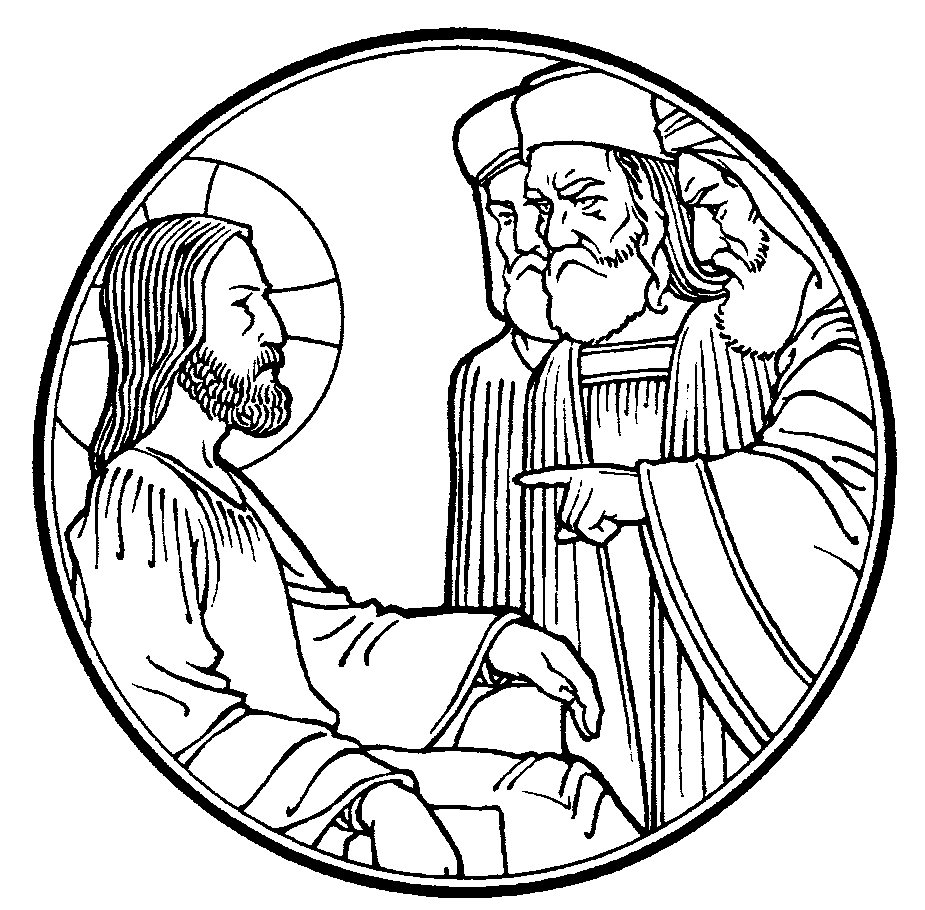
It was the day after Palm Sunday and the chief priests and elders of the people, were challenging Jesus’ authority to do the things that He was doing. “By what authority are you doing these things, and who gave you this authority?” Who did He think He was? Riding into Jerusalem like some kind of Messiah? Turning over the tables of the money changers and calling the temple ‘His house’ when He said: “My house shall be called a house of prayer, but you have made it a den of thieves.” Who did this Jesus think He was, walking around the temple and teaching the people as though He owned the place?
It’s a matter of authority. We tend to think of “authority” in terms of power. That’s true to a certain extent, but there more to it than that. Authority is actually referring to permission: permission granted by another to do certain things. So, the president of the United States is authorized by the people to be the chief executive officer of the nation. A judge sitting on the judicial bench has been permitted to judge cases. To have authority is to have permission from someone greater in order to say and do certain things in their name of stead. When I, as the pastor, forgive sins in the name of the Father and of the Son and of the Holy Spirit, I do so in the stead of our Lord Jesus Christ and by His authority. His permission. He approves of it, delights in it, recognizes it and stands behind it because He authorized it in His name.
We would be justifiably outraged, if someone simply assumed authority without having been duly authorized. If police knock at your door, they have to present evidence in the form of a badge and legal papers that they have the authority to search your house. Someone just doesn’t decide to be president or a judge one day and assume that office. It is the same with a pastor of a congregation. It is to be granted, permitted, in other words, authorized. That’s what a call, ordination, and the laying on of hands are all about. It is about good order, showing that a pastor in a place has been prepared, examined, and then authorized to perform the tasks given for him to do. That’s why we don’t just stand anyone up here on Sunday morning even if they could do a creditable job, or even a better job. If you decided to enforce the law and presented yourself as having the authority of a police officer, no matter how great the need or how good a job you were doing, you would be promptly arrested for impersonating an officer.
All of this lies behind the question of the temple authorities. They were like, “We have our credentials, where are yours? By what authority, do you Jesus, come in here and stir up all sorts of trouble? Who authorized you? Who sent you?” It’s a very good question, because had Jesus just been doing these things by His own authority as a man, it would have been bad. But there was something about Him that was different. The people were amazed at the words of Jesus, because He taught as one who had authority in himself. This was the key. He did have authority in Himself: not as a man but as the Son of God. He had the same authority as the Word of Holy Scripture, because He was the one who had caused the Scriptures to be written. He was the Word become flesh and the fulfillment of that Scripture. Jesus actually had the audacity to stand up before a crowd of people and say, “You have heard it said by the teachers of old, but I say to you.” No one dared speak this way. No one else dared turn over the tables of the money changers and sacrifice sellers, or criticize what was going on in the temple. It was contrary to God’s Word, but it had been going on under the authority of the chief priests and elders.
Jesus’ own words and works gave witness to His authority. Healing the sick, casting out demons, stilling storms, walking on water, casting out demons, raising the dead. These are the works that God does, and only one who is authorized by God could do these kinds of things. The miracles of Jesus were His badge of authority. Jesus also pointed them to the prophecies of Holy Scripture as pointing to Him and His authority. “You search the Scriptures because you think that in them you have eternal life; and it is they that bear witness about me.”
They all knew who He was. There was no one walking around Jerusalem who hadn’t heard about Jesus, least of all the religious leaders. John the baptizer and Jesus’ authority had been revealed ever since John’s baptism of Jesus, when Jesus was visibly and audibly approved by the descent of the Spirit and the voice of the Father. “This is my beloved Son with whom I am well pleased.”
The religious authorities would have none of that. They had refused John’s baptism. Why? John was calling them and everyone to repent of their false religion, their pride, their hypocrisy, their unbelief. Besides, they figured baptism was for proselytes, for those newly coming into the faith, not for them who had great blood lines, great power, authority, and were able to keep the law so well. It was an insult to their authority. Who did John think he was? And that’s precisely the point of Jesus’ question: The baptism of John. Where did it come from? Because it came from the same place of authority as Jesus. Until Jesus got an answer for that question, there would be no answer from Him.
They realized that their trap for discrediting Jesus now quickly swung back the other way. They realized there was no safe way to answer this question. If they said, “It’s from heaven,” they knew exactly what the next question was going to be. “Well, if it’s from heaven, why didn’t you believe him? Why did you refuse his baptism, if it came from heaven?” Their unbelief would be exposed.
They were aware that John was revered by the people as a prophet sent from God. So if they said that John’s baptism was from men, the crowds would turn on them. So they went that soft, say-nothing way of political correctness. They went agnostic. “We don’t know.” By the way, that’s what the word “agnostic” means – don’t know. John came preaching a baptism of repentance for the forgiveness of sins in preparation for the coming Messiah and the dawning of the kingdom of God and the best that the religious leaders can come up with is “we don’t know.”
When it comes to the question of who Jesus is and by what authority He comes, “we don’t know” is just not going to cut it. Unbelief is incredibly stubborn and it’s not a self-healing condition. It’s unreasonably resistant, which is why we cannot by our own reason or strength believe in Jesus Christ our Lord or come to Him. He must come to us, engage us, deal with us by Word and Spirit, baptize us, forgive us, feed us. He must break down those walls of skepticism, atheism, agnosticism, our darkened thinking, our stunted imaginations, our unwillingness to go beyond the realm of what we can see or comprehend. He must break through our own sense of authority over Scripture: picking and choosing which parts we like and which parts we don’t. Yet, the Lord breaks through all that using the authority of His Word to condemn your sin but to turn you to the hope given in His grace in Jesus Christ. He has the authority to take your sin upon Himself upon the cross.
As the perfect Son of God He could have come to judge the world. Instead He humbled Himself to be born as a human, He placed Himself under the authority of the Law to fulfill the Law for those who could not. He allowed Himself to be under the authority of men to be condemned to death upon the cross. He was using His own flesh to pay the ransom price for sin, so that He would then use His authority as the obedient, righteous, crucified, and resurrected one to free the captives to sin, death, and the devil. To break through unbelief, hypocrisy, and the ignorance of agnosticism by the overwhelming power of His Gracious Word to give us faith in these objectively true words: “you are forgiven your sins for Jesus’ Christ’s sake.”
You and I are still prone to questions that challenge God and who He is. The question that challenges Jesus’ authority in His Church and in our lives, when you and I think we know better than the Lord how to save us and how to deal with us.
Let us repent, and turn back to the Lord who is patient in His judgment. Let us return where Grace is given by His authority: to the font of Baptism, to the proclaimed Word of forgiveness, to the Supper where Jesus’ body and blood is served in faithfulness according to His teaching. You won’t get the answer to every question. You won’t have every intellectual itch scratched or every doubt addressed. But you will know this for a certain fact: Jesus Christ died for you, rose for you, reigns for you; lording His death and life over your sin and death. Nothing in this life can separate you from the love of God in Christ Jesus. God has laid His authoritative baptismal claim on you. He has justified you in Jesus, His Son, whom He sent with divine authority to be your Savior and to take away the sin of the world. That is why at the name of Jesus every knee should bow and every tongue confess that Jesus Christ is Lord, to the glory of the Father. In awe of His power and authority to judge but also in His overwhelming grace to save.
The Lord said through the prophet Ezekiel. “Why will you die, O house of Israel, For I have no pleasure in the death of anyone, so turn and live.
Trust the Lord of your Baptism and you will live. Jesus is authorized by the Father to save you, and He has done it. Today you have been forgiven for Jesus Christ’s sake through faith in His name under His authority. He will keep you steadfast in this Word unto life everlasting. May God ever keep us in that faith to trust this Word of hope in the name of Jesus Christ, Amen.
Pr. Aaron Kangas