Category Archives: main

Sermon for the Sixth Sunday of Easter: May 6, 2018

Rev’d Mark B. Stirdivant, Good Shepherd Lutheran Church, Yucaipa, California
✝ sdg ✝

How does something so bristly produce such flowers?

How does something so bristly produce such flowers?


How good are you at guilt techniques? Can you turn on a burden of shame upon other people just like a faucet? You could just hear it; maybe I’m destined to wield it myself in the future. Why are you doing this to me? Look at all the opportunities and advantages I have given you, and this is what you go and do! Can’t you show any kind of respect or gratitude for all I’ve done for you? Oh, yeah, many of you know how to turn it on, and some of you on the receiving end have figured out that it’s just a trick and you’ve worked some sort of detour around the guilt trip.

This other side of the guilt-laying coin, of course, is something I’ll call minimum satisfaction. If you figure out the least amount of effort that it takes to fulfill a requirement, then you’ve effectively short-circuited the shame. Come on, just eat three more peas and then we all can have dessert. Can’t you get up and dress yourself like a big boy for mommy? Or the teacher says, if you don’t want to read the extra credit book, you don’t have to! And it goes on from the home and school room to the work place, where the general feeling might be that one’s productivity isn’t going to get rewarded, so everyone finds out the most creative way to pass time without getting anything done. Minimum satisfaction even afflicts the church. Our budget is so bleak! One could complain. What’s the least we can do and still get by as a Christian organization? Surely I can “opt-out” of my promised giving to the Lord! He would understand that I need the weekend time or the money for other things. How few a number can there be of our willing volunteers before things start falling apart? It doesn’t come as easily to our human nature to think the other way, like: what potential do we have by God’s grace to do some great things in His kingdom? Or: What creative way can I use my talents for someone else’s good? The temptation to minimum satisfaction is rather strong in all of us and it gets in the way, and it leaves the feeling like there’s no solution in sight. Why is that?

Techniques of guilt and the automatic response of doing the least to fulfill an obligation are both related to the same thing: the Law. The Law is all about requirements, what we are to do, and not to do. Transgressing the Law brings about punishments and consequences. You cannot escape getting measured up against its demands. The guilt that the Law imposes upon you is not a game or a technique. It’s got real teeth in it, so to speak. No minimums are going to be accepted. Full payment is due now, no exceptions! You would agree that such harsh words would be words of the Law.

Now recall the words of Jesus in the Gospel of John: As the Father has loved me, so have I loved you. Abide in my love. If you keep my commandments, you will abide in my love, just as I have kept my Father’s commandments and abide in his love. …This is my commandment, that you love one another as I have loved you.

Now I ask you: Is this the language of the Law? Are there threats or punishments connected with these words? Where are the teeth to enforce the requirements? Such things are nowhere to be found. Jesus is not using the language of the Law as He is speaking to His disciples, and to you, these words. It’s often misunderstood that He might be laying a guilt trip on you, that you might make Him really upset if you don’t follow what He says. That’s because the Law, and guilt trips and minimum requirements for satisfaction are all that your sinful human nature knows and recognizes, as does mine. When you hear these words of Jesus, what He says is quite literally from out of this world, and so you are led to think that Jesus is setting down new laws and requirements just as soon as He pays for the punishment and condemnation of the first Law. That’s what leads so many people, including Christians, to misunderstand that the Christian faith is only about doing good things, and following a certain code of conduct, and being good people with cheery attitudes so that Jesus will smile on you and reward you with success and prosperity.

That clouds these blessed words of Jesus and strips away their true power. Your Lord is not imposing laws and requirements on you. He is not making you feel guilty so that you can turn around and work out some sort of minimal response to get Him off your back. You hear this quite often: Will you accept Jesus into your heart? Is He Lord of your life yet? What have you done to prove your Christian faith or put it into practice? You should show your gratitude to Christ after all He’s done for you. And so it’s just another guilt technique that you’ve seen before, and quite frankly at one time or another, this makes the one, true faith out to look no different from any other man-made religion. But that’s not the proper understanding of what Jesus is saying. It’s not what He’s about at all.

What your Savior is doing in His words in the Gospel of John is giving you your freedom: right here, right now. Just by speaking His powerful Word, He is crucifying and killing your sinful human nature, then He raises you up as a new creation, made in the image of Christ. He removes the shadow of guilt that hangs over you and unlocks the slave’s handcuffs that continually force you to do only the minimum necessary requirements. All the Law’s threats and punishments and condemnations are removed from you and pressed down along with that thorny crown on the bleeding head of Jesus. To put it another way, He accomplished both blessings for you: first, He fulfilled not the bare minimums, but your Lord kept every commandment perfectly, while acting in your place and for your benefit. Secondly, He accepted the guilt that belonged to you, and He paid the debt you owed, but could never repay.

The Law makes slaves, the Gospel makes friends. And what does Jesus say? No longer do I call you servants (or slaves); but I have called you friends. You did not choose Me or single Me out. Instead, I chose you; I singled you out that you would then go forth into your individual callings in life and bear fruit that will abide. And whatever you ask, it will be given to you. There are no conditions, nothing to take these blessings back. There are no contract stipulations for you to fulfill; it’s all from Him to you.

It all sounds easy. That’s because it truly is! There is no effort necessary for you to make it happen because Jesus did it all. He even sent His Holy Spirit so that God would place the faith in your heart enabling you to trust Him and receive His forgiveness and all the blessings of heaven. Look all you want for minimums and loopholes and you won’t find them because this isn’t about the Law. The Gospel is all about what God has done for your sake, and it would be silly to look for minimums when there are in fact no requirements at all! When Jesus says to keep His commandments, He’s not demanding anything of you so that you would have to earn His love and blessings. The epistle (1 John 5) says clearly, God’s commandments to Christians are not burdensome. His commandment rather is to believe in Him, and with this new commandment He gives you the ability to keep it. You did not have any possibility within yourself to believe in Jesus, but you have received that as a gift in the water of Baptism. The same body and blood of Christ that took away your sin now strengthens you in keeping His commandment to believe.

Now here is where the Christian holy life and love for each other comes in, not as your requirement to fulfill to God, but instead it is the natural result of what God the Father created you to be in the first place. It was just last week when you heard Jesus say, I am the Vine, you are the Branches. These verses today from John 15 simply explain this mystery in practical, everyday life. You have been restored and reconciled to the Lord because the Law no longer stands in the way. Now that same restoration and reconciliation branches out in your everyday calling as you interact with other people whom God has placed in your path. Your love for them that is expressed in prayer, words of encouragement, or helpful deeds are what Jesus is talking about when He says you are going to bear fruit.

Think again about the vine, the branches and bearing fruit. The fruit of love and good works that you produce did not make you a branch; it was the other way around: you are a branch connected to Jesus the Vine, therefore you produce the fruit that He enables you to produce. So, the things you do as a Christian do not make you a Christian, nor do they improve your standing with God. It’s the other way around: God, through Jesus Christ, has made you His very own. Therefore, by His Holy Spirit you can go forth and do not the bare minimum, because there’s no requirements to minimize. There’s no threat of a guilt trip to prod you along. Instead, you have the freedom to love as He has loved you; to give up your very life if that’s what will help your neighbor.

But if it’s so easy, then why aren’t all Christians more like this? What makes my life as a new creation so difficult, if I have nothing to do to add to my faith? What makes it hard is not that your faith isn’t perfect, because in fact everything your Lord gives you is perfect. Rather the problem is still the resistance of your stubborn sinful nature. It’s going to keep on working against you, even though you continually crucify it with Christ, which is what you do when you confess your sins and receive forgiveness in the gifts that God provides for you here. It is necessary for you to dominate and control that part of you that is still opposed to God’s love and mercy. But since you cannot do that yourself, you have the wealth of the Father’s grace in Christ Jesus to overcome and finally win the victory that your Savior has already achieved for you.

There is no need to look at the setbacks, the deceptions, the sufferings you’ve had to go through. Don’t look at what you don’t have among all of God’s blessings. Martin Luther once pointed out that Adam had countless trees to choose from, to satisfy his every hope and desire, but temptation to sin blinded his and Eve’s eyes so that all they could see was the one thing they could not have. So even though you see obstacles in front of you, do you dare to receive all the riches of grace that God has laid out for you? Do you suppose it might just work out if you believed the liberating Gospel word of Jesus that now enables you to love one another? Remember His words last week, He is the Vine, you are the Branches, and so you are free to abide in Him. He can’t wait to produce the fruit of love in you that He’s been planning on since before the world began!

In the Name of the Father and of the ✝ Son and of the Holy Spirit.

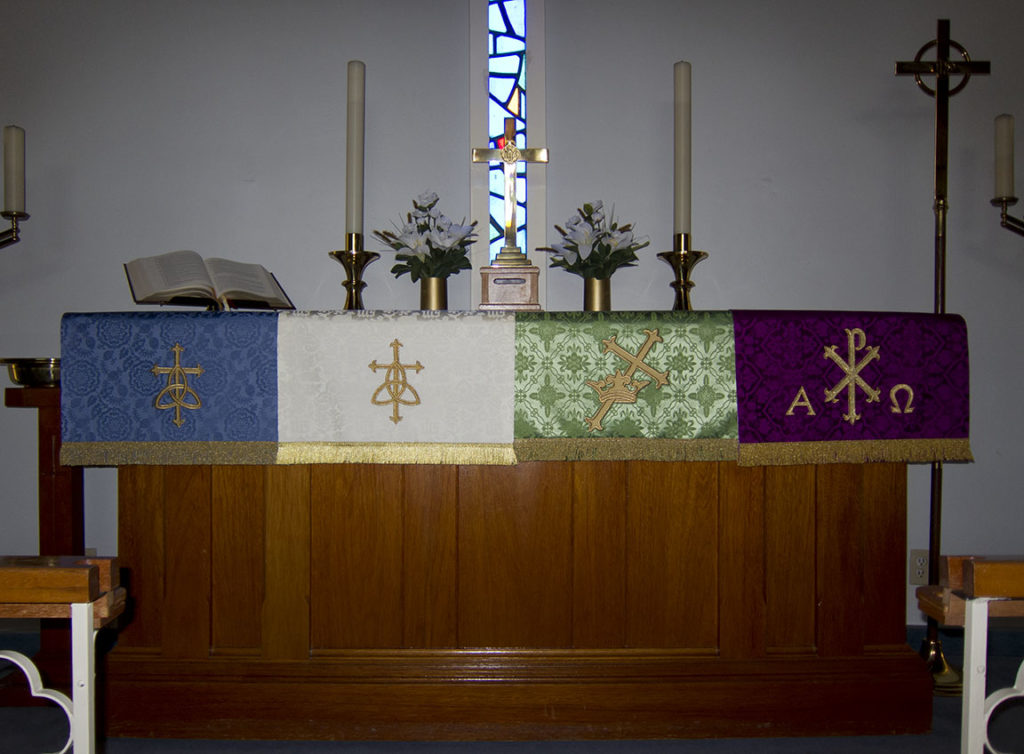
White Parament

White Parament

Readings:
Acts 10:34–48 God shows no partiality Peter at Cornelius’ house
Ps. 98 The LORD has made known His salvation
1 John 5:1–8 this is the love of God, that we keep His commandments
John 15:9–17 abide in My love … love one another as I have loved you

Sermon for the Fifth Sunday of Easter: April 29, 2018

Rev’d Mark B. Stirdivant, Good Shepherd Lutheran Church, Yucaipa, California
✝ sdg ✝

Yellow-bird flowers

Yellow-bird flowers


How much fruit is your life bearing? Jesus’ key words today are “I am the Vine, you are the branches.” That can be pretty intimidating when you first look at them or hear them. How can you not think of sometime, somewhere, when your life was not as fruitful as God’s law intended. Since you are connected as branches to Christ the Vine, what kind of fruit have you yielded – good things, important things, beneficial things, eternal things – or merely temporal, earthly things? And, if those things you achieved are, in fact, “good,” have you considered why you did them? Was the good you did, done to glorify God, or just yourself – and, will they stand up under the intense scrutiny and examination of the Judge of all? All of that, as you know deep down, concerns whether it really is good fruit, or not.

And what about our Church? How fruitful have we been as a Church? What have we done collectively – and what have you done individually – to “advance” the work of our Savior? What fruit have you borne in His name? And again, why have you done the things you’ve done – is it for our heavenly Father, or for yourself? Who can you think of that is not helping like they should, and should be chopped off as “dead wood”? How can someone determine that in the first place? When you read or hear the words of our Gospel, at first you don’t tend to hear any good news Gospel message at all. The initial reaction is to look inside, to assess oneself, and even pass judgment on others.

However, that would be a disastrous misuse of Jesus’ words. Analyzing yourself and your own fruit-bearing, or condemning your fellow Christians for their lack of fruit, so far as you can see—none of this is in alignment with “I am the Vine, you are the branches.” Jesus is not giving us some new commandment to bear fruit, but simply to remind us that as Christians we have been given a precious gift over and above the forgiveness of all our sins—we have, in addition, the continuing gift of the Holy Spirit who ensures that we abide and remain in our Lord.

But, you may ask, what about all those statements we just heard in the Gospel itself, concerning the fruit we are to bear? Did you happen to notice that there’s actually only one command that required action? And that command has nothing to do with our bearing fruit, but with abiding in Jesus. That may sound like a petty, hair-splitting distinction, but in fact it is quite important and it needs to be strictly correct. When Jesus speaks of His Father as the Vinedresser, who’s doing the work? Not you! The only One doing anything here is God. You’re not being asked to concentrate on the amount and kinds of fruit your life ought to bear, because there’s something more important to focus attention on – that is your connection with the true Vine, who is Christ. After all, the farmer or rancher doesn’t first get concerned about how large their harvest or yield will be, but instead, he or she concentrates on the condition of the plants, the health of the animals that are going to bring forth the result. If the plants or cows are healthy, then healthy fruit, a good crop, or wholesome milk products will be the natural result.

In one of Aesop’s fables there is a farmer, who, on his deathbed, tells his sons of a treasure buried in his vineyard. Well, you can imagine what happened when he died. His sons went out and dug up the entire vineyard looking for the buried treasure. But they didn’t find a thing. However, that year the vineyard bore its best crop ever – and all because of the extra cultivation the ground received while the sons were digging all around the plants. The inheritance the farmer left to his sons was that they would receive a bountiful harvest from his vineyard thanks to the work they were meant to do anyway.

Instead of concentrating on the fruit your life bears, the how much and why, you ought rather stay attentive to the Who: to Jesus’ reminder that the Holy Spirit keeps you firmly connected to Him, the “true Vine” – for only the true Vine can give the branches what they need to bear much fruit. Only those who stay connected to Christ – the true, life-giving Vine – are able to bear godly fruit in their lives. But how does one stay connected to that Vine? It simply happens to those who remain in Jesus and His fruitful Word. And remaining in Jesus and His Word, by the way, is what Confirmation and professing membership in a Church is all about, and by God’s grace we may look forward to more adults and young people being prepared to promise to do just that.

Everything is tied together by this Word of God, this Gospel of salvation, this Good News of God’s love and how it comes to sinners. It’s Christ’s Word heard in His Church, read in your home, and placed in your heart as you hear it over and over again in Liturgy, hymns, readings, sermons, and prayers. And when you consider what it means for you to abide in Christ – and Christ in you – how can you not be reminded of the Sacrament of the Altar, where Christ’s true body and blood become one with you as you eat and drink it? To be sure, we must never forget that the words of Jesus that we heard today about the Vine, He originally spoke as He was making His way from the upper room where He instituted this Sacrament.

Another image used that might cause us discomfort is the idea of pruning and cleaning. Jesus teaches here that every single branch has to be pruned if it’s going to stay healthy. Fruitless branches, hypocrites who outwardly appear connected, but really aren’t, will be cut off in God’s judgment and thrown into the fire. They don’t bear fruit. They don’t believe. The Vinedresser has to cut them off, for they are no longer useful, indeed all they do is hinder the rest of the crop.

That’s why Jesus says here that even fruitful, believing branches have to be cut, cleansed, and pruned. Even believing Christians abiding in Christ have to be pruned from time to time so that they bring forth the fruit God desires. In the original, the words “pruned” and “clean” are the very same. So reread verse 3, thinking of yourself as a branch: “Already you are pruned because of the word that I have spoken to you.” God alone is the Worker working in you with His Word of forgiveness, and the fruit borne in your life is a gift. It isn’t something you produce, but what the Holy Spirit produces in you, by keeping you connected to Christ the Vine. If God desires fruit-bearing plants, then it’s up to Him to prune them so they remain healthy and flourish.

Even though we are Christians, we still understand, none of us is perfect. We possess salvation, a new nature, and have a new man living inside us, yet the old man of sin inside us is very much alive. That’s precisely what must be pruned and cut back from us. But that sinful old man isn’t always visible. He lives deep down inside the very depths of your flesh. You need to stay healthy and alive, so that sinner inside has to be continually cut back. And to do this, God uses His Word, which cuts deep into your heart to bring you to repentance of your sins and keep you in the faith. The Vinedresser’s Sacrament of His Son’s true body and blood feeds you His forgiveness and gives you the strength to endure what you’re going through. And God also reminds you through the affliction, suffering and pain we all experience in pruning, you must rely on Him for all things. God’s desire is that you realize He is the One at work in your life accomplishing His will—the will that you stay connected to Christ the Vine.

What about that person who tries to get by without Christ? Jesus says, without Him you can do nothing. He doesn’t mean you can’t be “successful” as the world views success – or that you can’t accomplish a great many things that might benefit others here in this world – but that in the most important things – eternal things – you can do nothing without Him. Even if you turn out to be a very successful person in the eyes of the world, without Christ your life will amount to nothing. For if you don’t remain in Him and Him in you, you’re like a branch that withers, is cut off, picked up, thrown into the fire and burned. And that’s what Satan would like more than anything – to cut you off from the true Vine, that you stay away from the Church, that you no longer hear God’s Word, that you stop praying, and that you no longer receive the Lord’s Supper to sustain you. And if Satan has his way, the end, for you, would be eternal death and hell.

But when you remain in Christ, you have everything. No matter what happens, your life will be fruitful. You’ll still need pruning from time to time. But in Christ you’ll have everything you need. Though the fruits of your life may not be visible to you, God knows your heart and what your heart needs. He is the One who lifts up those who quietly abide in Christ’s Word and says to them: “You have produced fruit – yes, much fruit.” As a branch abiding in the true Vine, Christ is at work in you, accomplishing all things for His good pleasure and to the glory of His Father. So, whatever the fruit of your life might be – whether spectacular, hidden, impressive, or obscure – that fruit is God’s doing – and in His eyes it is “much fruit.”

In the Name of the Father and of the ✝ Son and of the Holy Spirit.

White Parament

White Parament


Readings:
Acts 8:26–40 an angel of the Lord spoke to Philip … of whom does the prophet say this?
Ps. 150 Let everything that has breath praise the LORD.
1 John 4:1–21 Beloved, do not believe every spirit…beloved, let us love one another…
John 15:1–8 I am the true vine

Pastor Stirdivant’s “Postil” May 2018

Aloe bloom at evening

Aloe bloom at evening

“Come, Holy Ghost, Creator Blest” (LSB 498/499) For centuries those words were sung at Pentecost (this year celebrated on May 20), asking the Holy Spirit to reside among the faithful and bestow His sevenfold gifts. What, exactly are we to expect from the Holy Spirit? Why were there so many powerful and wonderful signs of the Spirit’s presence in the earliest years of the New Testament Church’s existence? Why are those exuberant signs not present among us in the Church today? What caused this change in the Spirit’s work? Can we even be confident that we today have the Holy Spirit working in our midst? Will we even know when or if He has departed us?

Thinking about Pentecost can often leave us with more questions than answers. It doesn’t make matters any better for us when we hear about Christians who claim to have rediscovered the fiery, flashy special effects of Pentecost in their own gatherings. These are people who belong to Pentecostal churches and movements within other established denominations. People who have claimed the special gifts (“charisma”) of the Holy Spirit are sometimes called “charismatics.” Their apparent success at a “higher level” of Christianity makes us wonder, at the very least, whether or not we have the Holy Spirit working in us, especially if we do not witness the effects of direct Spiritual involvement in our lives, like they seem to enjoy. If we don’t observe the Holy Spirit working these mighty signs among us, then that makes us wonder whether we have assurance of our own salvation, another of the Spirit’s gifts. We get confused when we are told that our “mere” water Baptism, especially if it occurred in infancy, needs to be improved upon by some different, somehow more effective “Baptism of the Holy Spirit.”

Pentecost and the Scriptures that teach us about the Holy Spirit all help put these questions in perspective, and set our worries at ease. Jesus taught His disciples in John 15 and 16 about the Holy Spirit as our Helper, a Comforter who strengthens our faith in Jesus, and opens the Scriptures that we read, study and hear preached to us in the Divine Service. The account of the first Pentecost assures us that when we believe in Jesus and His sacrificial death for our salvation, then we have the Holy Spirit and all of His gifts. Fullness of His grace is depicted in the symbolic number seven (as in “seven-fold gifts of the Spirit”). Our Baptism with water, in the name of the Father, Son and Holy Spirit, follows our Savior’s own command to His Church (Matthew 28) and so with that comes the certain promise of the Holy Spirit. No further action is required in order to give us the Holy Spirit, like the misguided fanatics claim. We have the assurance of forgiveness and the full holiness of Christ granted to us through God’s Word, and God’s Word is not going to change.

The reason why these questions about the Holy Spirit can cause us some concern is that we at times have a tendency to doubt anything so fully free as the Gospel truly is. How can our Father’s love be given to us so freely? How is it possible for the Christian life and faith to be so easy to receive, and yet so many people fall away from it? The Law constantly tells us we don’t deserve it, and the Law is, of course, right in saying that. But do not fear. Pentecost is a great blessing of assurance to you that the Holy Spirit will invigorate the Church that holds to the truth of Jesus Christ in every age. We may not see the exact same “special effects” of the Spirit’s presence as the Apostles experienced, but we should not seek them out or assume that they must come. We will leave that matter up to God, and in the mean time, we will treasure the truth of His Word, that gives us all that we need to know about Jesus Christ our Savior, and the life that is ours in His Holy Name. Thank You, Holy Spirit!

Yours, in Christ’s service,

Pastor Stirdivant

Sermon for the Fourth Sunday of Easter: April 22, 2018

Rev’d Mark B. Stirdivant, Good Shepherd Lutheran Church, Yucaipa, California
✝ sdg ✝

desert and desert

desert and desert


Wolves and sheep are, you might say, wired differently. Wolves look to devour and to consume their prey. Sheep, on the other hand, look for cover, and run away for protection. They cower, they readily acknowledge the wolf’s ability to destroy them. Wolves are aggressive. Sheep are timid. Wolves, while they tend to travel in packs, are really quite independent most of the time. They can fend for themselves. Sheep, on the other hand, are communal. They are dependent on the flock, and as a flock all of them are dependent together on their shepherd.

It wouldn’t be right for a shepherd to allow wolves to enter into the sheep’s pen. For sure, the wolves would love it! If the sheep could think, they’d have to wonder about that shepherd who would allow such a thing to happen. What kind of a shepherd would do that, anyway? What kind of a shepherd abdicates his responsibility to his flock, thinking it’s okay to allow his flock to be devoured by their arch enemy? What kind of a shepherd puts his own well-being above that of his flock? Think back to the Old Testament about King David. He was a shepherd before he became a king. He ascended to the throne after having dispatched with Goliath, that giant enemy and blasphemer of Israel. Before facing Goliath, David tried to persuade Saul that he was, in fact, up to the task. Saul was reluctant to send David into battle because he was so small. In fact, Saul was a tall man, so his personal armor was so large that it engulfed the youthful David. David, of course, chose to forego the armor and to fight Goliath with the simpler tools of a shepherd: the rod and staff, and don’t forget the slingshot and stones.

In his momentous effort to convince Saul to assign him the task of slaying the giant, David countered Saul’s skepticism with evidence as to why he, of all people, should be able to go up against Goliath. In his defense he drew on his experience as a shepherd, faithfully tending to his flock in the fields. He said, “I, your servant used to keep [my] father’s sheep, and when a lion or a bear came and took a lamb out of the flock, I went out after it and struck it, and delivered the lamb from its mouth; and when it arose against me, I caught it by its beard, and struck it and killed it. Your servant has killed both lion and bear; and this uncircumcised Philistine will be like one of them, seeing he has defied the armies of the living God.”

Such powerful words from a little shepherd boy! Those words demonstrate that David was bound to his flock in the same way that he was bound to uphold the honor of the living God. He spoke from deep conviction within. He had a vested interest, you see, in the precious things that he defended. As a young boy David’s flock was his life. He could no more let a bear or a lion take one of his sheep than he could let that same bear or lion attack him without a fight. David, you see, was a true shepherd, one of the good ones, because he had more than a casual interest in the flock. In fact, He was willing to put his life on the line to save his flock from those who would destroy it. A mere hired hand, he was not.

It isn’t at all uncommon today for the flock of God, the Church, to be attacked by wolves. Sometimes those attacks will come from outside of the church and they will be quite evident, and even the sheep are moved to stand up together and oppose it. Other times, though, attacks can come from inside the church. In fact, Jesus warns that sometimes wolves will sneak in. “Beware of false prophets (He says), who come to you in sheep’s clothing, but inwardly they are ravenous wolves.” (Matt. 7:15). Certainly the attack that comes from within is much fiercer than the one that comes from the outside. The great danger posed by the wolf, the false prophet, is that he seems to pose no danger to the physical wellbeing of the flock. The flock grows quite accustomed to the wolves’ voice in its midst for the sheep sense that there’s no immediate danger, no threat. The wolf’s words seem harmless. His false teaching can seem acceptable, often it even sounds right. But, finally, as is the character of wolves, having disarmed his prey, at the right time he devours, he consumes, as the souls of God’s people are led astray into the wilderness to consume the poison of false teaching.

Jesus warns us at length in this parable about following such a false shepherd. In fact, He doesn’t refer to the false prophet in John 10 as a shepherd at all. Rather, he is a hireling. You could call him a “rent-a-shepherd.” When he sees danger on the horizon he leaves the sheep to fend for themselves because he has no vested interest in the welfare of the flock. And sadly, the sheep, having followed the voice of the hired hand, have walked too far into the path of danger.

Faithful is the shepherd who defends the flock against such heretical teachers, even though his words may be taken as an affront, as an offense to “ecumenical ears,” that is, people who favor no distinctions of belief whatsoever so that everyone, it is hoped, will get along. The early confessors of our Lutheran Church saw fit to include this portion of God’s Word, from John chapter 10, when they discussed the need for pastors to teach what is right, but also for them to expose what is wrong. The Formula of Concord says, “In order to preserve the pure doctrine and to maintain a thorough, lasting, and God-pleasing concord within the church, it is essential not only to present the true and wholesome doctrine correctly, but also to accuse the adversaries who teach otherwise. ‘Faithful shepherds,’ as Luther states, must both pasture and feed the lambs and guard against wolves so that they will flee from strange voices and separate the precious from the vile.'” We need more pastors who see this as their solemn duty, and are called, rather than just hired so that the congregation is the flock that has been given into their pastoral care and responsibility. They above all else need to emulate Christ, the Good Shepherd.

But how good is the Good Shepherd? Which person today would be more likely to be called “good” by most people? Is it the firefighter facing a blazing building or hillside? A police officer running towards, not away from, danger? Or the football player using his freedom of speech to opt out of showing respect for the flag? And yet of those three, all of them sinners, you couldn’t tell who was really good on the inside. Most everyone wants to say of themselves, I am a “good” person, at least more good than others. God’s Word, of course, tells us otherwise, “for we all like sheep have gone astray, everyone has turned to his own way.” We wouldn’t have needed baptism, if it weren’t true that we were born afflicted with sin, and that we do sins of thought, word and deed every day. That is hardly good. We need to acknowledge that we are sinners, or else we would deceive ourselves. We the sheep need a Shepherd.

Jesus says, I am the Good Shepherd. He emphasizes the word “Good.” No other good that we can think of, nothing comes even close to the Good that Christ our Shepherd is. As a shepherd, Jesus is, of course, the greatest. He instills faith into the hearts of called pastors, His servants of the Word to lead His flock faithfully as His under-shepherds, to defend the flock, to fight off wolves. Most importantly, though, the Good Shepherd Himself gives to His faithful servants His soothing Gospel voice of forgiveness of sins, even as He does what is necessary to protect the sheep for life lasting to eternity.

Jesus’ “goodness” as a shepherd goes even further. He was sent from the Father to become one of the sheep that He might suffer and die for the sake of the sheep. This is not putting on sheep’s clothing in an act of deception; this is our Shepherd actually becoming a lamb for the slaughter, all for our sake. Yes, you would have looked for Jesus to act more like brave young David, and take up the shepherd’s weapons to slay the wolves that attack you each day, but instead Christ offered Himself in weakness to the wolves so that you might go free. Avoid preaching or devotion books that tell you to do this or that as an improvement to your standing before God. But when you hear words about substitution, as in Jesus’ life being given for your life, or about God’s strength being found in weakness and the cross, then you can rest assured that you are hearing the true voice of your Good Shepherd. From this one, clear voice, you have your sins forgiven, and you have all the other blessings that come from the forgiveness of sins, namely life and salvation, and as we say together in the creed, you have also the future blessings of resurrection of the body and the life of the world to come. That’s the voice of our Good Shepherd, He is the good beyond all that is good, and His goodness is yours free of all exceptions, conditions and strings. Any other voice is that of a hired hand, a wolf whose employer is the Evil Foe. His is the voice we heard in the baptism today and His is the voice that will sound out an affirmation of that baptism for those who will make a public confession of their faith. They are joining our Communion, our flock in which we depend on one another and promise to believe the same thing together, the full teaching of Jesus our Good Shepherd. Thanks be to Him who gave Himself as a lamb to be slain and now lives and reigns in Divine glory to all eternity!

In the Name of the Father and of the ✝ Son and of the Holy Spirit.

White Parament

White Parament


Readings:
Acts 4:1–12 the stone rejected by you builders no other name under heaven
Ps. 23 The LORD is my shepherd
1 John 3:16–24 we know love, because He laid down His life for us
John 10:11–18 I am the good shepherd

Sermon for the Third Sunday of Easter: April 15, 2018

Rev’d Mark B. Stirdivant, Good Shepherd Lutheran Church, Yucaipa, California
✝ sdg ✝

ixthus

ixthus


My God eats fish! That sounds strange to you, doesn’t it? Today when you think of people talking about God, you’re thinking of deep, mysterious, and hidden truths, and in many people’s minds, God’s works are far superior to ordinary, earthly activities. In the Early Church times, there was a widely held heresy that made people think that the body actually held down the spirit and imprisoned it. Many people are enchanted with the thought that if you escaped your body you could then have direct contact with unseen spirits. Jim Jones convinced people to release their free spirits from the confines of their body, so they drank his poisonous cool-aid. There is something wrong with the body, but our human reason can’t bear to acknowledge its own sin. The body and the spirit, the visible and invisible, seem to be enemies in many people’s minds, and the human soul seems to long for something greater and higher than itself. Mankind is constantly attempting to approach God.

What do Christians today think is more spiritual? A prepared, written-out sermon, with a basis in a text of an ancient book? Or some helpful advice that you can find on the Internet? What prayer is better, one carefully crafted and printed in a book or one spoken on the spot and “from the heart?” Do we want a Savior up there in heaven, handing down principles to us to make our lives successful and more fulfilling, or one who takes up our poor, diseased and fallen flesh, dies, rises then eats some fish? I personally find it much harder to believe that what we have written down for us in the Bible is made up. It’s just not the kind of story that people usually tell. I mean, purely humanly speaking, why would God want to lower Himself to become a servant? The fact that He did is clear evidence that these events in the Scriptures really happened, and they are not made up, because mankind is always making spiritual talk about us rising up into heavenly realms, while God is concerned with coming down here to eat fish with sinners.

Here in the Gospel, these human “spiritualizing” notions are challenged – indeed, confronted head-on by our risen Savior as He miraculously stands before the frightened disciples. He stands there not spiritually, so that they have to close their eyes and feel Him in their hearts, but He stands in the very flesh which only days before had been crucified in bloody horror for the sin of the world. Christ is no fleeting specter or some shadowy “spirit-being.” He isn’t a disembodied Savior. But rather He’s the One who stands among us in His flesh and bone – especially is He here today in external means such as water, bread, wine, and words. His teachings haven’t come to us out of thin air, as it were, but rather through God’s human ministers, the servants of the Word and of His Church. God calls us not to a private, secret or spiritualistic Christianity, nor to merely changing our work ethics and morals, but He makes of us a living flesh and bone fellowship that receives a living flesh and bone Lord.

For weeks now, our Easter Gospels have found Jesus’ Disciples cowering in fear behind locked doors and windows – and for the third time, He appears to them speaking a Word of Divine peace. At first they were startled by His presence – even frightened by the thought that what they were seeing was a ghost. But hear what He says to them in order to put their troubled hearts at ease. “Look at My hands and My feet. Touch Me and see. A ghost does not have flesh and bones, as you see I have!” What a comfort this flesh and bone Savior desires to be for those who understand the dangers you daily face in life.

Where this tends to make the clearest difference is when our human struggle between life and death feels its sharpest sting. Right from the very beginning of life and from Baptism, the Christian faces death. Some reach a ripe, old age, others die far too soon. That’s why Baptism grants an abundant comfort to parents and ought to be a cause for joy for anyone who witnesses its ceremony. With simple water combined with His Word, God breaks into the darkness of death and sin and clothes us with the very same promise the Disciples received from Jesus on that first Easter evening.

Only those who are spiritually blind and foolish would refuse to seek such a concrete, tangible, flesh-and-bone Savior, for because of the sinful nature, they’re filled with such pride and arrogance that they think they have enough spiritual stuff inside themselves to manage on their own. But when trouble comes, and you find yourself standing before God stripped of everything and exposed, what you need is a real Savior’s real touch. When you’re buffeted by the storms of life, you need a steadfast Anchor to hold you steady – something outside yourself. And that Something, that Someone, is this same Lord who is pleased to come to us in ways that we can see, touch, and handle. That’s what was happening when Jesus appeared to His Disciples that night. He “showed them His hands and feet, and while they still didn’t believe it . . . He asked, ‘Do you have anything to eat?’ And when they gave Him a piece of broiled fish, He took it and ate it in their presence'” – so that they might see Him as a real flesh and blood Savior- God who eats fish and makes His followers into fishers!

Christ our Lord has given you a concrete promise to hold on to – a concrete hope upon which to build. He still provides you with a visible, tangible reassurance of His presence in this world today. In Holy Baptism, He applies His life to you through water and Word. In Holy Absolution, He personally grants you the forgiveness of sins in words spoken to you by your pastor. In Holy Communion, He gives you His body and blood to eat and drink as the real meal of salvation. Christ wants you to be confident that you have a Savior who’s still speaking to you the very same words of peace He first spoke to His disciples.

Contrast this faith with a so-called spiritual trust that looks only to your own heart for confidence and peace – and that ignores the real, saving touch of Jesus through flesh and blood! Aside from the outward promises of God, what else is there to cling to – private thoughts, feelings, personal opinions, or an independent religion in your heart that has no grounding in the Word of God? These things will consistently delude you and lead you astray. They won’t be there for you when you come face to face with the harsh reality of sin’s grasp on humankind – that death is waiting to claim your body someday!

But what God gives in the flesh of Christ, that will not betray you. You can count on His precious gift! That’s why God is here among His people to provide for them the saving body and blood of our Lord in bread and wine. As you eat that blessed Sacrament you have fellowship, oneness, with God through the very flesh and blood of His Only Begotten Son. That fellowship with God binds you together as one in the same confession of faith—the doctrine that upholds Christ’s Body, the Church universal which will never pass away.

John wrote in our Epistle last week: “We proclaim to you what we have seen and heard, so that you also may have fellowship with us. And our fellowship is with the Father – and with His Son, Jesus Christ.” Through our Flesh and Blood Savior, God has made you and me to be of one flesh – not only with Him as our God, but also with one another as brothers and sisters in Christ! Our Bridegroom is the Husband of only One Wife. And that Bride is us, His Church. We are bone of His bone and flesh of His flesh – and, since God called us by the Gospel, we now each belong one to the other.

When you and I eat the bread and drink the wine of the Holy Supper, God gives each of us the exact same food. There’s no difference in what we eat and drink in this Meal, for we are receiving it in common as members of God’s family in Christ. Thus it is a blessed Communion, and in it, we get all Jesus has – and all Jesus is. Jesus is here to make our hearts happy and bold, because we aren’t trusting in ourselves – or anything else we might have as individuals – but only in what we have in common, that is Jesus! If someone doesn’t believe and still eats this Supper, then it is harmful to them, so that is why we are called to be careful with the Lord’s Body and Blood.

Martin Luther once spoke of eating this gift of our flesh and blood Savior, saying: “When I eat it, then it eats me! Outwardly I eat the Meal, but inwardly and spiritually I receive all the treasures of Christ – and even Christ, Himself. So when I receive the Sacrament, it is Christ who receives, consumes, and devours both me and my sins, so that I enjoy and receive His righteousness, His godliness and His riches – as at the same time they swallow up my sin and misery.” (See What Luther Says, #2538)

In the very same way, as we are one in Jesus’ flesh, so we are also united together with one another. As individual grains of wheat are crushed, ground, baked and formed into a single loaf – as many grapes are squeezed and made into a single wine – so also we are gathered into one body in this Meal. As Christians, you and I don’t live our lives any longer in isolation from one another. In Christ your life has become my life, and my Faith has become your Faith. Our fellowship is not with God unless it’s also with one another! I, your pastor, serve you in my calling with all that I am and have, thus I become your food. And in turn, when you serve me and my family in love with all you are and have, then you become our meat and drink. We pray for you, and you kneel down before God’s throne of grace on our behalf as well.

We as the congregation of God are invested and completely consumed and lost in one another – and all because God the Father, in Christ, has made us to be of one family and one body. We all belong to one Christ – because whoever feasts upon the Savior has more to live on and live for than just himself. You have more than a private, secret, disembodied or merely spiritual Christianity to sustain you. We all have fellowship in real flesh and blood through Jesus Christ, your God who eats fish! – and in that fellowship we will live together forever with Him who has called us to be His very own.

In the Name of the Father and of the ✝ Son and of the Holy Spirit.

White Parament

White Parament


Readings:
Acts 3:11–21 how the lame man was healed repent and turn back
Ps. 4 I will lie down in peace and sleep
1 John 3:1–7 Behold what manner of love the Father has bestowed on us … we shall be like Him
Luke 24:36–49 Jesus Himself stood among them…peace to you.

Sermon for the Second Sunday of Easter: April 8, 2018

Rev’d Mark B. Stirdivant, Good Shepherd Lutheran Church, Yucaipa, California
✝ sdg ✝

Luther Rose and Bible

Luther Rose and Bible


Easter makes sense of just about everything else that we celebrate in the Church Year. We don’t celebrate disjointed holidays and string them together like a fruit-cereal necklace, as if you happen to take one away and eat it, you still have the other loops on the string. No, instead, the Church Year is carefully constructed by a very knowledgeable and pious church heritage that has gone on for centuries. It tells a story that is vitally important to our faith in Jesus, our Christian life in this world, and our hope of the life of the world to come. Having just finished the seasons of Christmas, Epiphany and Lent – where we heard about how God sent His Son to be born of a Virgin so that He could suffer and die for the sin of the world – and now as we have begun the season of Easter –we rejoice in the resurrection of our Lord Jesus. All that He did for us comes into clear focus for our faith. It was the same for the disciples: John said that he and the other disciples didn’t understand the things Jesus said and did until after He was glorified, meaning His death and resurrection.

The Easter season does mark a significant shift in the story we hear every year. Jesus fulfilled His salvation mission on the cross and when He rose from the dead. As we move further into the season of Easter and on into Pentecost we’ll take a closer look not only how God saves us, but also how He lifts us up in our faith, how He strengthens us, and how He enables us to go on living in this sinful world after receiving a foretaste of the glories that await us in heaven. Our God, you see, isn’t only a God who worked in the past and has made promises for our future. He’s also active in your life now, and in the lives of all His people as they go about their day to day activities.

Consider the Gospel for today. It begins on the first Easter Sunday evening. Only three days earlier Jesus had been crucified, died, and was buried. The Disciples had only just recently heard the stories of His resurrection, which made them even more dazed and afraid. Having locked themselves away in a room for fear of what the Jews might do to them if they were caught together, the followers of Jesus made sure no one would be able to sneak in and catch them unawares. No doubt they were fearful of the Jews’ reaction to the news of Jesus’ resurrection, but they might also have been fearful about what Jesus might say to them for deserting Him during the hours before His death.

Then, all of a sudden, there He was – standing in their midst. Although He appeared miraculously, He didn’t seem to be a ghost. He had a real human body and that body didn’t look as if as if it had just spent three days in a tomb. He wasn’t angry or distressed. They must have wondered to themselves what He was going to say or do –how He was going to react. Yet, the first words out of His mouth were the forgiving, freeing words: “Peace be with you!” Then He showed them the wounds on His hands and in His side. This was no ghost or a spirit– He was real – just like the peace He offered. His words weren’t empty or meaningless, but they bestowed on them the peace which He had just purchased on Calvary’s cross. And the most amazing thing was that this peace was now being given freely to them – the very ones who had betrayed and abandoned Him only three days earlier!

Jesus came among them to strengthen them and to reinforce their faith. He appeared in their midst to assure them that in His flesh He had indeed risen from the dead. He was there to plant the seeds of ministry in their hearts. He wanted them to go out and carry His peace and forgiveness to everyone. He was sending them on a mission – to go out into the farthest corners of the world and declare this peace to all – to call all mankind to believe in this One who died on the cross for the salvation of sinners.

Next, our Savior breathed on them the Holy Spirit. There they were, downtrodden, dejected, not knowing what to do or how to do it – and then He spoke. He gave them power to move forward with boldness. Through the proclamation of His Word, people’s sins would be forgiven. All they had to do was proclaim this message. But Thomas wasn’t with the others that night. We don’t know why he wasn’t there, but we do know that because he wasn’t there he continued to doubt – and this even after the others told him the Good News of Christ’s resurrection. He made it clear that he refused to believe, that the fear and slowness of heart that afflicted the other disciples still had their clutches on his soul. His spiritual colleagues already had the personal contact with Jesus. They were ready for ministry in His holy Name, because at the very beginning, the Holy Spirit would spread the Church through these appointed eyewitnesses. Thomas knew that he would be disqualified as an apostle if he had missed his opportunity to see the Lord Jesus like the others did. How terrible would that feeling have been for him?

Thankfully, the other disciples managed to convince Thomas to be in the room with them the next Sunday to meet Jesus. They knew only the Lord could help him. They wanted Thomas to be united with them in proclaiming the glorious Easter message of forgiveness, life and salvation! You may think of it as a similar feeling that you get when you think of those you know and care about, those whom you hope and pray would someday join with you in the services of God’s house to meet with our risen Savior and receive His gifts. Maybe their faith is struggling right now. Perhaps they find it hard to believe. You know that only the Lord Jesus can help them.

For Thomas, He appeared in the room once again, despite the locked doors and the fearful hearts, and said as the Greek literally translated says: “May you cease to be unbelieving from this time forward. Instead, be constantly believing.” And Thomas, the doubter – when he saw and felt for himself the peace that God purchased for him in the wounds of His Savior – he was convinced. Devastated at the state of his faith, he cried out, “My Lord and my God!” God had stepped back into Thomas’ life and rekindled the flame of faith.

What an amazing God we have! Those who are down are lifted up. Those who are despondent are given that peace which passes understanding. Those who are crushed are made whole. Those who are blind are made to see. Those who are sinful are made righteous. When God comes into a person’s life, even though his heart is locked up in fear of the unknown, He changes that person from a sinner in danger of His wrath, into a beloved saint and an heir of everlasting life. He changes that person from the status of faithless enemy to the standing of a trusting child. What a tremendous God we have!

My dear Friends, at one time God also came into your life. Just as He came to the disciples, He also came to you. When you least expected it, there He was – in His Word, in His Bath of Baptism, and in His Supper – in His Church and in the mouth of His servant – showing you those wounds which earned you His peace. When you wanted least of all to believe, He enabled you to confess Him as God and Lord. When you scarcely wanted to serve Him, He placed you willingly into His service. And He’s still calling to you today – right now – calling you to hear His words of comfort and reconciliation– and to rejoice in the Gift of life He brings.

You do not have the same calling as the Apostle Thomas, yet you do have a holy calling, and the specific blessing from the mouth of Jesus: Blessed are you who have not seen and have believed. You confess and declare with joy the praises of Him who called you out of darkness into His marvelous light. You pray for the opportunity to bring those loved ones on your mind and heart to have contact here with the wounded, yet risen Lord Jesus, since Easter makes sense of what those wounds really did for you and for them and for the whole world. You can invite them to come, see and hear what you’ve seen and heard – even as the other Apostles invited Thomas. You may not be trained or qualified to be an evangelist – to be sure, the prospect of speaking to others about your faith might be rather frightening– but all God has ever asked is that you tell someone else what you already know to be true. After all, “Jesus did many other miraculous signs in the presence of His disciples, which are not recorded in this Book, but these things are written that” you “might believe Jesus is the Christ, the Son of God, and by believing you may have life in His name.”

It’s a fearful task you face when you open your mouth to speak the Truth of God to someone who needs to hear it. Will they reject you for saying what you know you need to say? Will they laugh with scorn at your gullibility for believing something so amazing as this Gospel of Grace which saves us, or will they turn their back – thinking you’re a fool? It doesn’t matter, for this is really God’s work, and when God gives us something to do, He also gives us the words and power to do it. So do it we will – sometimes fearfully, sometimes joyfully, sometimes even against our unwilling sinful nature – but always with the knowledge that the Holy Spirit is at work in us, causing us to do and say that which would otherwise be impossible. For although such things are impossible with us, with Jesus, our Lord and our God, nothing shall be impossible, and His Easter victory will make sense of anything you may not fully understand.

In the Name of the Father and of the ✝ Son and of the Holy Spirit.

White Parament

White Parament


Readings:
Apr. 8 Second S. of Easter
Acts 4:32–35 they had all things in common
Ps. 148 Praise the LORD from the heavens
1 John 1:1—2:2 That which was from the beginning, which we have heard…if we say we have no sin …
John 20:19–31 Jesus came and stood in the midst…Thomas…my Lord and my God!
These are written so that you may believe

Sermon for Easter Day: April 1, 2018

Rev’d Mark B. Stirdivant, Good Shepherd Lutheran Church, Yucaipa, California
✝ sdg ✝

White with Lilies

White with Lilies

Christ is Risen! He is risen indeed! Alleluia!

The Easter message is all about a body. Early that morning those three women headed out to the garden tomb ready to worship. They were ready to demonstrate reverent devotion toward a dead body by anointing it. They would anoint the Anointed One! They had the spices prepared, but as they walked these women realized they forgot some small, but important details – like, who was going to help them roll away the massive stone – and how they would deal with the soldiers who’d been posted there as guards.

Then, as the tomb first came into view, some more questions soon began to overtake them. First, they discovered that the stone had already been rolled away from the mouth of the tomb – how could it stand wide open? They looked inside, there they saw a young man sitting – a young man dressed in white – an angel. The women were amazed and alarmed. Could you have seen them staggering back with eyes open wide, chins hanging down, and the hair on the backs of their necks standing up on end? It’s not every day you see an angel.

And what was the angel’s message? “You seek Jesus, the Nazarene, the Crucified One. He is not here. He is risen!” What could he be talking about? The angel was certainly speaking about the right Jesus – the One who’d come from Nazareth and just had been nailed to the cross. To be sure, all three of them had witnessed that whole episode with their own eyes. Yet now, here was this angel telling them a most amazing thing. From the very place where they saw the body of Jesus laid to rest— he spoke to them, saying: “He is not here anymore.”

Now what would have gone through your mind, if you’d been standing there at the tomb on that first Easter morning? Just like Mary and her companions, you probably couldn’t have avoided thinking, something else must have happened. Dead men don’t rise from the grave, do they? Perhaps it was the work of grave robbers, a cruel hoax by Roman soldiers, or a conspiracy with the religious authorities – anything but a Resurrection! But remember, at least three different times Jesus had told His disciples He would have to be handed over, crucified, and on the third day rise again. He even raised His friend Lazarus from the dead—clearly, death had no choice but to obey Him. In spite of that, all His disciples initially refused to believe the Good News that our Lord’s body was raised.

The Corinthian Christians to whom St. Paul wrote had similar problems. Their schools taught them some bad stuff, can you believe it? There was this pagan Greek philosophy which taught that the body was low-level material stuff, while the soul was high-level spiritual stuff – and that the body was a hindrance to the full expression of the soul. Sadly, that same kind of thinking creeps into Christian conversation today on occasion – even though we ought to know better. You’ve undoubtedly heard people talking about “spiritual experiences” they’ve had apart from – or outside the body. You’ve heard them speak of how they “encountered” God deep inside their feelings – rather than in concrete Word and real-life tangible Sacrament. And how many of us have thought of eternal life as if the saints of heaven somehow resembled disembodied souls floating around in the clouds beyond outer space?

We’re kind of funny when it comes to our bodies, aren’t we? On the one hand you might say we’re obsessed with them – pampering them, indulging them, dieting them, exercising them, massaging them, measuring them, and re-proportioning them. On the other hand, though, we live as if our bodies had no eternal consequence or meaning at all – like a soda can thrown out when it’s no longer of any use. So, we know all about what goes into our bodies – and think little about the greed, lies, hatred, bitterness and immorality that comes out them. In fact, we worry more about the brand name of our drinking water, than we do with putting the water of our Baptism into daily use. We concern ourselves more about the bread on our supper tables than we do when we eat the Bread of Life from the Lord’s table. Most people know more about their body from their phone and tablet than from the Catechism and the Liturgy.

God is definitely interested in our bodies, for God is the One who creates, Baptizes, nourishes, and blesses them. He’s the One who makes our bodies His temple – His dwelling place. That’s why St. Paul reminds us – that since we’ll all have to give an account on the last day for what we’ve done while living in our bodies – whether good or evil – we are therefore to glorify God with our bodies. You see, our bodies matter enough to God that He was willing to send His Son to be conceived, born, and suffer in a body for our sakes – to take up our sin and death into His body, to have His body crucified, die, and rise from the dead.

So you see, the body is what Easter is all about. It’s about God redeeming our bodies in the body of His Son. It’s about a physical Resurrection from the dead – for the One who was crucified now lives. His body – once pierced by nails and a spear – is still alive. That’s the Good News of Easter. Jesus, who was dead, now lives in His body. The tomb is empty; the stone has been rolled away; and death has lost its death grip on us all. The shroud has been pulled aside, and the disgrace of death has been swallowed up in God’s victory. The tears of our grief have been wiped away by the human hand of God – because Jesus lives!

Easter is not just an uplifting message, it’s action, God’s action. Talk is plentiful, but Resurrections are rare. We have plenty of great teachers, moral philosophers, and ethical men – but human bodies who rise from the dead after being bloodied and murdered are another matter altogether. There’s only One in human history who died and rose from the dead never to die again – only One!

You can’t ignore the Resurrection. You can’t leave here this morning stuck in neutral. You must either confess and adore Jesus as Lord and Christ – or you have to deny and dismiss Him as a hoax and a fraud!

When St. Paul spoke to the Greek philosophers at Athens, he didn’t spend much time or energy debating religious systems or philosophies. He simply proclaimed Jesus Christ crucified and raised from the dead because he knew that the Resurrection was the key – the one historic fact that confronts the unbelieving world each and every day – the one pivotal point around which all of human history turns. Nothing has ever been the same in this world since that first Easter Sunday – when a body turned up missing.

Now you’re always going to hear from somebody the Resurrection is nothing more than a pious myth. Never mind that our Lord Christ was seen after His Resurrection from the dead by over 500 men who were willing to go to a martyr’s death confessing His Name – and this during a time when the Roman government and the Jewish authorities held all advantage. If there had been a body to produce, you’d better believe they would have produced it and put it on public display to silence the so-called rumors of Christ’s Resurrection. Remember Peter, who went from denier of Christ to preacher in fifty short days – who went from someone who refused to admit he was a disciple of Jesus, to one who boldly preached Him to thousands at Pentecost? What could account for such a transformation? What could have happened to Peter in so short a time? Jesus rose from the dead – that’s what happened. Peter saw Him, heard Him, and ate with Him – and the Holy Spirit changed him forever.

So the Resurrection means three things: first, that Jesus’ death is the sufficient Sacrifice for all our sin. The Father accepted the death of His Son and raised Him to prove it. When from the cross Jesus cried out, “It is finished,” His work of redemption was actually completed. Salvation had been won. Now, the death of Jesus drowns out our sin – because He’s absorbed it all into His own body and nailed it to death on His cross. Now He is risen from the dead to say, “I conquered death for you. Trust in Me – rather than yourself – and you will never die.”

Secondly, the Resurrection means Jesus is true to His Word. He said He’d rise from the dead in three days, and He did. That means we can take Jesus at His Word when He says that those who believe and are Baptized will be saved – or when He says that the bread of His Supper really is His body, and the wine really is His blood – or when He says that His ministers have His permission to forgive and retain sins in His place. Those promises are sure and true. You know you can live and die with those promises, because Christ won’t lie to you or deceive you. His Word is true, and He’s true to His Word – His rising from the dead proves it.

Finally, the Resurrection means that the new creation promised by God has now come in the crucified and risen body of Jesus. St. Paul calls Christ the First-Fruits of the those who have fallen asleep. The first-fruits are like that first tomato that you see ripen on the vine. There’s more to come. So, the Resurrection of Jesus means there’s more rising from the dead to come. Death has been given its deathblow – and Christ has taken the sting out of death by dying for us all.

The women who fled from the tomb that first Easter morning were trembling, bewildered, silent, and fearful – that is, until later in the day when Jesus came to them again. It was then that their fear gave way to gladness. And so it is also with us. You may know all the facts surrounding Christ’s Resurrection. You may have heard the report. But it’s only a personal encounter with the crucified and risen Jesus in Baptism, the forgiveness of your sins in Absolution, the Lord’s supper, and in His body, the Church, which can calm your trembling, quiet your fear, and open your mouth to tell others. We meet Jesus here – here, where He’s told us He would come to us in His Word, in His Supper, and in His Church – whenever even as few as two or three are gathered in His Name to receive His gifts. Now our lives will never be the same again. Indeed, they cannot be. For Jesus – our Savior, our Christ, and our King – has risen from the dead! With the Prophet Isaiah we also now say: “Behold, this is our God. We have waited for Him and He will save us. This is the Lord. We have waited for Him. We will be glad and rejoice in His salvation.”

Christ is Risen! He is Risen Indeed! Alleluia!

In the Name of the Father and of the ✝ Son and of the Holy Spirit.

Readings:
Apr. 1 The Resurrection of Our Lord Easter Day
Is. 25:6–9 On this mountain the LORD of hosts will make for all people A feast
Ps. 16 Nor will You allow Your Holy One to see corruption
1 Cor. 15:1–11 I declare to you the Gospel
Mark 16:1–8 spices, that they might come and anoint Him.

White Parament

White Parament

Sermon for Easter Day at Sunrise: April 1, 2018

Rev’d Mark B. Stirdivant, Good Shepherd Lutheran Church, Yucaipa, California
✝ sdg ✝

He is Risen!

He is Risen!


Now, finally, you get to hear the end of the story. And really it’s not just the story of Jesus, but it’s your story because you are one who has been joined to Christ. Your story began when Jesus was tempted right after His baptism. It continued with Jesus testing the faith of the foreign woman who had a sick daughter, then with Jesus casting out demons, and feeding the 5000, and so forth. The story reminds us of other stories-the trials and sufferings of Job, and God telling Abraham to sacrifice his son Isaac. Your story crescendos with the scheme to kill Jesus, and comes to a climax on Good Friday when Our God and Lord was nailed to the cross. That was when the devil found an opportune time. That’s when he trapped our Jesus between death and hell. That’s when Satan was sure he had really messed up your life. And that’s when we believed the devil had gotten the best of us, because he pushed Jesus to such a shameful and painful death.

Now it is likely that you have heard this story before-not just because it is familiar, but because it is your story. It’s a deep truth that comes out in little shadows and in bits and pieces in other stories: like Sleeping Beauty, or the Lord of the Rings, or the Lion, the Witch and the Wardrobe, or the myth of the Phoenix. But this is the real thing that all those copy-stories borrow from. This, your story, takes you down and down and nearly leaves you without hope. And yet even as this story reaches the very pits of despair, there is no need for you to lose heart. For you know how the story ends-how it always ends.

Now we get to the end of the story. And what a glorious ending it is! For today-even if only for a moment-all the worries and frustrations, the grief and aches, the fears and sorrows, the faults and messes that you and I are in–all of that is pushed aside so that we can bask in the glow of this day, and take in the good feelings, and revel in the Lord’s unending mercy. Be proud about it! Confess the truth boldly! Christ is risen! He is Risen indeed! Alleluia!

Now you get to hear and sing about Our Lord’s victory. Now your Lenten tide fast brings you to a sumptuous and tasty feast. Now you enter not just into a joy-filled church, but you also enter into the joy of your Lord. Because now we get to the end of the story. And yet the story doesn’t really end. It didn’t really end when the angels said, “He is not here; for He is risen, as He said.” And, to be perfectly honest, it doesn’t really come to an end today. For there will still be agonies and trials. You will still suffer many things because of your baptism into the body of Jesus Christ. The devil will still haunt and attack you. Evil will still befall you. Your body and mind will still afflict you. Your heart will still ache, and you will still grieve. And you will still have the fallen, evil, self-centered desire to dig up your past sins, and live your life as if God and His Holy Sacraments have not changed anything for you.

But don’t let that alarm you, or scare you away. Don’t let that stifle your rejoicing, or cause you to lose faith. For those things that still happen to you don’t mean that the story isn’t true, or that the end wasn’t real, or that the climax was just another disappointing hoax. In fact, the crosses and temptations, the trials and afflictions, those sorrows and hard times-everything that you continue to endure actually verifies your story and validates its glorious end. For why else would the devil, the world and your own sinful flesh torment you-unless they know that it’s all over for them—these enemies of yours?

Rather, remember that the end of this story is really its true beginning. Everything else you’ve gone through, all the rest of the story that you’ve heard and lived-it’s nothing more than preparation for this moment, for this day, for this climax.

Isn’t that really what the angels are telling Mary Magdalene and the other women who come to the tomb? Aren’t they really saying, “It’s not over! It didn’t end the way you thought! In fact, it’s just beginning-for now Jesus is more than you hoped for, more than you desired, more than you thought possible. Look at where they laid Him-He’s not here in this place of death! So now it just begins. Now it gets good. So go quickly and tell His disciples that He is risen from the dead, and indeed He is going before you into Galilee; there you will see Him. Listen, I’ve now told you.”

And what do the women do? They don’t turn dumbfounded to each other and say, “That’s how it ends; that’s all there is?” No; instead, they run quickly from the tomb-with fear and great joy. To be honest, they have fear mixed together with joy because they don’t know how or when or in what way the story will go next in their lives. But this they do know and believe-no matter what happens next, no matter what they face, no matter how much scorn or ridicule, persecution or martyrdom, doubts or anxieties, crosses or adversity they will have to endure, they know it will turn out for the best-because they know how the story ends. Not just for Jesus, but for themselves. Not just that day, but every day. Not just in this life, but in the life of the world to come.

That’s so much more than simply having a positive attitude on life. That is faith-faith that is able to live against your own flesh, faith that has the courage to meet meanness with love, faith that is able to embrace the worst as though it is the best blessing from God, and faith that lives the Christian life not in fear or resignation but in confidence and hope. For this faith is the faith that says, “Do with me what you will. Throw your worst at me. Heap it all upon me-for I know how this will all end. I know how this story goes. I know how it will all work out.” Faith echoes Job’s words: “For I know that my Redeemer lives, and He shall stand at last on the earth; and after my skin is destroyed, this I know, that in my flesh I shall see God, Whom I shall see for myself, and my eyes shall behold, and not another.”

So don’t lose this moment. And don’t let this ending fade away-in your mind, or in your heart. Instead, feed your faith on it. Eat it up. Take it all in. Live from it. Hear it over and over again. Make this story, this Christ, this risen Jesus your food and drink; this is your Easter story: make it your very breathing and heartbeat, your life and living. For this is both all you have and all you’ll ever need. May it never come to an end but last into eternal glory in heaven.

This is the day the Lord has made! Let us rejoice and be glad in it!

Christ is Risen! He is Risen Indeed! Alleluia!

In the Name of the Father and of the ✝ Son and of the Holy Spirit.

Readings:
Apr. 1 The Resurrection of Our Lord Easter Sunrise
Ex. 15:1–11 The horse and the rider He has thrown into the sea!
Ps. 118:15–29 The right hand of the LORD does valiantly
1 Cor. 5:6b–8 keep the feast … with the unleavened bread of sincerity and truth
John 20:1–18 Mary Magdelene went to the tomb early

Alleluia!

Alleluia!

Sermon for Palm Sunday: March 25, 2018

Rev’d Mark B. Stirdivant, Good Shepherd Lutheran Church, Yucaipa, California
✝ sdg ✝

Palm Cross

Palm Cross


“In like a lion, out like a lamb.” That usually means you’re talking about the weather in the month of March. Around here, our weather has included a sampling of both extremes this season. The saying is also very likely meant to refer to constellations and when they appear in the evening sky at the beginning and end of March. But there’s another “in like a lion, out like a lamb” besides this—and you heard it today in the midst of the subdued, yet excited Lenten joy that is characteristic of Palm Sunday.

The whole Passion story really started a few days back on that first Palm Sunday. Jesus began a “March” so to speak, of His own, a holy March in which according to God’s ancient plan, the Son of Man in Jerusalem would go “in like a Lion, and out like a Lamb.” Jesus had predicted it would happen this way three times before, at least. The Son of Man would be handed over to men, suffer at their hands, and on the third day rise again. But nobody who heard Him give these warnings seemed to have understood what this suffering and rising meant; it didn’t sink into the disciples’ ears, quite like the Lord wanted. And it wasn’t Jesus speaking alone; all of the Old Testament pointed with great expectation to the many events of this holy Passion history that we heard today from the Gospel of Mark. The people in Jerusalem, including many visitors who had flooded the city due to the Passover festivities, they had heard of Jesus’ coming, and they were ready.

Leo

Leo


And so His March begins– “in like a lion.” He was the undisputed King of the Jews, prophesied of old, working miracles and teaching not as the scribes and Pharisees do, but with authority. He rides a donkey rather than a marvelous, powerful animal, but that’s because of what Zechariah predicted. Cut and wave those palm branches, strip your outer coats and pay your respects to Christ who is your true King! Shout for His salvation, saying, “Hosanna! Blessed is He who comes in the name of the Lord!” Behold, the Lion of Judah parades victorious up the hill toward His temple, passing through that building’s shadow in the late afternoon sunset. He’s the one for whom we’ve been patiently waiting, and now He’s here! Just wait till that Lion roars in all His power—and everything will be back to what it should be!
The Ram

The Ram


But what happens instead to Jesus? There’s no roar of a lion. He shares a final meal with His disciples, prays in anguish in the garden, gets arrested and charged with ridiculous crimes. But as Isaiah said it would be, He said nothing, “like a lamb before a slaughter, and as a sheep before the shearers is silent, so He opened not His mouth.” He paraded in triumphantly like a conquering Lion, but in mere days He would exit the city, holding a cross, headed for Golgotha’s hill as a beaten, bloodied, defeated, sacrificial Lamb. The Savior did not bare His teeth or let out any roar to settle the score with the evil ones. Even His disciples one-by-one were scattered like sheep without their Shepherd. Young Mark flees away naked, Peter adamantly denies knowing Him before the second rooster-crow. People are getting a creepy feeling out of all the dead people walking around alive. You can’t help but wonder at how disappointing this first Holy Week is turning out for those Jews who were excited over the Son of Man who marched in like a Lion, but was Marched out like a Lamb, in bloody pain, carrying a shameful cross.

Maybe you’ve had that same frustration with Jesus. Does humiliation, beating, insults, and apparent worthlessness hit a little too close to home for you? Why does it have to be a cross for me to bear, you may ask. What did I do wrong? Counselors sometimes use a technique to begin conversations with patients, asking them, “If you had a magic wand, what would you change about your life?” While that exercise may be a possible window into true healing for the soul, everyone still eventually remembers that such a “magic wand” doesn’t exist in real life. Like those Jews who desired their Lion to roar with power, your sinful flesh can push you to be ashamed of the Lamb-like Savior whose words of comfort sometimes sound little more than, “I’m there for ya.” It doesn’t ever seem to take any of that suffering away.

Lambs are weak. Lions are strong. We need strength. We’ve got to assure the younger generation that responsible adults are in charge. Children feel the need to demonstrate adult-like independence so their parents will trust them and let them have more freedom. When someone else has hurt you with their sin, you cannot let on for even a second that they’ve affected you, because then they’ll know that they’ve won, or they’ll be encouraged to keep on hurting you and take advantage. When Jesus tells us in the Sermon on the Mount to turn the other cheek, foretelling His own passion agony, we tend to say, “Sure, Jesus, you go ahead and let others beat You up; I’m going to keep looking out for #1.” But as long as you trust in strength, you stay in alliance with the sinful world, and remain opposed to the Lord who says, Not by might, nor by power, but by my Spirit. When you despise weakness, you despise Jesus, and you reject the salvation and peace that only He can give to you, and you are lost.

Behold the Lion of Judah! Says the book of Revelation. And contrary to popular understanding, Revelation addresses not only future things concerning the end of the world, but it also presents God’s point of view of spiritual things that are in effect right now. The heavenly worship service of Revelation chapters four and five is constantly praising Christ. “Behold, the Lion of Judah, the Root of David, has conquered, … and then (beside the throne) I saw a Lamb standing, as though it had been slain,…” Did you notice that? Jesus is praised with the title of the “Lion of Judah,” yet He comes forth as a slain, that is, a slaughtered Lamb! That is depicted for us in a common symbol for Lent, just like here on my stole. Your Savior achieves a Lion’s victory especially for you by offering Himself up as a Lamb for sacrifice. The ancient cry of Hosanna has been turned around when it comes to Jesus—it used to mean, Hosanna! Save Him, as in, God save the King! But now it means save US instead. That’s how His suffering is your salvation, His wounds and stripes are for your healing, His chastisement is for your peace.

The Passion story that you heard again this morning and will hear again this Holy Week, is not a story of defeat, but it’s a decisive win. Christ marched in magnificent victory, precisely when all it looked like was humiliation and pain. Good Friday was, and remains the brightest pinnacle of heaven for sinners like you, even though by all appearances it seemed to be the darkest and lowest hell for Jesus. The triumphant resurrection which we’ll celebrate with joy again next Sunday, signs and seals that Good Friday Passion victory for all time. This is no mere magic wand, a throwaway cheer-up line or feel-good imagination technique. This is the real-life solution that God provided by His grace: the forgiveness of your sins, the resurrection of your body and the life of the world to come. Truly, the conquering Lion who is the Lamb has achieved the blessings of the new heavens and new earth, the home of righteousness, the place of eternal joy where as Isaiah prophesied, the wolf will graze with the lamb, and the lion will eat straw like the ox, and a little child shall lead them. (Isaiah 11)

For now, until that glorious eternal day in heaven, we follow the lead of those who wave their palm branches and exult over Jesus the King and sing Hosanna, save us Lord. And as we progress through this Holy Week, I encourage you to pay close and prayerful attention to the Passion of your Savior who was led like a Lamb to the slaughter out of love for you. And at Easter, rejoice in the victory march of the Lion of Judah, for that conquest over sin and death and Satan is yours—not because you were strong, but because Christ suffered in weakness and overcame the Ancient Enemy by means of suffering and the cross.

In the Name of the Father and of the ✝ Son and of the Holy Spirit.

Readings:
Zech. 9:9–12 your King is coming to you … Lowly and riding on a donkey
Ps. 118:19–29 the stone which the builder rejected … this is the day … Save now … Blessed is he
or Ps. 31:9–16 I am in trouble; My eye wastes away with grief
Phil. 2:5–11 He humbled Himself … at the name of Jesus every knee should bow … every tongue confess
Mark 14:1—15:47 flask of very costly oil … the Institution … the betrayal, arrest, trial, crucifixion, burial
or John 12:20–43 unless a grain of wheat falls … If I am lifted up … He has blinded their eyes

Sermon for the Fifth Sunday in Lent: March 18, 2018

Rev’d Mark B. Stirdivant, Good Shepherd Lutheran Church, Yucaipa, California
✝ sdg ✝

Clouds and strong, high winds

Clouds and strong, high winds

James and John were the sons of the Galilean fisherman Zebedee and the disciples whom Jesus nicknamed the “sons of thunder.” They were there with Peter on that holy mountain when the Lord was transfigured and glowing in radiant glory. Now, it was Peter who at that time piped up and said to Jesus, “Lord, it’s good for us to be here; let’s stay and have a three-tent campout!” But it was James and John who never seemed to have left that glorious mountaintop, and they wanted to keep a bit of it for themselves.

Christ is on record three times to have said specifically to His disciples what was about to happen to Him once they arrived to Jerusalem. He was about to be handed over to the religious authorities; He would suffer, die and be raised to life again-everything we confess together in the creed. But these disciples, judging by their attitude, seem to have paid no attention to what He said. The benefits of having the kingdom of God inaugurated, a new age begun right here on earth seemed to them to be so close that they could just taste it. And so, to get the head start over all the other disciples, they got in first dibs to rule over this kingdom right alongside the Son of God. These common fishermen-turned traveling preachers not only wanted to ride shotgun, they were pushing for the driver’s seat. “Teacher,” they said, “Grant us to sit, one at your right hand and one at your left, in your glory.”

For Peter on the mountain of transfiguration, it was enough for the Father’s voice to speak from heaven: “This is my beloved Son. Listen to Him.” For James and John, and as Matthew points out, for their mother who was in on it as well, Jesus had to pull them out of their delusion Himself. He said, “You do not know what you are asking.” This is not going to be the same glorious mountaintop experience that you had before. The hill that Jesus and the disciples were ascending this time was leading them to Jerusalem. Instead of gleaming white garments, the sudden appearance of prophets from the past, and a thundering voice from heaven, there will be in a few days’ time nothing but darkness, desertion and the pain-inflected cries of the Son hanging forsaken on the cross.

The disciples would know soon enough that they would share in the fate of their master. The mocking, spitting, stoning, and of course, rejection, would be fired in their direction, too. For it is the lot of every Christian, not just the preachers, not just the “active, spiritually on-fire ones,” but everyone who is born into God’s kingdom through Baptism and is therefore His adopted child will suffer persecution of one sort or another. At Baptism, every newborn Christian makes three bitter enemies against whom the fight will never cease in this life: those enemies are the devil, the world, and the person’s own sinful flesh. Contention, strife, struggle and persecution are certainly not glorious-looking things, but these very things are the glory of Jesus as you see Him nailed to the cross.

Many Bible verses are widely misquoted every now and then, but I think one that is in the top five these days would be “I can do all things through Him who gives me strength.” This passage is not really about climbing every mountain and overcoming

every obstacle with smashing success, but it is rather, with the help of the insulted, whipped, slandered and crucified Jesus, you will be able to face all these same kinds of treatment whenever they come your way. Look it up in Philippians 4 and see for yourself what Paul means in that part of his letter.

I wish I could tell you that life gets automatically easier once you’ve been baptized. But I would then be misleading you. The cross that you are asked to bear will not be an impressive one like the cross here up front or some little pretty piece of jewelry that may be around your neck. You will probably have a bitter cup of pain and suffering to drink before you attend the final victory feast. The glory of Jesus that you receive in this life right now could make things uncomfortable at home, at work and at school. You will not be basking in the radiant sunshine of the mountaintop but slogging through the bogged-down valley of darkness below. And the devil will certainly be there, reminding you of how good things used to be without the cross; that slavery in Egypt is really better than the tough wilderness road to the promised land; how living as a Christian these days, making tough decisions that could really hurt, is not the way you want to go. Do you warn that friend or family member of yours who sees nothing wrong with growing marijuana or experimenting with homosexuality? Do you fear that you’ll lose that boyfriend or girlfriend if you don’t move in together? Do you look at the ever-increasing bills and yearn for a little more of the successes of others?

Do not fear. The One who gives you the suffering of your cross is the same Lord Jesus who already went through the cross’s pain for you. The One who baptizes you in your fiery trials was soaked wet in His own blood to pay for your sins. The One who sets His painful cup upon your lips has already drained from that cup the wine of God’s angry wrath against all your offenses. For it was in order to ransom you that Christ gave up His life. On the hill of the cross, He suffered, He was mocked, spit upon and flogged. In this kind of hidden, crucified glory He died to give you the glory of the mount of transfiguration and even more. The blood that once poured out of His holy wounds now fills the cup that brings you the blessing of life and forgiveness mixed in with the burden of suffering.

He who poured out His blood outside Jerusalem now pours you out as an offering for each other. You are not to concern yourself about earthly things like James and John clamoring to be the boss or how to get your way over others, but instead you are free to give up your life for the benefit of your fellow baptized citizens of heaven, even if that results in a disadvantage to you. It’s an amazing feeling, true freedom, in fact, when you have sacrificed like that, but when you think of it later, the sacrifice didn’t seem like that much at all. God says you are not your own, you were bought with a price with no requirements left for you to fulfill, and yet it is your joy to sacrifice yourself and put your neighbors and their needs first, ahead of yours.

Your opportunity starts right here—you could see someone sitting near you whom you don’t know and introduce yourself. Chances are pretty good for that when you come for our Easter services in a couple of weeks. Speak to your friends and those whom you happen to meet about the joys of forgiveness that you receive through God’s

gifts. Whatever you do, don’t think that your Christian good works can only happen on this actual piece of land, and only one or two days a week. Your neighbor is out there, too, in need of your forgiveness, your helping hand, no matter how small and insignificant the need and they constantly need your prayers as well. This is who you are and what you were born to do as a disciple of Jesus, a baptized member of God’s royal priesthood.

For your Lord Jesus came not to be served but to serve. But you, on the other hand, are different. You’re here today for both. First you are served the rich forgiveness, life and salvation that is found in His living Word, His sin-cleansing water, His sacrificed Body and Blood. Your master drops down low—He wanted to give Himself to you— so that you might be lifted up in your everyday burdens. Then He gives you away as a gift—not that you may lord it over somebody else because of your freedom from hell—but in order that you may live out the gift of forgiveness, and put it into practice.

The mountaintops may come and go, and the valleys may seem long and hard as you walk through them, but your Lord, your shepherd, has already destroyed the shadow of death and you will fear no evil. God deals with you not in power and control, like James and John the sons of thunder once imagined, but in weakness and forgiveness. The faithless people, the spiritual Gentiles, worry themselves about who’s the greatest, who will get ahead. But because your Master became the least to be your Savior, thanks be to God, it is not so with you.

In the Name of the Father and of the ✝ Son and of the Holy Spirit.

Purple Altar Parament

Purple Altar Parament

Readings:
Jer. 31:31–34 a new covenent…My law in their minds, and write it on their hearts
Ps. 119:9–16 Your word have I hidden in my heart
Heb. 5:1–10 a priest forever
Mark 10:32–45 whoever of you desires to be first shall be slave of all.