Category Archives: main

Sermon for the Seventh Sunday after Pentecost: July 23, 2017

Rev’d Mark B. Stirdivant, Good Shepherd Lutheran Church, Yucaipa, California
✝ sdg ✝

Dear Brothers and Sisters in Christ, Jesus does not tell you the parable about the wheat and the weeds in order for you to worry about the weeds. And yet, according to human nature, we tend to focus on the weeds. We are right along with those twelve disciples, disturbed about false believers whom the devil has planted all around us in this world and what is going to happen to them. We cry out to our Master in desperation along with the workers in the story, saying, “If You, Lord, sowed good seed in the field, then why are there weeds?” We even plead with Him to take them away, just so we don’t have to deal with such people, whom we see every day. Even if there’s a risk of so-called “collateral damage,” at least those nasty hypocrites are gone.

Now, if you walk around in a beautiful garden, you could feast your eyes on many colorful and well-arranged flowers, shrubs and trees. But it’s that big, prickly, ugly old milkweed stuck right in the middle that’s going to command your total attention. Or do you notice how the neighborhood seems to change about-face when you drive by that perfectly manicured lawn, then see next door to that an overgrown forest of tumbleweeds?

In Jesus’ story, those weeds sure were a nuisance to the workers in the field. The kind of weed he mentioned in this parable sprouts and comes to a head looking just like the wheat for most of its life cycle. And then when harvest time comes, those “hypocrite” weeds prove themselves to be worthless, even poisonous, and their only purpose is to be in the way. That is why the workers ask the Master if they should uproot those weeds now. It would only make good sense and save the trouble of sifting through them during the busy harvest time. However, the Master wouldn’t hear of it. He goes against what appears to be good sense in order that He might save the wheat from being uprooted. He is so concerned for his precious wheat that He is unwilling to sacrifice even a few of them so that the field would finally be weed-free.

There is hardly any person more despised and hated than a hypocrite. You can probably all think of someone who had at one time acted as though he were your friend, played the part beautifully, only to double-cross you when all was said and done. The same could be true of an unbeliever in the midst of Christians. This false Christian may do all the things true believers do, including praying, reading the Bible, leading a morally upstanding life, going to church and so on. In fact, they may do these things even better and more regularly than genuine Christians do! That’s why some people who have not been coming to church try to justify their decision by saying, “I’ve run into too many hypocrites going there, I don’t want anything to do with them.”

Wouldn’t you just love for God to find out such people, root them out and give them the punishment they deserve? Wouldn’t the Church and our Synod be more effective and holy if people who say one thing and do the opposite were kicked out permanently? Getting back to the parable, wouldn’t the work of harvesting wheat in the kingdom of God be much easier if all the weeds were bundled up and thrown into the fiery furnace? Doesn’t God our Father know what the consequences will be for us His children when He says, “Let both wheat and weeds grow together until the harvest?” Isn’t he aware that may be a big reason why from time to time we run into problems in our church in the first place?

Dear Christian friends, do not focus all your attention on the weeds. It is actually for your benefit that God has allowed both wheat and weeds to grow together in the field of this world. For you, too, have said one thing and done the very opposite. You, too, have acted as though Christ were not your Lord and Savior. Instead, you have trusted in how good you looked before others, what good things you’ve done and how you’ve put those people around you to shame. I have fallen to temptations like these as well. What you and I deserve is to be rolled up right now and bound together with all the other law-breakers like ourselves and cast out of His kingdom forever. The mere breath from His mouth is all that is needed to make us sinners wither away. But the Lord Almighty has waited in his divine judgment so that you could be spared. God has let the wheat and the weeds grow together until the harvest so that you would not be thrown into the fiery furnace, but would instead escape untouched by those flames, just like Shadrach, Meshach and Abednego, who walked miraculously out of the furnace of persecution in Babylon.

For the one who endured the flames of God’s furnace of wrath was Jesus Christ, God’s own Son. For your sake God the Father addressed Him as though He were the cause of all sin and put all the blame on that holy, innocent Man who was nailed to the cross. It was at great cost to the Son of Man that He planted His good seed in the field. In fact, it was watered with the very blood that He shed for you for the forgiveness of your sins and for the remission of your own hypocrisy.

Though you may have acted at times as though you had forgotten Him, He did not forget you, thanks be to God! By His unbelievable grace, you are not weeds, but rather His precious wheat, and He assures you that He will never let you be uprooted or cast away. Your destination is the barn of heaven, the storehouse of our merciful Lord, far from the scorching flames of the fiery furnace. For He Himself on that great harvest day will send His angels to gather you, not with the weeds, but with the wheat, meaning the believers whom God has planted with His Word, watered and brought to maturity in Jesus Christ.

Listen to the Almighty Master’s promise to you, His wheat, given through the Apostle Paul: “We ourselves, [even though we have] the first fruits of the Spirit, groan inwardly as we wait eagerly for adoption as sons, the redemption of our bodies.” And next week you will hear the very comforting words:

Who shall separate us from the love of Christ? Shall tribulation, or distress, or persecution, or famine, or nakedness, or danger, or sword?… No, in all these things we are more than conquerors through him who loved us. For I am sure that neither death nor life, nor angels nor rulers, nor things present nor things to come, nor powers, nor height nor depth, nor anything else in all creation, will be able to separate us from the love of God in Christ Jesus our Lord.

Dear friends in Christ, that is why our Lord Jesus does not want you to focus your attention on the weeds. False Christians and believers falling from the faith will always be in our midst, because God in His infinite wisdom will not pluck them out of the field before the proper time. Martin Luther said in one of his sermons on this parable that wherever God builds for Himself a church, the devil sets up his own base of operations also, in order to taunt and hassle those who are not his. But that should not be a cause for you to despair, for Christ has promised to be with you in any time of trial or persecution. In fact, He says you will conquer through it all especially during those trying times. And even as you groan with a curse- burdened creation and fight against the weed-like nature of your own sinful flesh, the Old Adam that still fights against God, you will still be given the victory most decidedly.

Aloe and Jerusalem Sage

Aloe and Jerusalem Sage


Because of the amazing love of our Lord, among all those weeds there still is wheat! Believe it: The Son of Man has sown good seed. He’s guaranteed that. Children of God are still born into His kingdom, despite the discouraging things we often see. The Father’s will continues to be done among us, even in spite of us. We have Christ’s own pledge right here in His Word that this is so. He says, “All things work together for good for those who love God.” His very Body and Blood, given for the sake of His precious wheat, is here for us and for our salvation as well. With such assurance as this, we look forward to the coming of the end of the age, without fear, because that will be the day when we break forth like the sunrise along with our Risen Lord and Savior, and we will rejoice forever in the kingdom of our Father in heaven. He who has ears, let him hear, and you shall believe, and be saved, for Jesus’ sake.

In the Name of the Father and of the ✝ Son and of the Holy Spirit.

Sermon for the Sixth Sunday after Pentecost: July 16, 2017

Rev’d Mark B. Stirdivant, Good Shepherd Lutheran Church, Yucaipa, California
✝ sdg ✝

Aloes

Aloes


What can you do about your dirt? Let me explain what I mean by that question… Here we have one of the few parables where Jesus Himself explains exactly what the story means, both for His disciples and for you, who are His people of this day and age. As Matthew informs us, our Lord begins His teaching session by getting into a boat, a very common thing to do in a fishing village on the Sea of Galilee, then He pulls out away from shore a little bit, and lets the natural reflective properties of the lake’s water surface magnify His Words to the crowds who had gathered to hear Him. Just imagine a congregation assembled on the shore of a mountain or hillside lake, and you’ve got one of nature’s ready-made amphitheaters, complete with amplification, and this parable in all of its details is the feature of the program. There’s the Sower, who is Jesus, of course. The seed is the Word of God, the hot sun and rocky soil is persecution and shallow growth of the Word in a person’s heart, the hungry birds are the devil’s efforts to mislead our understanding, the thorns are the choking deceitfulness of riches and the anxieties we face in this world. If you have heard or studied this parable before, you probably have made yourself quite familiar with as much of its meaning as I’ve mentioned so far.

But then we get to the soil—notice how Jesus’ careful explanation of His own parable makes no distinction about what happens in the good soil! Why is it that one patch of otherwise fertile dirt yields thirty fold, and another area brings forth as much as a hundred times the harvest? His disciples questioned Him about all the other details in the parable; why would they not press Him also about what this part means? It makes you wonder as you apply this parable to your life as a Christian—what can you do about your dirt? That is, not only are you careful to watch for the big stuff—the persecution, the devil, the worldly cares—so that you take root in fertile soil, but it seems like you should also take note of the fruits that your life bears: be it thirty, sixty or a hundred fold. Wouldn’t you want to be as productive as possible? Isn’t that what God would want for you?

And that is where frustration can enter in. You measure up the difference with other Christians and you start wondering about your soil. You may not have seen anxiety make total shipwreck of your faith, you may not be embroiled in the fires of persecution, and you may not even be tempted to fall into sin on a regular basis. But even so, even if you don’t find yourself planted in rocky soil, you’re not plucked up by the bird’s beak, and the sun hasn’t scorched you, still you find something that’s not quite right. You may not get this feeling all of the time, but it’s more often than you would like. You ask, why can’t I be a bit more diligent in Bible reading and prayer? Why am I complacent about making just a minimum effort at the Christian life? I have my chances to tell a neighbor about the saving Gospel of Jesus Christ, but I too often avoid them and walk the other way. I already know that it is very important to hold to God’s true and pure Word, but there are days when that true and pure Word doesn’t seem to have a hold on me. What’s going wrong?

Many Christian denominations claim to have the answer to that frustration. Commit to the Lord! Make Him your number one priority! Be a disciple, and not merely a member! And it sounds like they have a point. The Law that they are using is in fact the Law that tells you your Christian life has fallen short, has lost its luster, and you are squarely to blame. You have potential, so they say, to yield a hundred fold, that is, be totally on fire for the Lord, be constant in prayer, and outdo one another in showing honor, as Paul says in Romans, but instead you bring forth a fraction of your fruits of faith. Churches should be doing more. Pastors should be more energetic about getting the Word out. Children should be paying more attention to the worship service and the sermon. And as far as the Law of God says these accusatory things, it is most certainly justified in doing so. It’s all true.

There’s one thing missing, though. There is a reason why Jesus does not explain the differences between the yield of thirty, sixty and a hundred fold in the parable of the Sower. The answer lies in the Gospel of forgiveness. With the Gospel, there is no how-to, no formula or recipe for you to follow to get the results you’re after. When it comes to forgiveness, there’s nothing to do, because it has all been done. The Sower Himself grants the yield. The differences between you and other Christians are His matter, not yours. He has spread His costly seed indiscriminately, casting it all over the place. He is superabundant in His grace, freely and willingly paying the high cost of your salvation. He endured the pain of the cross, because it was the eternal punishment that was meant for you because of your sins.

But your sins are remembered no more. Your frustrations are removed, because you fix your eyes of faith not on yourself and your performance, as it were, but you fix your eyes on Jesus, the author and perfecter of your faith. Through the waters of your Baptism, you have already been brought out from death to life. Your Savior has shut the roaring mouths of the Law’s accusations. You are not going to be saved through trying harder. Your dirt is not going to improve its yield because of anything you do. Instead, it will be Christ and His Word of forgiveness to you, His Body and Blood in the Lord’s Supper that will strengthen you, the buried treasure of Scripture that will fertilize your soil for the yield of the fruits of faith that your heavenly Father has had in mind for you from the beginning of time.

When you think of it, there’s nothing for you to do, really, except take yourself out of it all. You are planted as a seedling in your particular area of dirt, remember, so the true work belongs to Jesus working in you. When the Law’s accusations come your way, instead of assuming you can meet them and put a bigger effort into your Christian life, I’d suggest that you admit instead that the Law is right, say that you are a sinner, and bring that confession of repentance to the cross, talk to your pastor for personal absolution and counsel from God’s Word. Leave the results, that is, the yield, whether it’s thirty, sixty, or a hundred fold, as a matter of Christ’s concern and not yours. He has your dirt under His control. Now that you are forgiven and purified by His cleansing blood, He will join Himself to you so that it becomes Jesus who tells others about Himself through you. Jesus and His Words will lead you to pray and work for God’s kingdom in your particular vocation. As Saint Paul wrote, it is not I but Christ who lives in me. All I need to do is get my sinful self out of the way through repentance. This is not an excuse for me to sin more and work against the Lord—that’s what weeds do, and since Christ is the Sower, He did not plant you as a weed. His Word has taken hold of you, and your Lord will not lose His grip, no matter what happens in your life. With His good seed doing the work, He will produce your crop, and at harvest time, He has promised to gather you to Himself in heaven forever more.

The next few weeks in this portion of the Pentecost season, our Divine Service’s Gospel reading will proceed through the rest of the parables that are collected in Matthew, chapter 13. Our Lord Jesus Christ has more of His Word of the kingdom and of the salvation that was meant for you. He is not going to give you mere words of instruction, or demands to serve Him, or a complex of guilt because you have failed Him. He is going to plant the seed of His Word into you, and to make of you the disciple that He has already called you to be. He urges you to get into the boat of the Christian church. In fact, you are right now sitting in what is called the nave of the church building—so you are in the boat with Jesus! And just as the water’s surface magnified His voice at one time on the Sea of Galilee, so today let the remembrance of the water of your Baptism magnify the Word you hear, reminding you that Christ came to be your Lord too, the one who has redeemed you by His Blood. With Him working in you through the Holy Spirit, your frustrations are removed, your sins forgiven, your reconciliation complete. The Lord has sowed the seed. He will also bring you and your works to full completion when you behold God’s face, shining in all glory and blessing upon you.

In the Name of the Father and of the ✝ Son and of the Holy Spirit.

Sermon for the Fifth Sunday after Pentecost: July 9, 2017

Rev’d Mark B. Stirdivant, Good Shepherd Lutheran Church, Yucaipa, California
✝ sdg ✝

15th Anniversary

15th Anniversary of Pr. Stirdivant’s ordination


Infant Baptism is pretty difficult to grasp for some Christians. You’ve maybe heard something like, “Young children don’t know what’s going on. There’s no way they can understand the Christian faith. They can’t be expected to make a ‘personal commitment’ to Jesus.” They may go on to say, “No one should be Baptized until they’ve ‘grown up’ enough to ‘decide for themselves’ whether or not they want to believe in Christ and belong to a church.” When you first hear it, all this sounds logical. I need to know what and why I believe, right?

What does Jesus say? Does He say, “Let the grownups come to Me, for the Kingdom of God belongs to such as these?” Does He say, “Unless you mature and become like an adult, you’ll never enter into the Kingdom of God?” Of course not! Rather, at every opportunity your Lord shows that little children are the model and example, not of action, certainly they’re not the example of pure innocence, but an example of faith – and that anyone who doesn’t receive His Kingdom like a little child will by no means enter into it. In our Gospel today, Jesus praises the Father for revealing His blessed Gospel to little children – even to infants – and not to wise and learned people. What this means is that in regard to your faith you must become like a helpless little child if you’re to have any hope of entering into God’s Kingdom!

In no time, babies grow up into strong, energetic kids, but at the very first they are utterly helpless on their own. Twenty-four hours a day someone has to do absolutely everything for them – feeding, clothing, cleaning, holding, rocking, or soothing them. And if these things aren’t done correctly, soon the baby would die! Even the infants themselves seem to sense their own helplessness. Consider how a newborn baby automatically searches for his or her mother’s nourishment and soon after birth clings for dear life to the parents whom God has provided for him or her.

You see, that’s where you and I stand in relation to our heavenly Father every day of our life. And that’s true for everyone – whether they will acknowledge God as Creator or not. God makes the rain to fall and the sun to shine on all people – even as He gives them each day their daily bread. As Christians, of course, we recognize God’s gracious hand in all of this. We realize that He has done absolutely everything for us – or else we would die. We look to Him for all we need to support this body and life.

Unfortunately, our sinful human pride often rejects this work of God. That’s why we frequently insist on trying to make it on our own – as we stubbornly make our personal declaration of independence from God and everyone else. All of us are well-aware of how notorious the macho men are for not wanting to ask directions – or for not wanting to go to a doctor when they should. And I’m sure you can find examples of how women can be just as fiercely independent and stubborn in their own way, though I won’t mention any now. All of us take a certain pride in going it alone – in standing our ground against all odds – in being our “own person.” Eventually, however, we reach a point where we realize we aren’t going to make it on our own, no matter how hard we try. Actually, the more you try, the worse it gets! We’re again reduced at that moment to “infancy” in the face of something we simply can’t handle or control. Have you reached that point recently?

It’s the point when God – as He uses the trials of this life – drives you back to Himself and reduces you once again to a child-like, helpless state, it’s then that He reveals Himself to you in Christ and brings you into His Kingdom. Then, “like newborn babies” you hunger and thirst for the precious Word, Body and Blood of Christ your Lord as if they were your mother’s milk. That’s what faith is – a simple trust in Christ – like the trust an infant has in his or her parents. Seek all things from your heavenly Father, in and through Christ your Lord, and rely solely on Him for all you need – for this life, and for the life to come.

Remember the story of Jesus and Nicodemus in the Gospel of John? Nicodemus was actually much closer to the truth than he could ever have known. He was being either sarcastic or was utterly dumbfounded when he asked Jesus: “Can a full-grown man enter again into his mother’s womb, in order to be born again?” Well, yes, in a sense. Jesus told him, “You must be born again and become like a newborn child.” But the womb Jesus spoke of isn’t the physical womb of an earthly mother. Rather, you know it as the womb of the Church and the font of Holy Baptism. For just as the Church is described in the Bible as the Holy Bride of Christ, so also is She described as the Mother of all Christians, like in Galatians 4:26. And in the baptismal font, is where She gives new birth to the children of God. The font you pass as you leave today, that’s where you have received this Kingdom like little children – for that’s precisely what you become here, over and over again in absolution.

Regrettably, though, there’s a negative side to childishness, one that’s not so good to model – that innate mischievous disobedience which causes you to try and crawl out from under the care and supervision of your heavenly Father. Much like restless toddlers or teenagers you rebel from time to time, looking again for “freedom” and “independence” from God. And so you push the boundaries of His authority over you. You find yourself testing the limits to see what and how much you can get away with. You keep striving for that feeling of independence – always wanting to “grow up” and make it on your own – to feel as if you’re actually able to stand by yourself on your own two feet.

And when that happens – that is, when you fail to recognize and seek God’s gracious preservation – when you stop looking to Him for all things necessary to body and soul – when you think you’ve made it – that you’re finally “wise” and “learned” – that’s precisely when the Gospel becomes hidden to you. That’s when Jesus has to invite you once again to come to Him for rest and safety. And He does it gladly, because He knows that if you continue in the false belief that everything, including matters of
the heart, depends on the sweat and labor of your own two hands, you will one day wear yourself down and burn out – both physically and spiritually!

You may feel that you run carrying the weight of the world on your shoulders, but Christ isn’t going to let you go unnoticed. He isn’t going to just write you off. He’s always going to come after you to rescue you from fatal disaster. He’s always going to seek you out and bring you back to the Father. And of course, your loving heavenly Father will always welcome you back home with love and forgiveness. He’ll remind you that you’re His child, and urge you to receive His Fatherly, divine care and mercy. When you recognize the Fatherly hand of God in this way, then you can live your life and go about your work with joy and confidence, knowing that He’s taking care of you, and that come what may, He’s always going to be with you.

That’s why living the Christian life isn’t a heavy burden for those who understand that Christ’s already given us Himself and all good things – including forgiveness, life, and salvation – freely, and with no strings attached. His yoke isn’t just some other burden you have to bear, but it’s a joyful privilege and you share in His life. For the Lord is no cruel Taskmaster, but a gentle Savior. He didn’t make you His child so He could then enslave you and put you to work, but so you might live freely as a member of His household and family. It’s true that the yoke of Christ might at times seem heavy and burdensome, that is, until one of those moments when you find yourself thinking about the possibility of facing life without your faith – without the presence and power of our Lord and Savior. It’s true that there are some who manage to drag themselves through life without Jesus – and at times it seems they’re doing OK without Him – but most of you realize you couldn’t even drag yourself out of bed in the morning, if it weren’t for the hope and confidence that Christ was going with you every step of the way.

That’s why the Gospel we heard today is such great joy and comfort – for it not only reminds you of God’s desire to govern all things according to His gracious will, but it also speaks to you of God’s great gentleness and tenderness toward you in Christ. And on this day you see Christ, the obedient Son of the Father, who humbled Himself unto death, like a sheep being led to the slaughter, as He tenderly invites you to lay all your cares upon Him. He is a gentle Savior caring for His children – inviting you who are weary and burdened to come to Him for rest – so that He can once again make you like little infants, helpless, but fully cared for, as He cradles you gently in His arms, safe and sound forever.

In the Name of the Father and of the ✝ Son and of the Holy Spirit.

Sermon for the Fourth Sunday after Pentecost: July 2, 2017

Rev’d Mark B. Stirdivant, Good Shepherd Lutheran Church, Yucaipa, California
✝ sdg ✝

Listen to Jesus Christ, the Prince of Peace, as He says: “Do not suppose I have come to bring peace to the earth.” Someone forgot to tell that to the multitude of the heavenly host of angels when Jesus was born. It looks like they might have been mistaken when they announced to the shepherds in the field, “Glory to God in the highest, and peace on earth, goodwill to men.” Instead of that, you heard it right out of Jesus’ mouth in today’s reading, He said as clear as day that peace on earth just isn’t His thing.

Jeremiah 28:9

Jeremiah 28:9 German – If, however, a prophet of peace prophesies, him will one know, whether him the LORD truly sent, if his word comes to pass.

Are you upset? Are you disappointed that you were led to understand that believing in Jesus was going to change your life for the better? Maybe at one time you were convinced that since God loves you, He wants you to be happy. That your family would be free of conflict. That your job would be secure and more than adequate. That your plans for education or retirement would be well-financed. That people would give you the respect you deserve. You tend to follow the desire of most American Christians who long for a God who believes in you, who takes you for who you are and blesses your life. You want your church-going experience to improve your attitude and outlook; you know, make you look on the bright side of things. Develop a deep relationship with God and grow closer with other people who feel the same way you do. You are led to believe that these things are the best of what Jesus can offer to our hurt and broken world.

So Jesus simply is not helping His cause at all when He claims that He’s the cause of division and strife. When your Lord claims not to bring peace but a sword, it appears to set back the success of the Christian Church and puts it farther from its goal of reaching out. If you are worldly-wise, you know already that it’s best to “choose your battles.” Don’t go out and ruin your prospects by nit-picking over details. Someone should tell Jesus what a grave mistake He’s making. Someone should rush the latest survey results straight to the Son of God so that He stops all this talk about tearing up homes and families. People want peace! It’s a very appealing and popular message. They’ll pay handsomely for it, and they’ll even come to Church to get it. Leave well enough alone. You’ve got plenty of the Bible that you can use to say what you want, and then just ignore the rest of the Bible that seems to contradict it.

But suppose for a moment that Jesus is not making a mistake. Let’s just say for the sake of argument that He isn’t the bad guy, and that all this division and strife is really for your good. If that is true, then the peace of God is different from the kind of peace that you have in mind. If a family is at peace, without any contention or division, and yet at the same time does not have Jesus, then whatever peace that family does have is false and misleading. God is not blessing them, rather, the devil is deceiving them. And he may be deceiving you. It’s easy to fall for. It’s easy to have false peace. It’s tempting to make false peace as if it were the kind of peace that Jesus was sent from heaven to win for the world. But Jesus simply won’t let you do that. There’s too much at stake. Your eternal salvation is more important to Him than your temporary comfort in a pleasant state of false peace. Your heavenly destination takes greater precedent than your worldly success. “I did not come to bring peace, but a sword.”

And boy, can that sword hurt. It stings with the rejection and dirty looks that you may get at school or work because of your faith. Ask anyone from the Sudan or any soldier who’s come home from the Middle East how bloody the sword of persecution can be. And yet the Christians suffering in these areas are perhaps the ones with the strongest faith in the world today. In your own family, the issue may come up that a couple is living together without the protection and blessing of marriage. You thought they were raised better than that, but you hold your tongue because you don’t want to start a fight. It’s not my place, so you reason with yourself, while the whole time God’s command as well as His promise of blessing remains ignored and despised. Your kids resist coming with you to church. It gets harder and harder to make it happen like it did when they were small. So you relent and give in to them for the sake of peace at home and rationalize that the Church isn’t giving them what they like anyway.

If that’s the peace you want, then you aren’t going to get it from Jesus. For the peace of God, that passes all understanding, is a peace that hurts like the sword. It hurts you because it also hurt your Lord. It cut into His hands and feet, bleeding with every blow of the hammer to those spikes. The peace of God ripped open His side with the centurion’s spear, so that the cleansing flood would wash away your sins and offenses. This peace divides the church because after all it was a group of church leaders and teachers that pushed for the passion of the Christ in the first place. This peace even divides you within yourself, as St. Paul describes of his own Christian life in the Epistle: “What I want to do, I do not do, but what I hate, that’s what I do.” The victorious life on this side of heaven doesn’t always look so victorious!

Romans 7:7

Romans 7:7 German – What shall we say, then? Is the law sin? Certainly not! But rather, I would not have known sin, except for the law…

For though you have often rejected God and His peace in favor of your own, though you have done wrong against your neighbor and your family, you have the promise of God’s true peace because the blood of Jesus paid the price for you to get it. He doesn’t promise you the success and creature comforts that false peace offers to you, but He does guarantee suffering now, and glory later in heaven. This isn’t to say that if you aren’t going through strife and struggle right at the moment, that you should go out of your way to pick a fight. No, like any good soldier, always be prepared to fight, but stay true to your orders laid out in God’s Word, remain faithful to Him in whatever your vocation is, and let your Almighty General Jesus choose the battles.

Give thanks that your Lord and Savior came to bring you not the worldly peace you want, but the heavenly peace that you need. Realize that it is for your good that the worship of the church is not merely entertaining and attention-grabbing, but instead it is a solid deliverer of the precious, divine gift of forgiveness. Be grateful that you have not empty success at home, school, work or church, but rather the painful sword and cross to bear in your life. For although Jesus has destroyed the false peace that you had at one time come to love and cherish, He replaces it with the real peace that the world cannot give, a peace that is sealed with this promise from the Prince of Peace: “Whoever loses his life for my sake will find it.” Dearly baptized children of God, you have already lost your life for the sake of Christ. Welcome to true peace.

In the Name of the Father and of the ✝ Son and of the Holy Spirit.

Sermon for the Third Sunday after Pentecost: June 25, 2017

Rev’d Mark B. Stirdivant, Good Shepherd Lutheran Church, Yucaipa, California
✝ sdg ✝

VDMA

Verbum Domini Manet in Aeternum – The Word of the Lord Endures Forever. Grace Lutheran Church, San Diego

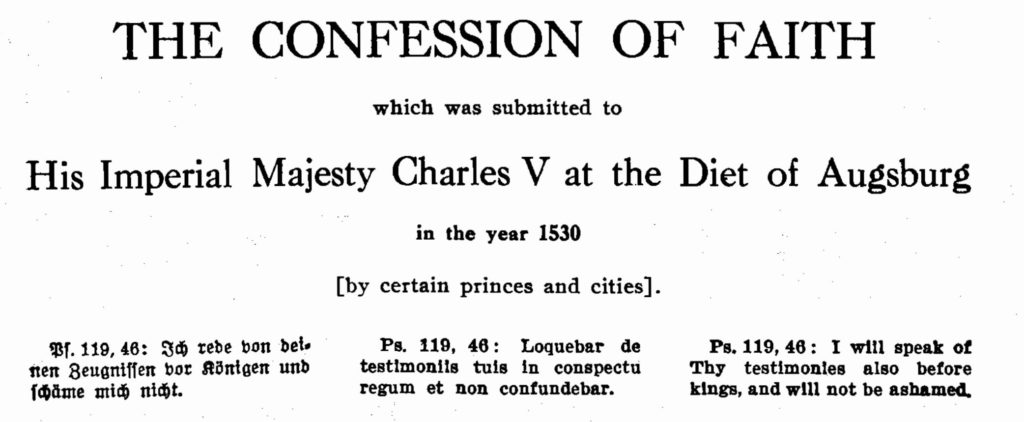
There they were, one Saturday afternoon in Germany: seven laymen, leaders of their communities, a university professor, representatives from the councils of two major cities. All of them were gathered at 3 o’clock on June 25, 1530, together with a massive, standing-room-only crowd that filled the Great Room of the Bishop’s palace. Even more stood outside in the courtyard, their ears bent intently toward every word that emanated out from the open windows.

Augsburg Confession

Augsburg Confession – Title Page


The Holy Roman Emperor had commanded them to travel to Augsburg in Bavaria to submit their statement of faith and offer their support for defending their land from an imminent Muslim invasion. Emperor Charles wanted to hear what they had to say in Latin, but they boldly and fearlessly replied, “If it please Your Highness to consider that since He is hearing us on German soil, we would be grateful to Your Highness if he would allow for our Confession to be read aloud in the German language.”

Then every Lutheran prince stood up and their speaker stepped forward to the middle of the room. In clear and loud voice Chancellor Beyer read the German document he was holding, and the reading, the proclamation, you could say, took about two hours from start to finish.

Martin Luther wasn’t there because he would have been killed on the spot, but that still didn’t make a difference; everyone knew who had made these ideas from the Bible popular once again. One Catholic bishop who attended the meeting said privately that he could find nothing wrong with the statements of faith that he heard, but he could never say so in public because it was one, lonely monk who had the audacity to say that the rest of the Church had it wrong.

But Martin Luther, safe inside the Coburg castle, waiting for the next messenger to arrive from Augsburg, as well as the brave laymen who stood up in that Hall in front of the Emperor, they knew in their very heart the words we heard from Jesus today in our Gospel: “Everyone who acknowledges Me before men, I also will acknowledge before My Father who is in heaven, but whoever denies Me before men, I also will deny before My Father who is in heaven.”

They were fully aware that now was the time for them to acknowledge Jesus Christ and His true message of forgiveness in front of the most powerful man in the land. If they were to shrink back now, then they would be turning their back on their Lord, and that was not going to happen; their eternal salvation meant too much to them to put it at risk.

They also heard the very comforting word of Jesus: Have no fear of them. That means, those things the world throws at you to scare you—don’t allow them to steer you off course even one degree. Be bold! Be courageous! It will not be popular at times to believe in Jesus—so what? You have Him at your side; there’s nothing else that could be better. The hairs of your head are all numbered, which means that God’s careful watch and loving concern cover every last detail of your life, how much more will He be concerned over the greater, more significant problems you will have to face!

As easy as this is to say and to believe, especially since you are sitting here and listening to it as a very familiar statement you might’ve heard many times, it is immensely challenging to keep reminding yourself about this truth. What happens to you when you get rocked with difficulty? What happens when the temptations of this world lure you away from what our Lord has clearly said? Do you fear that you will not have enough of what you are told that you need? Life will certainly be much easier for you if you were to say: you live the way you want, I will live the way I want. Later on, God will sort all this stuff out. Keep me out of it. I’ll just worry about myself.

Augsburg Confession

Augsburg Confession – Latin

Think about this: No matter what political party you like, I’m certain there has been a time or two when you have thought, or perhaps even shouted to the TV at one of our elected representatives in government, saying something like this: Just do the right thing! Stop worrying about where this is going to get you in the polls or the next election! Forget about pleasing the people who had nothing to do with electing you! I’m tired of these men and women of principles throwing those values out the window once they get elected to office!

You may think yourself the last person to get affected by politics, but I must point out to you—those things that drive you crazy about politicians—that’s inside your own human nature too. You have acted as if you and your needs and desires were more important than what God has given you. Your moments of worry and anxiety, however momentarily that they were, still they shook up your total reliance on Jesus your Savior and you let fear of men cancel out your love for Him. A mere moment where you might feel uncomfortable in this life seemed worse to you than an eternity without the Lord your Life giver. You know that whenever you did, thought, or spoke that way, you sinned against God in thought, word, or deed. Just like that frustrating politician, you deserve a shakeup of your senses in which God’s Law shouts at you: Do the right thing!

But fear not, nor fret! When you could not do the right thing out of fear of this world, Jesus did, and He did it all for you. He gave you the calm and patient assurance that spoke deep to your soul: you are of more value to Him than many sparrows. He has rescued you from the utter Divine wrath that had every right to destroy your soul and body in hell. Jesus suffered that destruction for you when He was on the cross dying for you. As we read today in Romans, you are not slaves to sin and fear anymore. You are slaves of righteousness, meaning you now have the freedom to love God perfectly because Jesus, who is in you, He already loves God perfectly. By the free gift that your Savior earned for you, you have eternal life and it will be your highest joy to give yourself in love for the good of your neighbor.

You will have no love for the world and its empty promises. There is no longer a tug at your heart to try to please the people and things that try to be your God, but are nothing like Him. Yes, it will still be tough in these last days before Jesus returns at the End of the world. Brother will hand over brother into death, and father his child, children will rise up against parents and put them to death. Even the closest earthly relationships will try to get in the way of you and Jesus, but evil will not win this victory over you.

Instead, you have delivered one another, including children and parents, into a different kind of death. You are all killed in your sinful nature through Baptism! Sin doesn’t reign in your mortal bodies, because it was crucified with Christ. Parents, you have brought your children to the font to drown the sinner in them and they have been brought back to life as fellow believers. Brothers and sisters in Christ, here in the sight of God and one another, we have through confession of our sins handed our sinful selves into destruction, so that Christ our Lord will then make us a mighty Church, bold with the same faith that they had at the beginning of the Reformation 500 years ago. It means too much to you to think otherwise.

Here we are, one Sunday morning in California in the year 2017. Muslim invaders are still making the news, but as for us, we’re pastor and people, a group of hearers of the Word with various callings all gathered together, with our ears bent intently toward every Word of life that comes from our gracious God. Whether it’s a standing-room-only crowd or a few faithful, whether it’s a fifteen-minute sermon in English or a two-hour Confession in German, it’s the same faith, the same liberating freedom in Christ that they had, and that you have.

One lowly monk may have started it all, but it was the Bible’s Word that he preached that made the difference. As is true with our Lutheran forefathers of long ago, Christ will also acknowledge you before the Father who is in heaven. Why? Because you believe the Gospel Word that has forgiven you all your sins. When you say Amen to that forgiveness, when you trust that all Divine gifts are yours as an inheritance, you are also confessing that Jesus is your Lord, and nothing else evil that happens to you in this world measures up in any way or form to what good lies in store for you. Now is the time to be brave and bold! In Christ you will do the right thing without regard for the hatred of the world, because Christ did the saving thing for you that would secure your everlasting life.

Augsburg Confession - German

Augsburg Confession – German

In the Name of the Father and of the ✝ Son and of the Holy Spirit.

Sermon for the Second Sunday after Pentecost: June 18, 2017

Rev’d Mark B. Stirdivant, Good Shepherd Lutheran Church, Yucaipa, California
† sdg †

Green Altar Parament

Green Altar Parament

Jesus could have taught the message of His kingdom in so many other ways. What if He sent out legions of angels to declare it to multitudes? He could’ve used a loudspeaker from heaven for all to hear at the same time. He could just sit in the temple and summon all nations to come to Himself. He could do whatever He wants: He’s the Son of God. But instead, we see Him picking twelve men to go and tell.

They go, and they know two things at this early time in their education: they’ve been given a Word, and they’ve been sent. There’s no making up the message as they go along, but they proclaim the message that has been generously given to them. They don’t perform wonders and healings out of their own magic hat of powers. Instead, they’re going to work wonders because Jesus has given them the power to do so. They’re not even going out on their own, but they’re going because they’ve been sent. Freely all this has been given to them. Now they may go and give the Gospel for free.

Imagine the crowds that gather around them. They gather in order to see the Savior, but here they get the understudies instead. Perhaps some leave disappointed or disgusted before the disciples open their mouths. Perhaps they feel like Jesus has let them down by not coming personally, or because the student is never better than the master. Those are typical human reactions, but humans are typically wrong with God’s things. The Lord is not unfaithful. This is His way. This is His order. Jews first, Gentiles soon to come. When the disciples heal the sick, the sick are healed. When they cleanse the lepers, the lepers are cleansed. They raise the dead; the dead are raised. They cast out demons; demons flee.

Why? Because it’s not them doing it. Thaddaeus isn’t saying to the sick, “In the name of Thaddaeus, be healed.” Bartholomew isn’t saying, “In the name of Bart, come out of them.” Demons aren’t afraid of Bartholomew. But they are afraid of Jesus, and the disciples speak in Jesus’ name. He’s sent them; and by His Word, He is there with them. When they preach, “The Kingdom of Heaven is at hand,” it’s true because the King is there by His authority and Word. And, when the disciples tell the people that their sins are forgiven, their sins are forgiven. Not because the disciples are forgiving them, but because really, Jesus is. That’s what He sent them to do. That’s what He gave them to do. Freely they have received. Now they freely give.

One of the favorite Sunday School and Vacation Bible School stories to tell is the one about the prophet Balaam in Numbers 22. As you may recall, the unbelieving King Balak sent the prophet Balaam to curse the people of Israel. However, as Balaam rides his donkey toward the people, God opens the mouth of his donkey and the donkey talks. The donkey rebukes the prophet Balaam, and Balaam blesses God’s people instead of cursing them. Pastors like to say this:

“If God can speak through Balaam’s donkey, then He can speak through me, too.”

Beyond the laugh, there’s an important point. In His wisdom, with a world full of lost and wandering sheep, God has chosen to spread His kingdom in a most curious way: He wants sinful human beings to speak His Word. He calls pastors in the Holy Ministry to preach that Word publicly, on behalf of His Church; and pastors can be quite a strange bunch. Despite the quirks and personality failings, however, the Lord still uses them as His instruments. Not just them, though: every Christian, tempted though they may be by sin and weakness, every believer has the privilege of telling that Word about Jesus to others. That is how the kingdom of God spreads.

Why is that? It is not the people. It’s the Word. The Lord Jesus Christ, the Word made flesh, is present by His Word: the kingdom of heaven is at hand because our King is at hand. The same Savior who went to the cross to die for the sins of the world, now comes in His Word to give that forgiveness to individual people—to you and me and all who will hear. Jesus is present where His Word is. Add that Word to water, and He’s there in Baptism. Add that Word to bread and wine, and He’s present in His Supper.

It’s the Word that’s powerful—not the person speaking it. It’s the same Word with the same power that heals the sick, cleanses the leper and casts out demons in the Lord’s time. By that Word, Jesus comes to give forgiveness and faith and life, to turn wandering sinners into the people of His pasture, the sheep of His hand. It’s that simple.

Can the people who are sent get into trouble and stand in the way of God’s Word? Of course, they can; even though the Lord is faithful, sinners are sometimes not. Sometimes though, people place their hope in the preacher’s great charisma. If his style is engaging and holds interest, then that must make the Word powerful. If he is less interesting or has a bad day, then the Word maybe isn’t so powerful. If this is true, that means that God is only as faithful and powerful as the sinful man who is preaching the sermon. It means that God’s power varies based upon how much sleep the pastor got the night before. This is an extremely seductive temptation in our culture and society, because image is emphasized so much. People judge books by covers, and companies spend millions of dollars to make sure that their products have the right packaging and an exciting ad campaign.

We are easily tempted to judge the quality of anything by how well it holds our attention. Old Adam inside you and me makes sure that we judge the power of God’s Word on the same criteria. Pastors suffer this temptation, too; they can believe that their personality or style make the Word more effective. It’s simply not true. However, repent and rejoice! The Word’s power is not bound by the personality of the speaker. Where the Word is, Jesus is. Where Jesus is, there is forgiveness and life.

Crown with Chi-Rho

Crown with Chi-Rho

Some may fall for the opinion that only pastors have the ability to share God’s Word. Sure, only a pastor is given God’s holy orders to preach in a setting like this, for the benefit of God’s congregation in the Divine Service, but the misconception is that if a layman shares the Word with someone in their daily life, it’s just information but nothing more, like a recipe or a news broadcast. It tells about salvation, but it doesn’t save the person hearing the good news. If this is true, then God would have made a mistake when He told us to forgive those who trespass against us! No, you give forgiveness with the same power that the pastor has been given.

In fact, Christians meet and spend time daily with all sorts of people whom the pastor will never meet, and each believer has the joy of telling of the hope they have in Christ. Sadly, many believers balk at the thought of doing so. “I don’t know what to say,” is one excuse, well, why not? With Bibles to read and sermons to hear and classes to attend, what prevents you from not knowing? Simply tell other people about Jesus—about His ministry and miracles, His death on the cross and resurrection; about forgiveness and the hope of eternal life. “Oh, but I’m not a very good speaker.” Neither were Moses or Paul, and I suspect that Balaam’s donkey wasn’t usually eloquent either; yet God used each of them. “People won’t listen to me.” Careful, now; because that’s like saying that the power of the Word depends on you, not on Christ. I can assure you that people don’t always listen to pastors more than anyone else. Once again, it’s the Word—not the person who speaks it. “I don’t like talking to strangers.” That’s okay. Talk about Jesus to each other. To your kids. Your grandkids and other family members. A good friend who’s curious about your faith. The Lord will provide opportunities.

That’s how the Lord spreads His kingdom on earth: He sends out His Word. He gives His people, you and me, the privilege of telling it to others. He gives us the honor, despite our sins and weaknesses, of being His instruments to tell others of Jesus; and He promises that His Word will not return to Him void, but will accomplish what He sends it forth to do, whether or not there’s a huge crowd coming to hear it. Where people do listen to us and rejoice with us, that’s when we give thanks and glory to God. Where people reject the Gospel we proclaim, we remember that people rejected Jesus, too, and we give thanks that He counts us worthy to suffer for His name’s sake.

But as you speak His Word, rejoice most of all in this: Jesus first speaks that Word to you. Freely you have received; only then do you freely give. Your salvation this day is not based upon how well you evangelize, how many people you tell about Jesus, or how well you tell the great story. God’s gifts are already yours because Jesus has already died on the cross to save you. By the mouths of people in your life—parents, pastors, friends, and others—the Lord has told you of forgiveness; and whenever you’ve heard that Word, He has given it to you. He could have done it any way He wanted; this is what He wants.

So it is this day, as we gather here. It has all been about God’s saving Word. As the Gospel is spoken, it speaks and delivers forgiveness. So on this day you rejoice: you have not just heard about forgiveness today. You have not just been told you have to go and spread the kingdom by telling others. But most importantly, by that Word that you have heard today, you have been made a part of that kingdom, you have been healed by Jesus the merciful Savior, you have been forgiven of all of your sins.

Cross and Crown

Cross and Crown

In the Name of the Father and of the † Son and of the Holy Spirit.

Sermon for the First Sunday after Pentecost; Holy Trinity: June 11, 2017

Rev’d Mark B. Stirdivant, Good Shepherd Lutheran Church, Yucaipa, California
† sdg †

White Parament

White Parament


The celebration of Trinity Sunday is unique. Unlike Christmas, Easter and Ascension Day, there appears to be no historical event that has taken place upon which this church festival can build. The Trinity didn’t happen; the Trinity…just is. If a church happens to have been named Trinity Lutheran, like many are in the Missouri Synod, then this day can be a special namesake celebration for them, just like Good Shepherd Sunday last month was special for us. But we have all heard the true statement that is often pointed out- the word “Trinity” is not in the Bible. No that term is not there, but the God who is Father, Son, and Holy Spirit, yet at the same time one true God, most certainly is professed all over in Scripture. The name, which was constructed out of the words three and one, describes succinctly what our Triune God revealed to us His Church through centuries of prophets, apostles, and most importantly, the Son of God Himself who came to our world clothed in perfect, untainted human flesh.

Since the Trinity is a confession of doctrine more so than an event that occurred, and since our congregation does not go by the name of Trinity Lutheran, it may be difficult for us to find a clear reason why we should celebrate Trinity Sunday, other than, it shows up on our Church Year calendar. The Athanasian Creed goes on and on about three persons, one God, not three Lords, nor three Uncreateds nor three Infinites, but One Uncreated and one Infinite. Then, this third creed that we don’t see as often shocks us with the statement that we will have to believe this unwieldy, confusing, complex statement called the “catholic faith,” believe it perfectly or else we cannot be saved. Based on everything else you’ve heard preached in a Lutheran Church, it would be very likely that you might hesitate a second: just what is the purpose of celebrating Trinity Sunday, anyway?

Thankfully, the Bible, which is God’s Word from God’s mouth, produced by the work of God’s Holy Spirit, does not speak to us using lots of difficult terms like we read in the Athanasian Creed. The Bible, rather, unfolds for us a story, our true history, and little by little our Lord reveals more and more of Himself as He speaks His Word to us. We read about the Creation this morning—here’s the Trinity: God the Father, spoke forth His eternal Word with His Spirit fluttering over lifeless waters and then there was light, there was Earth, there was Sky, there were seas, birds, fish, land animals, creepy crawlers and, finally, Man in God’s image, created to be male and female, and it was all good! In that momentous event, the very beginning of our universe, God showed us a little of who He is, but the entire picture of Father, Son and Holy Spirit was not yet fully disclosed.

Jesus had called His disciples and said simply, Follow Me. At first, that’s all they had to go on. As He taught them, these students understood more about who Jesus really is and what He came to do for the redemption of the world. There was no complex doctrinal statement with legal jargon that they had to grasp perfectly and

then sign on the dotted line. They simply trusted that Jesus was teaching them the truth, beginning from the basics. These students of the faith needed to witness our Lord’s brutal crucifixion and death. They needed to meet face-to-resurrected face with Christ who conquered death. Jesus lovingly reminded them that all these things that they experienced came true because their Lord perfectly fulfilled His Word. And then something wonderful happened.

Finally, with all of those lessons learned, all of those precious gifts received from the great Teacher, then it was time to reveal the greatest mystery behind it all. Then, after all was completed, Jesus spoke of the Trinity. He said, “Go and make disciples of all nations, baptizing them in the name of the Father, and of the Son and of the Holy Spirit, teaching them to observe all things I have handed on to you.” As we read today in the last chapter of Matthew. Only then did Jesus speak this full, majestic and excellent Name to the disciples. It was like the entire story from Creation up to that very minute had come to fulfillment, and then it was time for these apostles to spread out into the created world and make more students, more disciples just like they were.

Yet we read that they doubted, even while they were worshiping Jesus! Actually, it was more of a hesitation than it was a hardened, I won’t believe at all, kind of doubt. Sure, I believe, they must have thought, but something is just in the way at the moment. I need help. That’s what was troubling these disciples as they were coming closer to the moment when they will not see Jesus any longer.

Where has been your moment of hesitation? For some I would guess it might have come from a significant change in your life. For others, it has been a gradual gnawing at your spirit—sure I believe, but there seems to be some little thing in the way. I don’t feel it’s important to give a portion of my time or my treasure to the Lord. I’m confused about why the church teaches against living together before marriage or against homosexuality or transgenderism. I have questions that seem too tricky to resolve in my mind. I have friends or loved ones who challenge me and what I should think is right as I deal with them—I don’t want to lose them just because something they’re doing is going against God’s Word.

You are not alone with those hesitations and questions. You are not in danger of condemnation to hell if they pop into your mind. Jesus’ own disciples worshiped Him in those last days that they saw Him, but also they hesitated. It was a problem that they could not fix or resolve for themselves by their own reason or strength. Jesus Himself knew that about His disciples, and He knows that about you, His own dear children. That’s why even while His students were hesitating, Jesus came to them! He had said earlier that No one comes to Me…unless… unless God the Father draws him to me. He also said I am sending you the Comforter, the Holy Spirit who will guide you into all the truth. See, there’s the Trinity again! We confess that God is Father, Son, and Holy Spirit precisely to save you, and to help you in your doubts, questions and even slight hesitations. You didn’t have to grasp it perfectly and completely in your head, but your Lord made it possible for you to believe it with all your heart.

There was even an event that happened for you, an event in which the Holy Trinity actually came into your life and changed you forever! That was the moment of your Baptism; the moment when water was combined with God’s Word and administered with God’s Command- the Command to make disciples by baptizing in My Name, as Jesus said. So, when you celebrate the Church Festival of the Holy Trinity, you are celebrating again your own baptism. Every day you remember your baptism when you admit your sins to God in confession and believe that you have received forgiveness from the pastor as from God Himself in the Absolution.

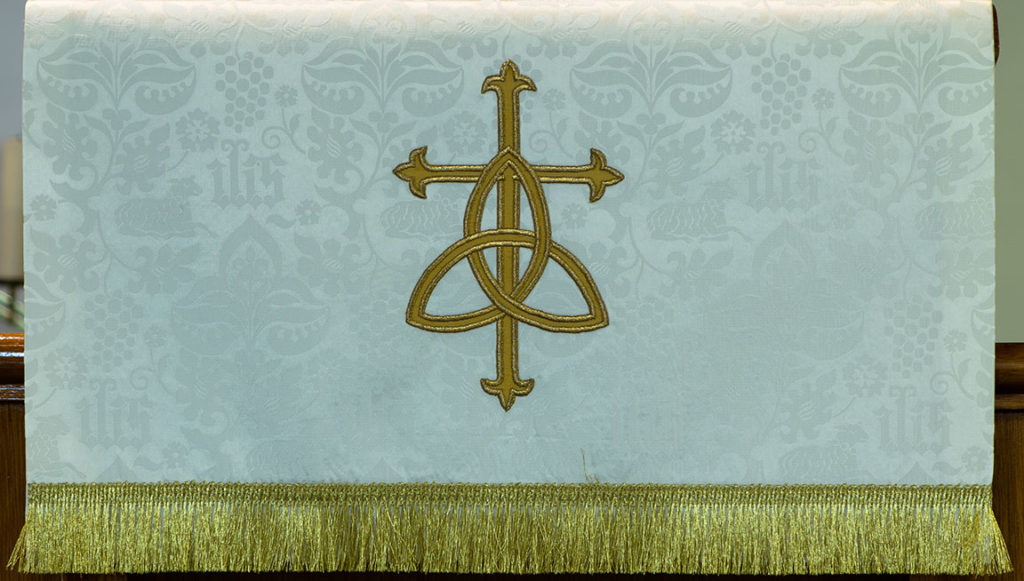
White Parament on the Pulpit

White Parament on the Pulpit


Take a look at that Baptismal font as you leave today. There in Baptism the Father begets you anew. There the Son cleanses you from all sin and delivers you from every death. And there, in the waters of Holy Baptism, the Holy Spirit gives and delivers you into your Lord’s very own Body so that you also become true sons of God and are born of God. He is your only peace in all time of adversity and prosperity, during life and in death, when things go well and when things get scary. Remember your Holy Trinity event in your baptism when you leave this sanctuary after the Divine Service and pass by the baptismal font. Dip your finger in the water if you like—it’s not special holy water, but the water you touch can help you clearly recall to your mind and heart the powerful words that were once spoken with a similar splash: I baptize you in the Name of the Father and of the Son and of the Holy Spirit.
Your own personal Trinity historical event happened and you have never been the same since. On this Holy Trinity Sunday and every day of your life, confess with conviction along with the rest of us that God is indeed Father, Son and Holy Spirit as the Bible teaches; insist as a forgiven sinner that Jesus is true God at the same time as He is true Man, because that’s how your baptism truly does save you. Strap on the great Triune Name of God as your breastplate and armor, just like St. Patrick of Ireland did even as he faced the deadly evils of persecution. He sang this song about the Trinity which you can find in our hymnal:

I bind unto myself today
The strong Name of the Trinity
By invocation of the same
The Three in One and One in Three.

The strong Name of the Trinity has saved you also this day, it fills your heart with joy over your forgiveness and everlasting salvation in heaven, and it will energize you to live for God and sacrifice yourself for the sake of your neighbor’s needs. To this Holy Trinity alone belongs all glory, honor, worship and praise, now and forever.

In the Name of the Father and of the † Son and of the Holy Spirit.

Sermon for the Day of Pentecost: June 4, 2017

Rev’d Mark B. Stirdivant, Good Shepherd Lutheran Church, Yucaipa, California
† sdg †
Acts 2:1-21

What an exciting day this is! On this day we celebrate the coming of the Holy Spirit. Pentecost was first a Jewish holiday, called the “feast of weeks;” that was the shadow. Now Jesus stands up in the midst of that feast to declare He’s the real thing that all the shadows have led to. He’s the source of the living water that was prophesied to flow from the Temple. The Christian festival of Pentecost has been named the birthday of the Church, the beginning of the Gospel’s spread throughout all nations, as noted by the many languages that instantly appeared on the tongues of Jesus’ disciples, who are now apostles. At Pentecost, we are thankful that Jesus sent us the Holy Spirit, the promise of our Heavenly Father, and rejoice that by His help, our church will thrive in this evil world. Thus we pray that God will continue to work among us for many more years to come until the return of Christ.

Red Parament

Red Parament


Now I hate to rain on your Pentecost parade, but I must. If the most important thing for you as a Christian is to believe in Jesus Christ your Lord, then perhaps the second most important thing is to acknowledge that it is impossible to believe by your own reason or strength. To say it another way: I believe that I cannot believe. But boy is that a hard thing to confess! These days you see people giving personal testimonials and people trying (with good intentions of course, but) trying to make church no more than just a fun and exciting place to be. Free hamburgers might get them in the door! Then, once you’ve lured them in, perhaps they’ll commit their lives to the Lord, thanks to you. That makes you feel good, it feels like God is using you and you made a difference, and that good feeling you tend to translate into a stronger faith. Why? Because you feel that your own commitment got stronger, and your heavenly Father has no choice but to be pleased with you for what you’ve done for the good of the kingdom.

Isn’t that what having the Holy Spirit is all about? Jesus Himself said after all that the rivers of living water (meaning the Spirit) would flow right out from the believer’s heart. And isn’t the Holy Spirit supposed to come with some spectacular special-effects like we read about in the book of Acts? Miracles and tongues and prophecies and so on. Your human nature would crave a little more of this visible, tangible proof that God is acting mightily—it would do our world some good. Just like those Jews were looking for Jesus to overthrow the Roman Empire’s rule and establish a kingdom right then and there. And then you suddenly find yourself tempted to write the agenda for the work of the Holy Spirit, rather than believing that He works when and where He pleases. When that happens, then your ideas of success in the church take over God’s plan and mission.

Which is why you cannot get anywhere as a priest of God and worker in the Lord’s vineyard unless you first admit that you cannot make a difference. In fact, your own efforts that flow out of your own sinful purposes, those could actually bring harm and hindrance to the work of the

Church, if it weren’t for Christ’s forgiveness. Whether you like it or not, the Holy Spirit convicts you because in the eyes of God’s law in the Ten Commandments, you stand condemned. You have not loved the Lord your God with all your heart. You have not loved your neighbor as yourself. And when it appeared to others like you were fulfilling these things, still your sinful thoughts, which are known only to you and your Lord, dragged you into sin despite any good that might have resulted.

You must face the truth. All your righteous, spiritual-looking acts are in God’s eyes no better than filthy rags, as Isaiah says. Your ear has bent more readily to nasty rumors than your mouth has spoken up for the truth. You have insisted in many and various ways that the Holy Spirit works in ways that you determine, rather than through the Word of the Lord. It’s a common misperception that doctrine is dead, cold and lifeless—just a book on a shelf that does nothing unless you dress it up and add the Holy Spirit to it as though the Holy Spirit came from somewhere else besides the Bible. But really, doctrine, that is God’s teaching, is the only thing that gives true life and it’s the source of the Holy Spirit. No wonder the devil attacks doctrine in the church, in his effort to destroy it.

Don’t think that you’re immune to this, that you can ignore it, be nice, and it’ll all go away. Satan doesn’t want you to live from the Word, but rather to use it as a weapon like he tried to do with Jesus in the wilderness. He leads others to ridicule you, even in petty ways, like what happened when outsiders accused the apostles of being drunk at 9 o’clock in the morning. You could find yourself with a lust for peace despite the sufferings of the cross of Christ that has pushed you to give mere lip service to your confirmation vow: the promise that you would suffer all, even death, rather than fall away from your confession of faith. But for you to live renewed each day with the Holy Spirit’s power within you, the sinner that you are must die—drowned each day in the waters of your baptism. Your spiritual thirst can only be quenched in one way.

This is why it is so important to believe that you cannot believe. You need to receive the Holy Spirit from outside of you in the Word of Christ’s forgiveness. For the rivers of living water wouldn’t have had a chance to come out from your heart, had it not been the case that the same river streamed out first from the pierced heart of Jesus as He hung on the cross. After all, it is Jesus Himself who says to you who are thirsty, Come to Me. The Holy Spirit comes from no other source than from Christ. Forgiveness and eternal peace comes from nothing else besides His death for you and His resurrection from the dead. Your Savior doesn’t want you to be uncertain of the future; His plan is not to have you scrambling around looking for comfort for your distressed soul. He wants you to call on His name and be saved, each and every day. Believe in Him. Don’t trust in your commitment to Him. Instead, latch on to His rock-solid promise to you. Feed on His flesh just as He told the 5,000 whom He miraculously fed out there in the remote field.

Yes, all this comforting Gospel may be offensive to your selfish human nature. I may be raining on your parade, as long as your parade makes you the Grand Marshal, or the center of attention. But you know, the prophet Joel speaks of rain as God is moving him to write in his book of prophecy about the coming of the Holy Spirit at Pentecost. Peter quoted from Joel as he was speaking to the gathering people on Pentecost, and just before that quoted part, Joel writes this: “Be glad, O children of Zion, and rejoice in the Lord your God, for he has given the early rain for your vindication; he has poured down for you abundant rain, the early and the latter rain, as before.” (2:23) This kind of rain from the Lord your God is what you need for your faith in Christ to grow. God the Holy Spirit comes and goes as it pleases Him, but He always comes to give you faith when you hear the Gospel of your forgiveness. This is not the same as to say if you don’t feel loved by God, wait 10 minutes and the weather will change, but it does say that you are not in control of the Holy Spirit no more than you are in control of where it rains in Southern California, and that is a good thing for you. He’s the one who calls you by the Gospel, enlightens and sanctifies you and keeps you in the true faith. Your Savior gave you the ability to trust in Him, you didn’t have it by yourself. And His Body and Blood will strengthen that faith until He comes again in fully visible glory.

And that is the answer to your nagging question on a day like Pentecost? What is the future of this particular church that was founded decades ago? Jesus answers: Come to Me. Drink of the living water that comes straight from the heart of Jesus. Hear My Word and trust Me when My called and ordained servant of the Word says your sins are forgiven. Eat My Body and Drink My Blood and you will have forgiveness, life and salvation through yet another means. When it comes to the mercy, grace and blessing of God for you, His people, when it rains it pours! Then in turn, He automatically directs your heart to serve your neighbor, that they may also partake of the living waters of grace. And though you may or may not see the visible, special-effects of the Holy Spirit among you, like the fire and wind and language-abilities, you still have God’s promise that as long as there is the preaching of the Word, there the Holy Spirit is poured out on all flesh. May He bring you to Jesus until you see God the Father face-to-face in the heavenly Zion of His kingdom.

In the Name of the Father and of the † Son and of the Holy Spirit.

Sermon for the Seventh Sunday of Easter: May 28, 2017

Rev’d Mark B. Stirdivant, Good Shepherd Lutheran Church, Yucaipa, California
† sdg †
I Peter 4:12-19, 5:6-11

You’ll have to excuse the disciples for being a little confused. They had just witnessed Jesus’ ascension into heaven, which happened forty days after He rose from the dead. There they were on that Mount of Olives, staring upward as the Teacher and Friend who said He would be with them always, even to the end of the age… then He suddenly disappeared out of sight. That would be the opposite that someone would expect, right? He had also told them, “Go and make disciples of all nations… Preach the Gospel to the whole creation.” And yet, the Lord also commanded, “Stay right where you are in Jerusalem.” Don’t you think that would make it hard to understand what it was He had in mind? And then we hear from St. Peter in the epistle he wrote, “Do not be surprised at the fiery trial when it comes upon you to test you, as though something strange were happening to you.”

Wouldn’t you think that would be strange? We are now beginning our seventh week of the Easter season, and Pentecost is knocking on our doorstep. God has been proclaiming His great power right and left. Jesus died on the cross, then rose from the dead on the third day. Sin and death have been undone; the debt to God that we could never have paid—Jesus paid it! Nothing more needs to be accomplished for our salvation. Fiery trials, we figure, come as a result of sin, so it perplexes our minds that sin continually makes this great comeback against us, everywhere we turn, especially when we have the promise that Jesus is our Lord and our Savior forever. So why isn’t He using His power to hold it back?

Codex Sinaiticus

Codex Sinaiticus – I Peter 5:8 “Be sober-minded; be watchful. Your adversary the devil like a lion roaring”

And then you have the Apostle Peter’s words about the devil: “Be sober-minded, be vigilant, be watchful. Your adversary the devil prowls around like a roaring lion, seeking someone to devour. Resist him, firm in your faith.” Well, who let him loose? Why is Satan seemingly so free to assault and trouble us? I thought that on the cross, Jesus defeated the devil too! He descended into hell in His exalted human flesh to proclaim His victory over Satan. Why do we now have to watch out, always looking back over our shoulders, lest the evil foe’s lion-like attacks pounce upon us unawares? You can understand now why the disciples were very confused in the moments right up to our Lord’s ascension into heaven. They looked at each other in confused disbelief over this apparent contradiction. It had seemed like His grand triumph did not make a single difference as we find ourselves still in the difficulties and problems of this world. Wouldn’t we still suffer, Jesus or no Jesus? That’s what it feels like. So for us to rejoice simply because we are suffering these problems, there has to be something more that leads us beyond the simple facts of Jesus’ death and resurrection. Those events happened long ago in the past. What good are they for us today? What message is still there in those ancient Bible books for real people in the 21st Century?

Codex Sinaiticus

Codex Sinaiticus – I Peter 4:17 “For it is time to begin judgement at the household of God”

The first message we need is the message of judgment, since Peter himself told us: It is time for judgment to begin at the household of God. We must repent, because we wrap ourselves up in everything that concerns us today. Our

schedules are crazy, the demands for us to get stuff done, it is outrageous. If we can put off anything that we don’t need to treat right now as an emergency, we feel we can get away with setting it out of sight, and hopefully it will become out of mind. Guess what usually is set aside because it never seems like an immediate emergency? It’s this: You have sinned against the Lord. He has given you commandments, and you keep breaking them. You are a sinner. All of those don’t have any alarms or reminders or past due notices clamoring for your attention. So you ignore them, as do I.

This message of judgment gets a little tricky for us, though, because it is possible to hear condemning words not only from God, but from the devil, too. I’ll explain. God says in His total, perfect justice: You deserve to die; turn away from your sin and believe in Jesus, and you will live. I, however, will bear you up as you suffer, and I promise you full deliverance, just repent and believe that forgiveness is yours, no matter what your feelings tell you.

The devil then steps up to say his piece, and tries with all his might to scramble that message: Did you just hear God tear you down? I heard it myself! You have no chance with Him! No matter what you do, you’re just going to keep suffering because you are a sinner. Your sin must be too big for Jesus, if we’re going to face facts. Simply put, you have sinned too much, and you haven’t demonstrated that you’re ready to change your life to sufficiently please God. You know I’m right, he says, because you are still hurting more than others around you.

Lies. All lies, through and through. But as you hear them, and feel the way you do sometimes, you can’t help but fall for those lies. You get confused, and the message of judgment that we all need to hear, starts sounding like the blessings of life with Christ are faraway, unattainable dreams. For a little while, your ears start to itch for more law, for more ways to make yourself feel better, for a less condemning and more inspirational, do-it-yourself message, but eventually you realize that the devil’s discouraging voice in your conscience has won out and you get convinced that judgment is the last word.

Codex Sinaiticus

Codex Sinaiticus – I Peter 4:13 “But insofar as you share in Christ’s sufferings, rejoice”

But it is not. There is an all-important second message. The Apostle says rejoice, even in suffering, and that too is God’s Word. Peter doesn’t say try to rejoice, not, reach deep inside yourself and make a believable effort at faking happiness. No, he says, rejoice—you really are sharing in Christ’s sufferings. This is not a mental exercise or trick—Jesus, the risen and ascended Jesus, He really is suffering, the same way He was when He once told Paul: Why are you persecuting Me? He is to this very day identifying with us in all that we are going through. He’s linked you together with Him because you are baptized into His Name. And when Christ is suffering, you can know for absolutely certain, that you are being saved, delivered from evil just like you pray for in the Lord’s Prayer. All Divine judgment landed on Him on the cross. Do you suffer insults? Then you are being blessed because all those insults fall on Jesus, and He turns them into blessings. Have you been shamed, that is, someone has forced you to accept their sin because they claim that
would be the “loving thing” to do, but you wouldn’t? Then be ashamed no longer. Glorify God because He rejoices with the truth. Without Jesus on the cross it would have been impossible for you to hate the sin and love the sinner.

This is going to be tough—most of you already know that it is. The righteous is “scarcely saved,” Peter says. That means it looks like it would all go the way of judgment against us, as if the devil’s lies would turn out to be reality. You and I need God’s help every day—there is absolutely no way we could simply read our Bible and Catechism once through and then think, All right; I’m done. I’ve graduated from learning the faith. There’s nothing more I need to know. I believe in Jesus and I know I’m forgiven. That’s not humbling yourself, waiting for the Lord to exalt you. That’s exalting yourself! That’s when you become ripe for the lion to pounce on you and pin you to the ground. Do not let a complacent, vague, forget-about-it style of forgiveness keep you from taking God’s Word of judgment seriously. But also, at the same time, do not fall for the devil’s scheme that makes the precious Gospel seem like it’s too far out of your reach. Both the word of judgment and the word of rejoicing are necessary, and they are yours for your eternal good.

How did Jesus make sure that both those words would be yours for certain? He promised you the Holy Spirit. The gift that we will celebrate next Sunday at Pentecost was actually the answer to Jesus’ prayer to the Father, as recorded in our Gospel today. By the Holy Spirit and not by any other way, believers know that Jesus is the Son of God, and that they belong to the Father thanks to Him and what He has done. By the Holy Spirit you have the glory of Jesus that He always had as God, but as man that glory was given to Him upon completion of His salvation mission. Now that Jesus has been glorified—He suffered, died, was buried, rose from the dead, and ascended into heaven—now that He has this glory, He lavishes forgiveness upon you and grants you the only reason you need to rejoice in the midst of suffering, hardship, and the conflict of this world, even the conflict you face from time to time with fellow believers. The Son and the Father are perfectly one with the Holy Spirit in the mystery of the Holy Trinity, so that unity is bequeathed to you. Now you are one with God and with one another in Christ.

Codex Sinaiticus

Codex Sinaiticus – John 17:11 “that they may be one, even as we are one.”

Jesus prayed for you! And His prayer was certainly answered in your case when you were baptized, and the Holy Spirit made His home with you. This is not a fairy tale or make-believe catch-phrase. This is really happening because you are not just hearing my mouth speak; you are receiving the blessed words of judgment and rejoicing sent to you straight from God Himself.

Your Lord continually prays to His Father even now, that you may be one with one another, but most importantly, one with God. And as you are joined together with Him, you are made bold to confess the truth, even to the point of death as the confirmation vows require, for in fact you have already died to yourself that you may live to God. He will bring you to Himself whenever He serves you with His Holy Word and the Blessed Body and Blood of

Christ, and give you the hope of eternal life in perfect bliss and happiness.

In the mean time, rather than be puzzled at the apparent contradictions that you see, trying to make human sense of what our Lord is teaching you, may you continually pray that when you are attacked by any evils of body or soul—pray that the Lord would yet accomplish His Will among us His Church on earth until He comes again. And God who has called you to His eternal glory in Christ, will Himself restore, confirm, strengthen and establish you.

Codex Sinaiticus

Codex Sinaiticus – I Peter 5:13 “will himself restore, confirm, strength and establish you”

In the Name of the Father and of the † Son and of the Holy Spirit.

Sermon for the Sixth Sunday of Easter: May 21, 2017

Rev’d Mark B. Stirdivant, Good Shepherd Lutheran Church, Yucaipa, California
† sdg †
Acts 17:16-31

The second half of the month of May is very solemn in America, you could even say it’s spiritual. It urges us to dip down deep into our nation’s religious roots and our reliance on God our Creator. This past week was National Police Week, a memorial for those cops who died in the line of duty. Today is Armed Forces Sunday, and we thank God for our loved ones past and present who have served in uniform. And of course at the end of this month our Nation will observe that most somber national holiday, Memorial Day. At these seemingly spiritual occasions it just feels right to say a prayer with all our fellow citizens, regardless of denomination, thanking God for His abundant blessings and including a prayer for those who are still out there, hard at work defending our liberties and promoting the well-being of our allies. You have often seen students in the past holding hands in a moment of prayer standing around the flag pole. Churches often make a patriotic tug at the heart strings, even going so far as to force the pledge of allegiance into the liturgy and manufacture a new creed exalting the Christian virtues of certain founding Fathers.

Of course, if feeling is the only thing you go on when you consider the spiritual work of prayer, then you run the risk of straying from God’s Word and what our Lord Jesus Christ gives us in the gift of prayer. I can give you an example from Kansas City, where they absolutely love President Truman. I know some people there terribly miss him in the White House! But a few years ago, on the occasion of Truman’s birthday (also in May) a Catholic priest offered a so-called “prayer” that really was a collection of Truman’s pithy quotes arranged like a litany so that one of them went like this: “If you want to have a friend in Washington, get a dog.” And everybody was supposed to respond, “Amen.” As cute as that was, and well-intended to honor one of our presidents, I’m sure, it said to me at least that American Christians can sometimes get a little lost when they think about prayer. It’s like they are wandering around in the dark, and can’t find their way.

In our reading from Acts 17, the Apostle Paul visited the eminent city of Athens—it was already an ancient city in his day! Athens was constantly buzzing with philosophers, thinkers, theologians and religious experts from all over the known world. Following the tradition of Alexander the Great, leading thinkers at Athens were constantly pursuing all possible philosophies and religions in order to arrive at a deeper, more profound truth.

Our world around us may look like it is doing the very same thing as those educated people did in Athens. Always learning, but never coming to a full understanding. What I would say is the most profound difference, however, between then and now was that the men of Athens gathered more and more information so that they would better understand those things that were already true in the world around them. Today, on the other hand, there is no more search for information, really! The information bombards you constantly, and it practically demands that you must throw out the window anything that you currently consider true, and make up for yourself whatever is true for you. Nobody is confident anymore, including many Christians. They question truth; in fact, it can be considered quite rude and arrogant for you to say one religion is better than another. Instead, it’s popular to believe that you just have to find what works for your own purposes. You can use religion, philosophy, values, politics, anything. You just can’t say in today’s world that whatever you have found to be true for you is really the one, profound, all-encompassing truth that’s good for everyone. And with just the right amount of boldness, you could respond, “Who says you can’t say that?”

1534 Luther Bible

1534 Luther Bible – Acts 17 “and found an altar on which was written To The Unknown God. Now I proclaim to you this same, which you unknowingly”

Paul’s tactic was not to condemn the Athenians, to be sure. That wasn’t his apostolic and missionary call. But it is important to note that he did not affirm their scatter-shot belief in all those false gods, either. Instead, he preached the Gospel to these people, saying, “I know you are nobly diligent in searching for the truth and if you will hear me out, I will present to you the Good News that your search is over!” Then Paul preached to them following an outline that’s very similar to the Creed. He said: “The God who created you and has sustained your earthly life, is the one and only true God. He sent His Son as His appointed Savior, who died and rose from the dead, and will come again to judge the world in righteousness.” Rather than condemning them, Paul, out of Christian love for all people lost in sin, delivered to them God’s own command that everyone should repent. He let God remain the judge, and He informed the ignorant so they would know the one and only Gospel truth.

1534 Luther Bible

1534 Luther Bible – Acts 17 “God, who made the world and everything that is in it, since He is the Lord of heaven and earth, does not live in temples made with hands”

We have the blessing of the freedom of religion, for which we should daily thank and praise the Lord. In general, it holds true that all citizens ought to be free to worship according to their conscience. Still, that does not accurately translate into a conclusion that all religions are true. Nor does it mandate that religions be mixed together or treated as equal attempts to approach our Creator. There’s a lot of “try us, see if you like what we have to offer,” out there, and that is especially tempting in American society. But it wasn’t easy for St. Paul, either. He needed great courage to confess the one, true faith. And he had the sincere love for the lost brothers and sisters of Athens and other mission fields to tell them what God wanted them to hear. He did not have to change or modify what he said in order to help the Word out or give the Holy Spirit a helping hand.

Note also that Paul did not ask them to continue their ignorant spiritual groping, saying something like, that’s OK, one day you may possibly stumble on Jesus Christ the crucified. He did not invite them to pray until they were brought into the Holy Christian Church through baptism. Prayer was certainly not Paul’s instrument by which a person accepted Jesus into his heart. Instead, prayer is described in the Bible as the response of a faith already given. It, too, is a precious gift of God, thanks to Christ. Prayer is a privilege bestowed upon us by the Holy Spirit, along with all of His gifts, about which we will hear again soon on the Day of Pentecost.

Today, we heard the promise that Jesus gave to His disciples just before His suffering and death. Yet a little while, Jesus says, and you will see Me. If you love Me, you will keep My commandments. If you ask anything in My Name, I will do it. But how can it be that those great blessings and promises often have such a tough time breaking through to your heart? Why are you at times concerned about only your own well-being, and not about that of your neighbor? What kind of grip does worry or anxiety have over your spiritual life? Perhaps it’s difficult for you at times to see your faith as having any impact on the rest of your life out there in the so-called “real world.” Or, in order to search for something more relevant, you start to fall for the “pick and choose” temptations of our culture.

Our merciful Lord is not an unknown God, after all. In fact, as St. Paul said to the people of Athens, He is very near to us. He had every right to condemn you for your sin and for your sluggishness in putting your faith into practice. He deserves to refuse your prayers. But he doesn’t. Not because you said you were really sorry this time. Not because you made a handsome deal with the Lord. It’s because Christ your Savior pleaded for you. He followed through on His promises to you, and granted you the forgiveness that was bought and paid for by His blood on the cross. Your experience and your feelings may tell you in certain times of your life that you might be an abandoned orphan in this cold, cruel world. You feel as though you have no one to rely on but yourself. No one will understand you, and the politically correct society will inevitably find some way to refuse a place for you and for what you confess to be true. But Jesus says, I will not leave you as orphans. I will come to you. Because I live, you also will live. My resurrection is yours. You may pray with certainty in my Name because I have already given you everything for free.

As we enter the week of Christ’s Ascension in the Church Year calendar, prayer is highly emphasized. Prayer and keeping the commandments both express one and the same love for Jesus. That’s because they also flow from His great love for us. He comforts us with the assurance that we need not grope around for truth in the darkness of our sin. We need not fear the antagonism that comes at us from every corner of our society, from people claiming to be smarter, from those followers of Hollywood debauchery, from anyone more interested in self-preservation (whether it’s in politics or in the school and workplace). Yes, we might even get friction from wholesome American spirituality in this solemn part of May and feel forced to focus only on our feelings of love for God and of brotherhood with each other, and forget about all our different doctrine talk.

No, you are not a slave to the cute and the current. Those things of this world don’t make prayer any more effective even though they may feel good. You don’t have to pray to satisfy some innate feeling or urge to get closer to God. You rather have the privilege to pray because Jesus Christ gave that privilege to you before He ascended to the Father’s right hand. He died and rose to forgive you and claim you as His own. You have the Savior’s own sworn promise that the Father loves you. Thanks to His Holy Word, He is not an unknown God, like He was in ancient Athens. During this month of May leading up to Memorial Day, when you set aside a holy day and remember those who are now gone, remember also your living Savior, who is with you as He promised, and make use of the precious gift of prayer that He has granted you.

In the Name of the Father and of the † Son and of the Holy Spirit.