Category Archives: main

Sermon for the Twentieth Sunday after Pentecost: October 22, 2017

Rev’d Mark B. Stirdivant, Good Shepherd Lutheran Church, Yucaipa, California
✝ sdg ✝
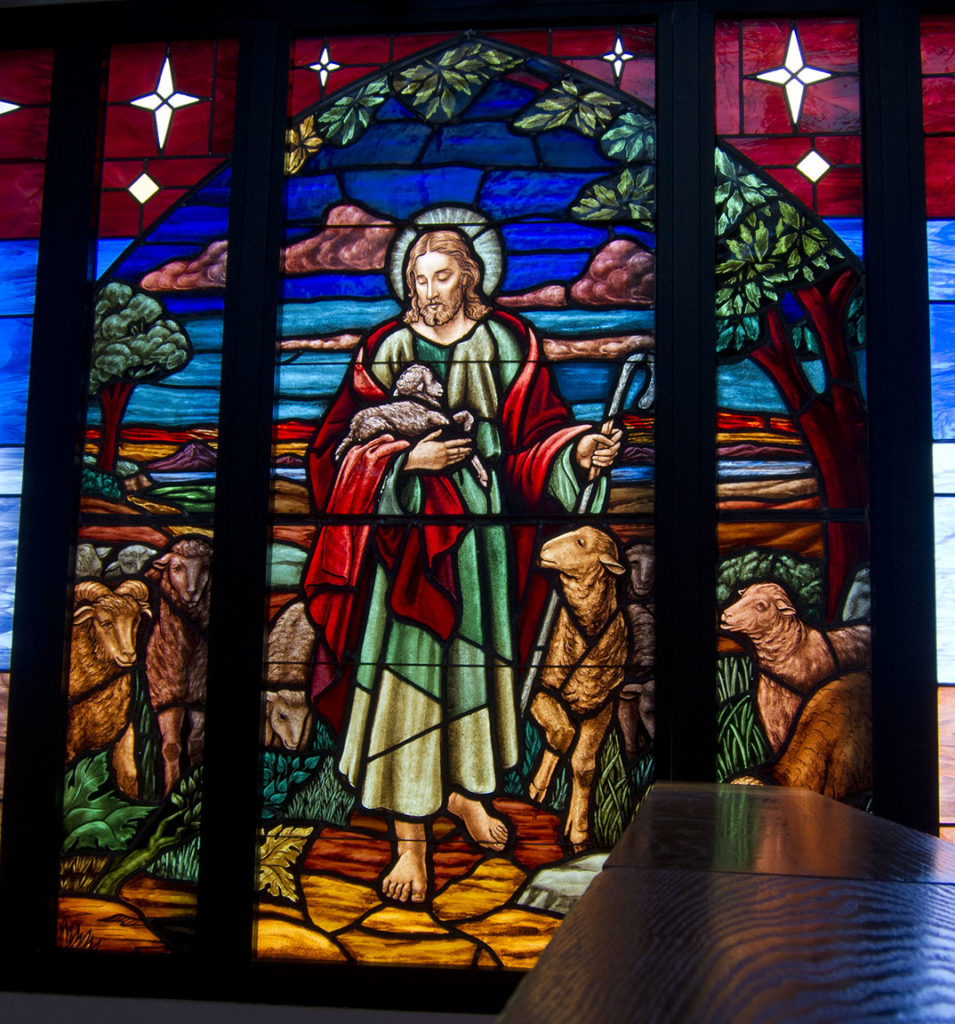
Good Shepherd window, Grace Lutheran, Rialto

Good Shepherd window, Grace Lutheran, Rialto


This sermon is from Pastor Eric Kaelberer of Grace Lutheran in Rialto, who graciously stepped in when I could not make it to church. Then following below is the sermon I had prepared for the 22nd, but did not preach. God’s blessings and thanks so much for your prayers! Pastor and Krika and Turner, whom, God willing, will be baptized on November 12th.

Beloved of the Lord, Happy Birthday! I guess we’ll hear that again next Sunday as we celebrate the Reformation. But as you did a few years ago when Kelly Nava gave birth to Zoe, every time a pastor’s wife gives birth, the baby holds a special place in the hearts of the congregation. My own bride, my Kawai is sitting in the pew with me this morning, rejoicing with all of you, anticipating with all of you, praying with all of you that Krika, your beloved Pastor’s dear bride will be safe and that their dear son will be safely delivered and be healthy.

I’ll let you in on a little secret: Every time there is a birth in the church, the pastor and his wife rejoice, for that child of yours becomes theirs as well. I guess that is the true meaning that we are brothers and sisters in Christ! What a miracle, what a blessing. You belong to me, and I to you. We weep with those who weep and we rejoice with those who rejoice. Yes, today my wife and I celebrate with you and with Krika and your dear pastor as we sing and celebrate the birth of this fine little boy… we say it as we commend ourselves and this dear family into His care… Happy Birthday Good Shepherd, Happy Birthday!

That brings us to our texts. Did you catch the Introit? It is from that blessed 121st Psalm:
The Lord is your | keeper;*
  the Lord is your shade on your | right hand.
I lift up my eyes | to the hills.*
  From where does my | help come?
My help comes | from the Lord,*
  who made | heaven and earth.
He will not let your | foot be moved;*
  He who keeps you will not | slumber.
Behold, He who keeps | Israel*
  will neither slum- | ber nor sleep.
The Lord will keep you from all | evil;*
  He will | keep your life.
The Lord will keep your going out and your | coming in*
  from this time forth and for- | evermore.
Glory be to the Father and | to the Son*
  and to the Holy | Spirit;
as it was in the be- | ginning,*
  is now, and will be forever. | Amen
The Lord is your | keeper;*
  the Lord is your shade on your | right hand

It is one of those great Psalms of Ascents, the songs that pilgrims sang as they turned the corner and got their first real look at the City on the Hill, to Jerusalem. They knew that Salvation came from those hills. What they may not have realized when the Psalm was first sung is that on the hills just outside the gates of the city, the hill called Golgotha, that He who watches over Israel, the never slumbering, never sleeping one, the One who keeps you from all evil, that is, who forgives all sins, that is ALL sins, the one who keeps your life… for eternity…

He went to Golgotha to pay the full price for your redemption.

He has you. He has Krika and that beautiful baby. Going out and coming in. That is the movement. Did you catch it, beloved, the first motion is the going out, then the coming back in. For the pilgrims coming to Jerusalem for the first time this was particularly important. Though they may never have seen the Temple, with all its gold and fine linen, its woven wool and acacia wood, they knew they were already in the Ark of the Church, they were already in the womb, if you will, of God’s grace. He is our Good Shepherd who keeps us safely in the sheep pen, where He causes us to be found in Him. It is all His doing and it is glorious – thus we can say, “Soli Deo Gloria!”

This Good Shepherd is keeping this Good Shepherd Lutheran Church – He is keeping you, as surely as He is keeping Pastor and Krika, and their dear gift from God, their new son. Thus, the pilgrim coming to Jerusalem, seeing it for the first time from afar already knows that He is safely in the ark of the Church, that Heaven is his home, all because God the Redeemer was to make their Cross His home. We are home. Today we are “in” already. Thus, shortly, after we finish our Fine Meal of the Supper of the Lord, after we finish the coffee and cookies and the Bible Class, we will “GO OUT.” We are home and we will go out. Then, next Sunday, we will “come in” again – we will return home.

But wait! There’s more. He never leaves us, never forsakes us (Hebrews 13:5), He has inscribed us on the palms of His hands (Isaiah 49:16), we are His, for surely He has called us by name! (Isaiah 43:1) He holds us close, as close as a nursing mother and even closer than that! Wherever we find ourselves, He is there, ready to forgive, to heal, to enlighten, to lead, to keep you, ye, from the scorching heat of the day, and yes, the dark cold of the night! He keeps your going out and your coming in from this time and even forevermore.

As the new Stirdivant baby comes out, he will be kept. As He is home here for his baptism, He will know that the Lord has him, from that time forth and even forevermore. Oh, how strong are the promises of our God, How strong is His Cross to save, how strong is our Good Shepherd, who reminds us that we shall never want.

Oh, Pastor and Krika’s son is a sinner, saved by Grace, even as we all are. He will know the depth of his sin and weep over it. He will know the sweetness you all know as you kneel here to receive the pronouncement of God’s grace for you, literally in your mouth as you receive Christ, the full payment for all your sins, as you eat His true body and drink of His true blood, all for your forgiveness, healing and peace. To know what it means to be His own… what a gift… what a God!

Now I would be remiss if I didn’t at least touch on the Gospel. It is Holy Week, Jesus is just hours away from what is surely your cross and mine, the full payment for all sin, for all time! The Pharisees want to entrap Him, to ensnare Him in His own words, and so, like master politicians they set the trap regarding taxes and Caesar.

But unlike a politician, He answers not with the answer that will garner the most votes, as with the Tennessee politician at the time just before Prohibition (tell the story) .. He does not obfuscate, like, or deceive to curry momentary favor. He will leave that to the devil, the world, and our sinful flesh. No, He will answer their question with His gift of life and death on the Cross. He will render unto Caesar the things that are Caesar’s – in a word, full payment of the tax for living, and He will render God the full payment, the tax to cover death.

Jesus came into this world because of the tax, not of Caesar Augustus, you know the one when Quirinius was governor of Syria, where each went to their home country to be taxed, where Mary, the espoused wife of Joseph went with him to Bethlehem, the City of David, for they were both of this house. Jesus came to Bethlehem because of the heavy tax of sin, and He came to Golgotha some 33 years later because of the heavy tax of sin. He rendered unto Caesar whatever that fool wanted, namely a scapegoat, a payment, and He rendered unto the Father, all that was His, the full payment for all sin, for all people, for all time.

Yes, Krika will bring into this world her firstborn, a son, a sinner, and yes, one who will be as the great Baptismal Hymn by Jaroslav Vijda, “See this Wonder in the Making” –

See this wonder in the making God Himself this child is taking As a lamb safe in His keeping, His to be, awake or sleeping Here we ring a child of nature; Home we take a new-born creature, Now God’s precious son or daughter, Born again by Word and water. (LSB, 593, stanzas 1, 4)

Jesus rendered unto God the things that are God’s – not merely forgiveness of sins as the idea or concept, but the very child of nature now become the new-born creature. You, beloved are safely in the Ark of the Church. He is leading you out and in. He is keeping your beloved Pastor and his dear bride, He is keeping their son, and He is the One who causes us to look up, to see that our redemption, it draweth neigh. We know that our help comes from the Lord. Therefore, this morning I greet you with a blessed and happy Birthday, in the name of Jesus, Amen!

Pastor Eric Kaelberer
Grace Evangelical Lutheran Church
Rialto, California

In today’s Gospel our Lord Jesus speaks a most profound, divine truth when He says: “Give to Caesar what is Caesar’s, and to God what is God’s.” With these words, Jesus makes it abundantly clear that the lifelong duty of every Christian is to faithfully serve our government in whatever righteous demands it might make upon us – yes, including even those mundane things like taxation, civic-service and voting – but more importantly, that we must also faithfully and dutifully serve our Heavenly Father in all He gives us to do so long as we live here in this fallen world and await Christ’s return.

But an honest desire to clarify a citizen’s duties toward God and country wasn’t what started this conversation between Jesus and His opponents, the Pharisees – indeed the whole question of whether or not it was right to pay taxes was nothing more than a ruse that they cooked up in a futile attempt to ensnare Jesus. You see, these enemies of Jesus couldn’t have cared less about this question – nor were they all that interested in how He answered it. The only reason they asked this question at all was because they hoped to destroy our Lord no matter what He said. If He answered, “No, you shouldn’t pay taxes,” then these enemies of His could have had Him arrested as an enemy of the State. But if He answered, “Yes, you must pay taxes to Rome,” they could have turned Him over to the people to be lynched – for there was nothing the Jews hated more than Roman government.

Truth be known, the Pharisees were trying to trap Jesus in His words because they quite simply hated His words. Remember, He’d just finished telling them the Parable of the Wedding Feast, which we heard last week. And when Jesus spoke in that Parable about how the King of the Feast would destroy all who ignored His invitation, everyone knew He was talking about those Pharisees. So, should it come as any surprise that from that moment on they began to lay plans to trap Jesus in His words and find a way to kill Him? For Christ’s words required a change of heart and a change of mind, and the Pharisees weren’t about to do either one! Jesus’ words demanded proper recognition from them that He was the Man of integrity who taught only “the way of God in accordance with the truth” – a way which stripped His enemy’s words of all authority and power and removed the hold they had over others. Believe me when I say they wanted none of that!

And so what we learn from this is that Jesus isn’t really speaking about taxation, but rather about the clash of God’s Word over and against the false words, thoughts and opinions of sinful men. It’s about the false assumption that we fallen human beings make even today – that is, that the pure Word of God cannot endure in today’s world as we know it. But Jesus proclaims to you and to me that faithfulness to the Word and Promise of God isn’t merely an ideal that we can try to see if it’ll work, but instead, His life and peace make up the very substance of our life here in this world as we wait for the Resurrection of all flesh on the Last Day. He’s all we have that we can rely on.

Now when some hear the words of Jesus – and you and I would certainly have to be included in this group from time to time – they may be tempted to say: Well, that all sounds fine and good, but how about when I come up against the real world? We can talk about grace and peace in church all day, but I still have a boss, a neighbor and a husband or wife who will give me no peace! You can talk all you want about generosity and Christian giving, but I’ve got my own problems and my own bills to pay. It always sounds so good, to hear what God says in His Word about marriage, family, gentleness, concern, faith and piety, but there’s not much room in my reality for such things as these! This may have worked in days past or with people who have been Christians all their life, but life is different in today’s real world. We live in a place filled with divorce, anger, temptation, strife, and yes, even physical harm. “Pastor,” you may say, “Life ‘out there’ in the real world very seldom measures up to what I hear you talking about when I’m sitting here in Church.”

Yet, dear friends these thoughts and questions that may be in your mind today are, in fact, the very things Jesus confronts in today’s Gospel. His enemies came to Him and asked: “Is it right to pay taxes to Caesar or not?” But is that question any different from the kinds of questions on the minds of believers today? Haven’t you ever wanted to corner Jesus and ask Him, point blank: “Exactly how far can I take Your words, Lord, when You speak of soaring over clouds while I live stuck in the gutter? Are you speaking about ideal conditions, or do Your words actually have a place here in my reality? You talk all the time about this Kingdom of God, and that’s fine, at least until those who are firmly entrenched in the world hear about it – because they aren’t interested in any competition from You, Your Church, or Your people! You talk about the forgiveness that comes from the Father, and that’s fine, too – at least until I fall into sin again and my guilty conscience starts holding up all my past sins against me. You talk about how Your Church is holy, pure and blameless, but all I see is a bunch of poor, miserable sinners huddling together for a while on a Sunday morning – then leaving – by themselves – to brave the storms of this world all over again. Just how far can I take Your words, Lord?”

Dear Saints of God, what you need to know and remember is that our Lord Jesus isn’t some ivory-towered professor who shrouds Himself in abstract theories and potentialities. He isn’t some mountaintop guru who spends all His time telling you how things ought to be, and could be, if you’d only get your act together and be more obedient. No! Jesus’ only desire is to speak to you about the way things really are. And when He speaks His words to you, you need to know that these words will not fail you or let you down – even though admittedly they oftentimes appear to be colliding with – and sometimes even seem to be destroyed by – the awesome forces of this world and the sad realities of life. Everybody wants rules for self-improvement. Jesus instead kills sinners and raises up from their dry bones His own dear children.

The Pharisees, you see, came to Jesus asking their question, in the hopes that it would set up an impossible situation in which Christ’s Word couldn’t possibly prevail. “Is it right to pay taxes to Caesar or not,” they asked. What they didn’t know is that our Lord Jesus always remains above intimidation by whatever so-called “impossible” situations life might try to throw at Him. So He answered them, saying: “Give to Caesar what is Caesar’s and to God what is God’s.” With those words, Jesus not only answered their question about taxation, but He also spoke – and He speaks to you now – the reality by which you and I live in this real world. And the reality is this: Christ and His Word are not separate from you. He not aloof and ideal, nor a God who is far away out there. Rather, Christ and His Word have come to you – and made His life your life now and forever.

“Give to Caesar what is Caesar’s and to God what is God’s.” With these words, our Lord Jesus was really describing the whole of our Christian life – and the fact that our allegiance to one facet of that life need not collide with any other allegiance we might have. According to Holy Scripture we owe to the world the things which are of this world, for naked we were born and naked we shall die. From dust we came, and to dust we shall one day return. If the government should ever require of us every earthly possession, what Jesus is saying is that even that would not be too great a price for us to pay. It would be a huge injustice, but none was a greater injustice than killing the perfect Son of God on a cross. Luther once said: “If someone takes my clothing, my life, my property, or obstructs me in this way or that, so be it. As long as I cling to Christ I have nothing to fear.” Or again, to quote Luther’s most famous hymn: “And take they our life, goods, fame, child, and wife. Though these all be gone, our victory has been won. The kingdom ours remaineth.” Caesar – that is, the government – can only lay claim to things temporal. Our brothers and sisters in the Lutheran Churches of Siberia or of Haiti or Southern Sudan can back me up on this one. The Word of the crucified Christ remains, and is powerful to grant endurance and strength in every struggle here in the real world – in every so-called “impossible situation” created by the evil hearts of men.

Caesars of all stripes will come and go, but the Word of the Lord stands forever. That Word has imparted to you many great gifts, my dear brothers and sisters – gifts unseen except by the eye of faith, but real gifts nevertheless. These have come about – and have been delivered into your hand – by our Lord’s refusal to remain separate from you and your situation – and by His willingness to take your life into His own body, which was then sacrificed on the cross for us all. And these unseen gifts which flow to you from this cross – forgiveness of sins, life and salvation – are indeed and really yours. So you see, There’s really no clash between your life of faith and your life in this world, for the life of faith is most certainly lived out here in the world. There’s no impossible situation which can be devised that our Lord hasn’t already overcome by His death and resurrection. And His promise to you is that His Word will always remain and be there to strengthen and guide you through the ministry of His Church – as it comes to you in water, Word, bread and wine – no matter what daily life may demand.

In the Name of the Father and of the ✝ Son and of the Holy Spirit.

Sermon for the Nineteenth Sunday after Pentecost: October 15, 2017

Rev’d Mark B. Stirdivant, Good Shepherd Lutheran Church, Yucaipa, California
✝ sdg ✝

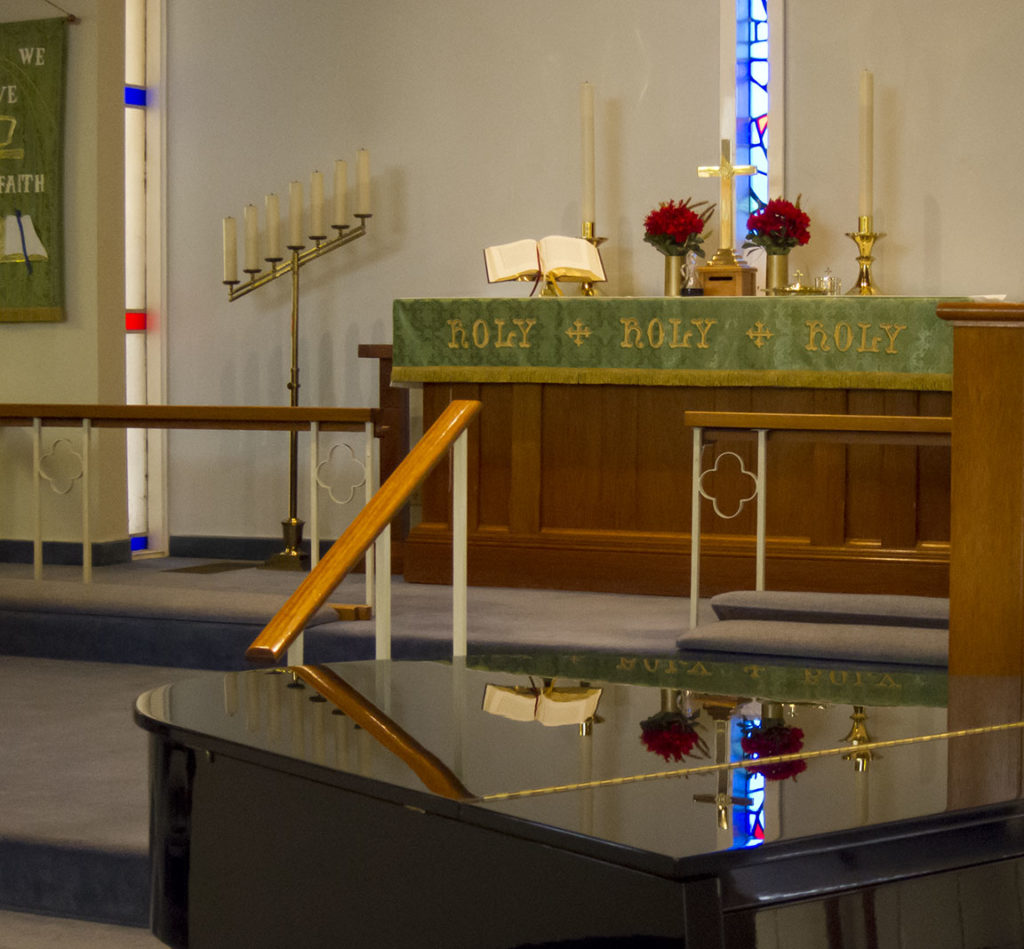
Altar reflected on piano

Altar reflected on piano


Did you know that God loves planning a wedding? He is probably the only Father who doesn’t dread the expense that looms on the horizon. He doesn’t roll his eyes when He looks at the ever-increasing guest list. In fact, a wedding was the first thing God had arranged, right after He created man and woman. Our Lord is THE specialist in setting up a relationship that is based on unconditional love, without a hint of fear, and with no requirement of paying Him back. No reality TV show producer comes close. God is most pleased when a man obeys His divine command and leaves father and mother to be joined to his wife. Such an activity proclaims to the world that the Son of God, true God and true Man, wants to join Himself to us in an eternal spiritual marriage. Such an invitation is precious, and ever since the world fell into sin, the invitation has gotten all the more valuable, because now the alternative to the heavenly wedding is everlasting punishment, you know, the weeping and gnashing of teeth. It is a totally free invitation to the Lord’s wedding, and it would be ludicrous to turn Him down.

The prophet Isaiah sings about this wedding feast that the Almighty Lord is putting on: the rich food, the well-aged wine. Nothing will be left out. It is truly going to be perfect. It is set on scenic Mount Zion, which is a favorite Old Testament symbol for the dwelling of God with men, and it is a fitting description that the Old Testament prophets have of the Christian Church, which for them was still to come. This banquet is not an empty symbol, it doesn’t merely stand for some future, heavenly happiness, but it also describes the gift you have standing before you this day in the worship service. Not only is this a wedding banquet, but a royal wedding banquet, and that if you’re invited to this event, you have just been given the highest honor that you’ll ever receive. And if you ever get to read through the whole Bible, you’ll find that it is all about this royal wedding banquet, about all the invitations that went out, the many and repeated rejection of those invitations, then the invitations were given to other people, and finally what will happen once the Royal Host of the wedding finally visits face-to-face with His guests. So Jesus, in telling this parable, is actually giving you the entire history of the world, from God’s point-of-view, in the form of a little story.

So, since this parable is a summary of the world’s history, where do you and I fit in to it? Now, the first invitation already went out: Adam and Eve were given the promise of a Savior immediately after they fell into sin. Many other generations after them received the same invite anew. The dinner has already been prepared, the animals have been slaughtered and everything is ready: this refers to the sacrifice of Jesus on the cross and His resurrection. Plainly speaking, the way of salvation is complete, otherwise Jesus wouldn’t have said “It is finished,” while He was hanging there on the cursed tree of Mount Calvary. Those who were invited first and rejected Him have already been demolished, meaning the old Jewish way of Temple sacrifice and the many detailed preparations for the Messiah are over. You can therefore find yourself in the final invitation: where the King’s servants went out to the roads all over the world to gather all people, good and bad, so that the wedding hall of the Church would be filled with guests.

I can understand if this identification hurts your pride a little bit. No one wants to take an invitation merely out of charity. If you weren’t first on the list, then it’s a slap in the face, even if there’s free food. At first glance, it looks from this story at least like you were God’s second-thought guests. Like it was all by chance that you ever came to faith and received the forgiveness of all your sins. Just so you know, that is all cleared up in other parts of the Bible that speak of your eternal election, that your heavenly Father had it in mind from before creation to save you and make you His own. What is emphasized here, though, is that those guests who were last invited, they relied totally on the generosity of the Host. That you can identify with. In the exact same way, you had nothing about you that made you worthy to receive the Gospel invitation; it was all by grace that you got in to the banquet of the Lord’s salvation.

But remember from this Gospel parable, getting in the door is not where it ends. There is a wedding garment to put on; house rules. Mind you, this is not something those guests needed before they arrived. They were fresh off the street. The wedding garments were handed out as the guests walked in. These clothes meant something very important. They were a sign that the guests belonged inside; a sign that the Master of the banquet had done everything to make it possible for them to attend the banquet. If they refused these garments, they would be no different from the other guests who had outright refused the earlier invitation. Which also means that they would suffer a similar retribution of destruction, complete with weeping and gnashing of teeth.

For each and every one of you, your heavenly Father has set aside a wedding garment for you to wear. It is the pure white gown of Christ’s perfect righteousness that clothed you when you were baptized. Though you were completely soiled in sin ever since your conception within your mother’s womb, it doesn’t matter anymore to God. He has washed away your sin completely and you are clean. You are presented to the Lord in radiant white wedding clothes that you did not earn or work for, but were given to you by God’s free grace, which is the main reason why many families pass along a baptismal gown from one generation to the next as a family heirloom. Since you are dressed in the forgiveness of all your sins, which was paid for by the Blood of Jesus Christ, you are most certainly welcome to your heavenly Father’s wedding banquet.

And yet, for the rest of your life you will face the constant temptation to throw this all away. You remain a sinner, and sinners reject the Lord and insist on their own way. They want to be independent from God; a sinner often falls for the alluring, but empty promises of the devil. Like others before you who rejected the Master’s invitation and one preferred to tend to his farm, another to his business, the pattern continues today: one to believe it’s more important to watch the football game, one to take the weekend off to relax, and another, she may be worried about what she’ll see in their next retirement fund or social security statement. All sinners, that is, all human beings, face these opportunities to gratify their sinful flesh. But for you, your Lord offers to strengthen you through these temptations and take away your sin, clothing you over and over again in the perfect wedding garment that you inherited when you were baptized.

And yes, there will be some, some even within the Church itself, who will continually refuse to receive this forgiveness. There are those who will insist on their own way of trusting in themselves rather than in Christ and what His Holy Word clearly says. A few will listen only so far as they agree with what the Lord has to say. In fact, God has promised that there will be such guests appearing for a time at the banquet. You might recall a similarity between this parable and the story Jesus tells about the weeds that grow in the field of wheat. False Christians will indeed look very good to others in this world, they may even stand as religious examples. Unless they make a clear denial of the faith in word or in action, you would probably never realize it.

But the Lord, the Master of the Banquet Himself, He will know when He personally appears to meet with His guests who heard His generous invitation and got inside. This refers to what will happen at the Last Judgment following the resurrection of everyone who has ever died. Then, all people, good and bad, will appear before His throne. Those who wish to continue independent of the Lord and refuse His forgiveness, will be instantly ushered out of the banquet hall and into utter darkness, where there will be weeping and gnashing of teeth. That is no symbol either, that is chillingly literal. But those wearing the wedding garment of Christ’s righteousness, even though they did not deserve it, they will dine at the never ending feast, and forever enjoy the presence of God in heaven.

That baptismal wedding garment is still available to you. Repent of your sin, including your worries and concerns. Believe that as the called and ordained servant of the Word speaks it, you have actually received full forgiveness; then extend that forgiveness within the context of your particular vocation, and forgive those who sin against you with the same Divine power that God gives to the pastor in his vocation. Believe that the heavenly banquet is here laid before you on the Altar, only for now it is hidden under bread and wine that truly is the Body and Blood of Christ, just as He says. You are worthy of this feast because Christ Your Savior bestowed His perfect worthiness upon You by faith. Be assured that your heavenly Father loves to put on His Son’s wedding feast to end all wedding feasts, sparing no expense, and that He and the myriad host of angels rejoice to know that they will one day also welcome you in face-to-face.

In the Name of the Father and of the ✝ Son and of the Holy Spirit.
Pastor Stirdivant’s Postil Oct 2017

There is a notable holiday in the Church Year calendar that gives us an opportunity to give thanks to the Lord for a unique disciple of Paul the Apostle and an inspired teacher of our church, the Evangelist Saint Luke. His designated feast day, October 18, is perhaps, like Holy Cross Day (September 14), the date of dedication of a church that was named in his honor.

Luke wrote two large books of the New Testament, together comprising over a fourth of its content, and those are actually two volumes of one work, referred to as Luke-Acts. He wrote an introduction, or prologue, to both of them (see Luke 1:1-4 and Acts 1:1-3) and addressed it to a Christian named Theophilus. The theory about this unknown man is that he had been already taught about Jesus and baptized, but he requested Luke to present a clearer and more orderly account of our Lord and His mission from beginning to end. Theophilus could possibly have also helped finance the major project, which in terms of our money today, might have cost over $10,000 to produce a single copy of each book!

Codex Sinaiticaus Luke 1 "soi grapsai, kratiste theophile, ina epignos peri hon katechethes logon ten ...

Codex Sinaiticaus Luke 1 “soi grapsai, kratiste theophile, ina epignos peri hon katechethes logon ten …


Codex Sinaiticus, Acts 1 "ton men proton logon epoiesamen peri panton, ho theophile, hon...

Codex Sinaiticus, Acts 1 “ton men proton logon epoiesamen peri panton, ho theophile, hon…


Luke probably grew up a Gentile, living not far from the Apostle Paul’s hometown of Tarsus, near the border of Syria and Turkey. When Paul received the vision and call from the Lord to begin proclaiming the Gospel in Europe, Luke joined him as he sailed for Philippi. This is clearly indicated in the book of Acts when all of a sudden the narrator changes pronouns from “he” to “we.” (See Acts 16:10) It seems that Luke stayed in Philippi as the brand-new church there was getting started, but then rejoined Paul as the Apostle traveled back to Jerusalem, bearing an offering that he had collected to relieve the struggling poor Christians in that city. It’s likely that while he was staying with Paul during his imprisonment, Luke collected writings and interviewed eyewitnesses that gave him the material he needed to write the unique Gospel stories that his book includes.
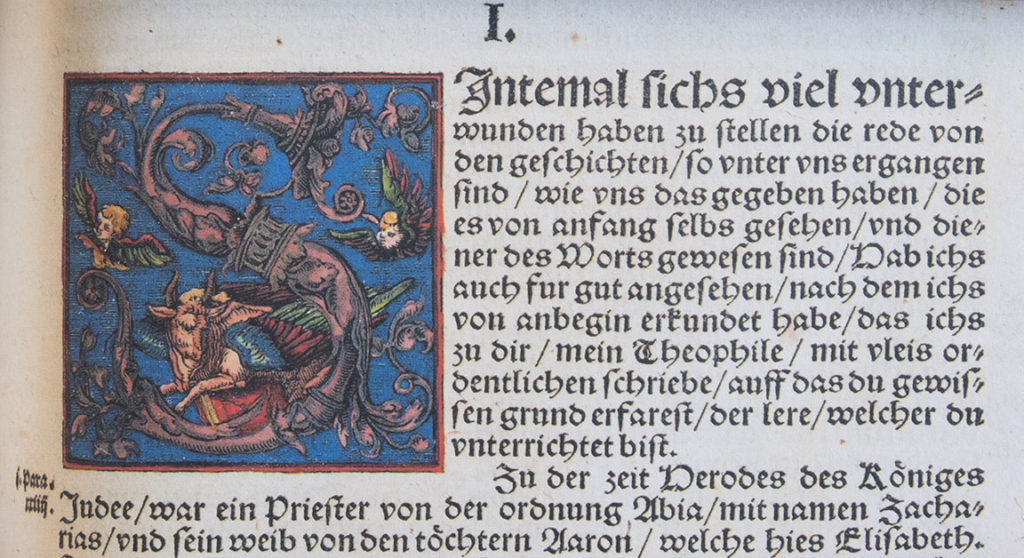
Luther Bible, Luke 1

Luther Bible, Luke 1


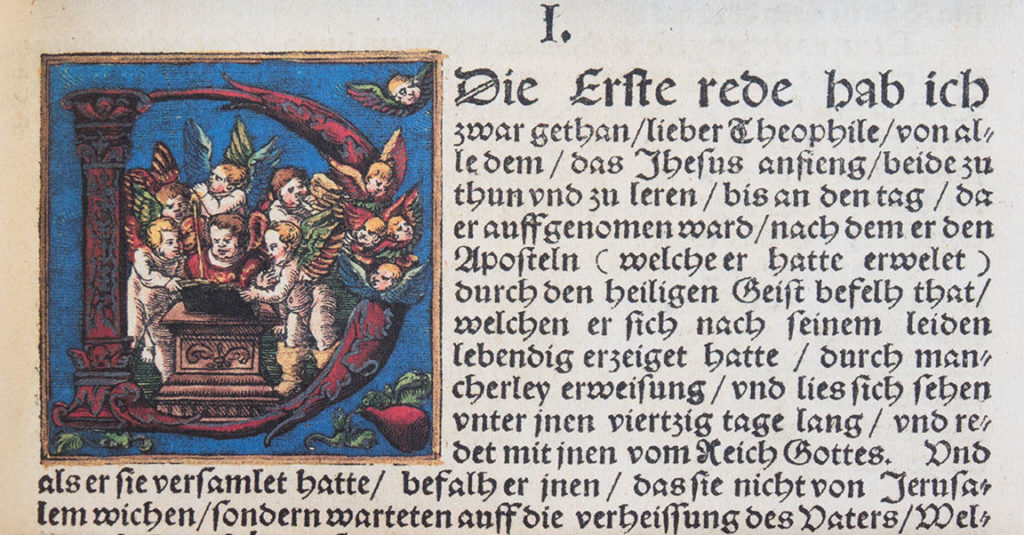
Luther Bible, Acts 1

Luther Bible, Acts 1


Luke has included in his narrative lots of unique events, for instance, the birth of John the Baptist, the angels singing to the shepherds, the Baby Jesus in a manger, the boy Jesus teaching the teachers in the Temple. He repeats the well-known parables of the Good Samaritan, the prodigal son, and the story of the different prayers of the Pharisee and the publican (or tax collector; the one who said, “God be merciful to me, a sinner!” Luke 18:13). The Biblical songs or canticles found in the Gospel of Luke are Magnificat (Mary’s Song, “My soul magnifies the Lord…”), the Benedictus (Zechariah’s Song, “Blessed be the Lord, God of Israel…”), and the Nunc Dimittis (Simeon’s Song, “Lord, now lettest Thou Thy servant depart in peace…”).

Luke was a physician and well-trained in the Greek language. It was thought that he used specifically medical terms when describing diseases or Jesus’ sweating blood in Gethsemane, but it has been more recently discovered that those words were widely used in Greek literature, more so than just among physicians. He wrote (with the guidance of the Holy Spirit, of course) for the benefit of Gentiles who might not have been aware of Jewish ceremonial requirements or have an extensive background in Old Testament history. Church legend also claims Luke was an artist or painter. Each of the Four Evangelists has been associated with a “living creature” symbol, which are borrowed from the vision that originated from Ezekiel 1. Luke’s symbol is the ox or calf, and it is sometimes depicted with wings. The other symbols are the angelic man (Matthew), the Lion (Mark), and the Eagle (John).

The Ox, Luther Bible

The Ox, Luther Bible


God bless your observance of this unique gift to the church, the Gospel-writer or Evangelist Saint Luke!

Yours, in Christ’s service,

Pastor Stirdivant

Mt. Rubidoux

Mt. Rubidoux

Sermon for the Eighteenth Sunday after Pentecost: October 8, 2017

Rev’d Mark B. Stirdivant, Good Shepherd Lutheran Church, Yucaipa, California
✝ sdg ✝

Cross and blue sky.

Cross and blue sky.


Whenever a prophet comes on the scene, it means that it is a critical time for God’s people. It is a critical time because that prophet’s message is basically this: “God’s judgment is just around the corner, and time is running out for you to repent and turn back to Him.” It is not a happy message. Rather, it is dark and foreboding and it stings you with the fear of the Lord. Its weight is meant to crush you so that there is nothing left for you to claim. If you had happened to live during the time of one of God’s prophets, he would usually tell you that God is about to punish His chosen people for turning away from Him. There is no comforting word that ever comes from the mouth of a prophet until God’s people have heard that harsh message: stop your sinning! They don’t preach the Good News of God’s mercy until the Law has cut the hearers’ hearts in pieces and condemns them for the sinners that they really are.

Isaiah certainly had that message for the people who lived in and around Jerusalem over 700 years before Christ. Like in Jesus’ parable, he said that they were God’s vineyard, which He had planted with care. This vineyard was as perfect as the Garden of Eden in His sight. And yet these people were bad vines: instead of good, ripe, sweet grapes perfect for wine, they produced wild grapes—the bitter kind that do nothing but set your teeth on edge. They did violence to God’s Name by worshiping other gods that they themselves have made up. They rejected the righteousness that God gives, turned their noses up at the help the Holy Spirit gives to live a holy life, and they preferred shedding the blood of God’s prophets instead. And so here is God’s Word for this critical time in the history of Israel—you will soon be destroyed. A foreign army will cut you down and trample you underfoot. If you don’t end up killed then you will be deported with almost no chance of ever coming back again. Your carefully watered and fertilized land will soon become dry, weedy, thorny wasteland. This is none other than God’s judgment and you will not escape it. That was what Isaiah had to preach.

Obviously, no one in the Old Testament would have liked to be a prophet. Their message is never easy to proclaim. Moses had pleaded with the Lord, using one excuse after another and then finally saying, “Please send someone else!” before he actually went to Egypt in obedience to God’s command. Jeremiah complained that he was only a child and that he didn’t know how to speak in front of God’s people as a prophet. One man after another is thrown into the task of going to sinners and telling them that the time of God’s judgment is near.

But not only is proclaiming the message a difficult task for a prophet to do, the response to that message usually makes it even worse. People with itching ears who want to hear only what sounds good have a real problem with hearing about their sin. Deep down, whether you realize it or not, you also don’t want to be stung with the fear of the Lord. For that would mean that you have failed, that you are not better than those other “hypocrites” and “sinners” whom you know. That would mean that the good things you do contribute nothing to your standing before God. To hear and believe God’s Word spoken by His prophet is nothing more than giving up on helping yourself and trusting in Christ instead to save you. Nobody is ever ready for a prophet’s harsh message, and some may even try their hardest to keep that message quiet.

And so, prophets will be persecuted for the sake of God’s Word. According to a tradition that is outside the Bible, Isaiah was said to be murdered by being sawn into two pieces, as mentioned in Hebrews 11:37 but without saying who that was. God sends one servant after another into His vineyard, and the workers continue to beat, kill and stone them. But not only did God not stop sending preachers at crucial times pleading with His people to repent, He then sent Jesus! His death, and the deaths of every prophet who preached before Him, these deaths were none other than the Lord’s doing. Every time we remember it, it is marvelous in our eyes. Isaiah himself says about Jesus: “It was the will of the Lord to crush Him.” (Is. 53) As it happened to the prophets, so it also happened to Jesus.

For our Lord, just like the prophets, appeared at a critical time, too. According to God the Father’s own design, just like in the parable, He sent His Son. The message Jesus preached sounded like that of the prophets through whom He preached in time past. He also preached that God’s judgment was right around the corner. And yet here was the difference: God’s final, once-for-all judgment was not going to fall on His sinful people, but instead it would destroy Jesus as He stood in their place. With His crucifixion only days away, Jesus spoke with urgency in His voice to call sinners to repent of their own ways, to stop sinning, and instead trust in Him to take away their sins. He wanted them to give up on trying to please God by their own good deeds and instead receive His free forgiveness and absolution. It was truly a critical time for God’s people—it was indeed the fullness of time. For God made Him who had no sin to be sin for us, so that He would get the punishment and we would have God’s righteousness and good favor.

Fellow citizens of heaven, this is a critical time for you! God’s judgment is right around the corner, and time is of the essence. The day of God’s final verdict is at hand. All those other times when God handed out punishment, those were really the first installments of the great Last Day, the Second Coming of Christ that will soon be here. I tell you now, be ready for that day! Stop your sinful thoughts, words and deeds that test the patience of your heavenly Father. God’s punishment is still very real and we have every reason to fear His wrath. Why? Because it is all too easy to reject God’s Word. It is all too easy for you to say, “I know all this stuff already.” But do you believe it? Can you defend it if someone challenges you? All who refuse to believe in Jesus for the forgiveness of sins will be deported to the permanent punishment and damnation in the everlasting fire of hell. This would have been your future were it not for Jesus, who took your place and He already suffered hell for you.

So if you are crushed under the weight of your own sin and you realize that there is nothing within you that pleases God, then the sight of Jesus despised and rejected, hanging on the cross—this is the Lord’s doing, and it is marvelous in your eyes. Your sins are all paid for, and your guilt is taken away. The coming day of God’s judgment is a day when you will finally see your Lord face-to-face and He will welcome you with open arms.

Though you were torn down and destroyed by the law and God’s condemnation, you are now replanted as a new vineyard by the Gospel. You are an heir of eternal life, a citizen of heaven. You as a fruitful branch are connected to Jesus the true Vine, and He uses you to bear good fruit in His vineyard, the Church. The very body and blood of Christ feeds you and waters you, and you are grafted into Him. Jesus has planted you Himself and you are the vineyard of His good pleasure. He gives you His Holy Spirit, so that by His power working in you, you can then, instead of sinning, serve others whom God has put in your path and so bring glory to Him. You had no ability within you to do good things, but it is Jesus and His Holy Spirit within you that bears the good fruit, in whatever responsibility in life or calling that God has given you.

Hear God’s Word from the mouth of His holy prophets and receive what it gives. God’s judgment is right around the corner—so do not reject His message. Recall Isaiah’s words about the vineyard of the Lord. Believe in Jesus Christ, His Son, who was sent to tear you down and destroy your sinful pride and replant you as His own vineyard, a Garden in which He delights. For the Son who was sent to the vineyard and killed—He is no longer dead. That is the happy Easter message, your punishment is gone. And joined with Christ, you too shall rise from the dead to be with Him on that last judgment day. Until that time you have your Lord and Savior here in front of your very eyes, giving you His life-giving body and blood and proclaiming forgiveness to you. You are the vineyard of the Lord, and He has promised to take care of you until the great harvest day.

In the Name of the Father and of the ✝ Son and of the Holy Spirit.

Sermon for the Seventeenth Sunday after Pentecost: October 1, 2017

Rev’d Mark B. Stirdivant, Good Shepherd Lutheran Church, Yucaipa, California
✝ sdg ✝

Office of the Keys, window at Christ the King Church, Redlands

Office of the Keys, window at Christ the King Church, Redlands

Jesus told the parable of a father talking to his sons. He said to the two of them, Go and do your work. To our ears that means a command from God our heavenly Father in His Law that says to us, Go and follow my commandments. Go, believe in me, which are commandments one through three, and love your neighbor, four through ten. There’s more detail about that in your catechism. Everybody receives this Father’s command because everybody is created in the image of God and our Lord never wanted anyone to be lost but for all to believe the Gospel, and be saved. It doesn’t matter whether you were part of the Jewish nation, God’s original people and children of Abraham, even if you’re a member of the Lutheran church since birth, or whether you have just heard His Word for the first time today. The Father simply says Go. The different responses of the sons tell us a lot about what is on our hearts and minds and how we approach our God and His holy command.

That first son really annoys us, doesn’t he? This disrespectful child spouts off with, “I will not do what you say!” Very defiant, very difficult to deal with. It’s easy to see this son’s attitude at home or in school or at work or on the highway and hey, we’re trying to drive here! Our wrath rises along with the hair on the back of our necks against those who are like this first son. What a disobedient, spoiled child, to refuse God’s holy Word like that! How shameful. Surely, he needs to be punished by parents, given detention in school, fired by the boss, or sent to jail by the police. Yeah, he goes back and does the work after all, but how can you depend on hypocrisy like that?

The second son says, “I go, sir.” Oh, now there’s a response that will make a parent proud, a teacher thankful, a boss pleased, and a nation grateful. We have here a law-abiding citizen and member of the church promising to be obedient. Just take a look at those two sons. One is a disgrace while the other is an up-standing example to us all.

But then you consider the second son a little more closely, the one whose mouth speaks obedience. The father calls him and says, “Son, go and work in the vineyard today.” The second son replies, “I go, sir,” but did not go. Who might this son be like?… Think of the little child who says “I’ll get ready, Mom”, the friend or family member or coworker who made a commitment to you, and then dropped the ball, some emergency came up or they outright refused to come through for you. Maybe you did that to someone else. Pastors, US Presidents, farmers, doctors and delivery drivers have all done this, said they’d do it and they didn’t. That’s not so good after all. Actions need to follow our words, and we have all failed.

But you know what? There is a third son! Yes, there were two in the story, but the third Son is the One Who is telling the story, the One speaking the Word, that is Jesus, of course. He’s the third Son, who is at the same time similar to and vastly different from each of the first two sons. From eternity the Father said to Him, “Son, go and work in My vineyard today.” Christ the Son of God said obediently, “I will go,” and He went and did exactly, completely and perfectly what His Father wanted Him to do!

He kept His own holy Law for the world and for you. He atoned for all the sins of the world and that includes all of your sins. He poured Himself out for the life of the world and for you, even as he cried out to the world and to His Father Who sent Him, “It is finished” (John 19:30) and to the One Who said to Him, “Go”, Jesus said, “Father, into Your hands I commit My Spirit” (Luke 23:46). On the cross He defeated this world’s deceiver for you. He humbled Himself to the point of death, even death on a cross. And the Father glorified Him when He rose from the dead. Actions perfectly followed promises, and He has saved all humanity.

Because He had said it would be so, the Counselor would come, that is, He would send the Holy Spirit to convict the world of sin, to inspire the apostles and evangelists to write down the very Word of God, and to work repentance in every believer. The Spirit causes the inscription of the Words of Jesus, the Son of God, in the Bible and in your heart. What do these Words of Jesus do in your Christian life? Well, something like this …

‘Son, go and work in the vineyard today.’ And he answered, ‘I will not’; but afterward he repented and went. Yes, just like that first son, that terrible, rotten sinner whom we thought was no good. That person couldn’t possibly be a good enough Christian. He is told to come into the vineyard to work and he replies that he will not. But then, afterward, he repented and went into the vineyard. What an amazing transformation! It’s an about-face. Even though he said he would not, he had a change of mind, which is what the word repentance actually means.

Maybe that has happened to you, or one you know, one you thought could never change, that the mess they made with their life could never turn around. Everyone may have given up, but as you found out, God did not give up; He turned their heart in repentance in order to reconcile with God and with other people, perhaps also with you. It may have taken a night or two of terror once the horrible effects of the wayward sinful life had ultimately caught up with them. Whatever God used to bring you or the one you’re thinking of to their knees, He was immediately there to feed the hungry soul and stick that hand out to rescue the one who, like sinking Peter, finally said, “Lord, save me!” And He did! Yes, it is true: the one who was like the first son did commit a sin by saying No, but following the repentance and forgiveness, the Lord Himself led them to be forgiven and restored to the family, eager and equipped to do the Father’s will once he had been set free.

The third Son, Jesus, finished telling His parable and then asks the religious experts a question concerning the other two sons, namely, the first son who said he wouldn’t go and then repented; and the second son who said he would go but didn’t. The question was intended for all within His hearing to ponder personally and to reply all at once, for surely there is but one answer and it is an easy answer. “Which of the two did the will of his father?” They said, “The first.” What other answer could there be? Certainly no other, for Jesus constructed and told the parable in such a way that the answer was clear for everyone who heard His Word that day and this day.

The first was the correct answer. And Jesus then said to the exposed hypocrites, “Truly, I say to you, the tax collectors and the prostitutes go into the Kingdom of God before you. For John came to you in the way of righteousness, and you did not believe him, but the tax collectors and the prostitutes believed him; and even when you saw it, you did not afterward repent and believe him.”

And why is this so? Because, even though those most notorious breakers of God’s Law are by nature sinful and unclean and have sinned against God in thought, word and deed, they have also received the gift of repentance and they look to Christ for forgiveness. Surely, this is why John came, to call people to repentance and this is why Christ came, to call and welcome them into His Kingdom, doing so gladly and with great joy. Their sin, however bad it was, is totally gone, it doesn’t matter anymore, and they have been made pure and holy in God’s sight, just like you.

For those who say they’ll follow God’s commandments, who claim that they have not sinned against Him at all, the Law has not yet done its work on these seemingly upstanding people, so they will hear no Gospel. They are not to the point where they admit that they have not kept the Law. Though they may be truly exemplary in the eyes of the world, Jesus says that without repentance, when they say No to confessing their sin, they are not in the Kingdom of God. They are not yet thirsty for His Living Water.

Still, it is most certainly true that the Lord wants the Good News to be proclaimed to them and they enter the Kingdom of God. For Christ truly wants all, including the hypocritical and stubbornly unrepentant, to hear the words that, after the Law has fully convicted them, these words promise to bring them eternal life and salvation. These words were the promise that the third Son made long ago and came through on it with the actions of His death and resurrection, all of which He has done for you. What are the words that will do all of this for you? They are the words of the Gospel, of course. But what words specifically? Well, you who are in the Kingdom of God know them well and you have heard them in the Absolution, namely, “Dearly beloved, you are forgiven.”

In the Name of the Father and of the ✝ Son and of the Holy Spirit.

Sermon for the Sixteenth Sunday after Pentecost: September 24, 2017

Rev’d Mark B. Stirdivant, Good Shepherd Lutheran Church, Yucaipa, California
✝ sdg ✝

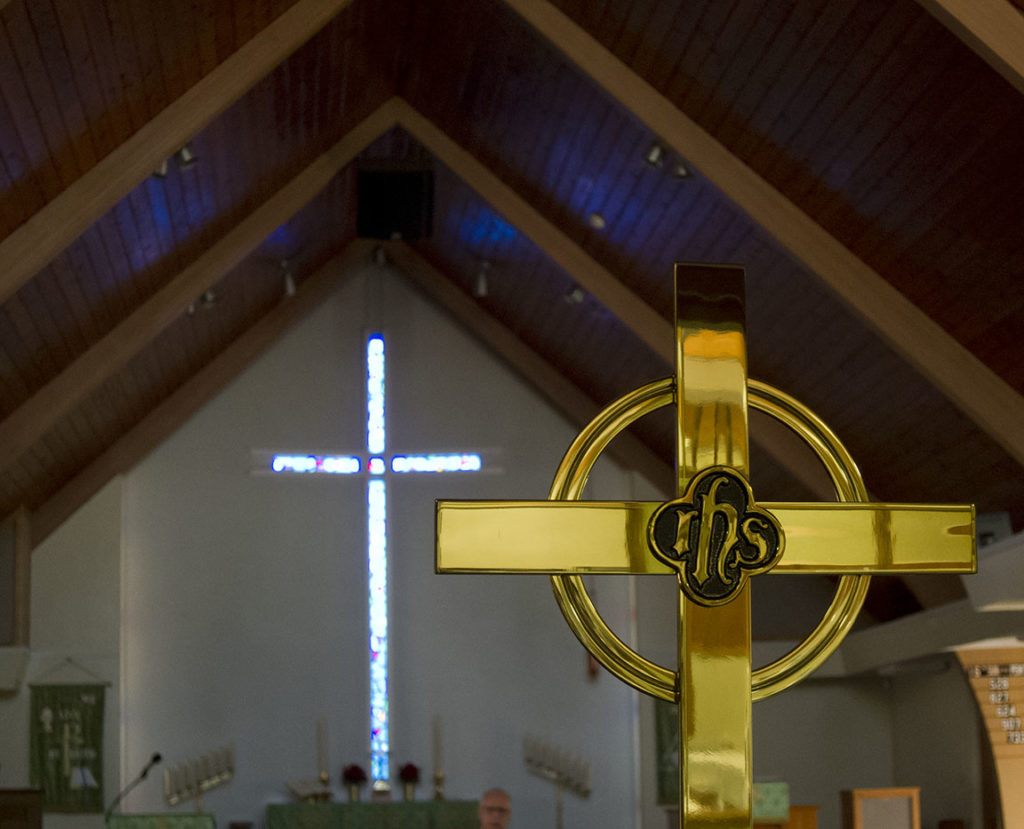
Processional and Stained-Glass Crosses

Processional and Stained-Glass Crosses


Peter had wanted to know what he was going to get out of all this following Jesus. The next two disciples, James and John, also former fishermen, were pushed by their mother to snatch the top two positions in Christ’s kingdom. These disciples were already thinking about their payday—when all this self-sacrifice of theirs would cash in. Have you thought of this, wondering whether you have given up everything; given it all away to those in need; and taken up the Cross that you have set before you to follow Jesus? Whoever loves his life will lose it—And whoever loses his life for my sake will keep it for eternal life. So, it seemed natural that, on behalf of the Apostles, St. Peter would point out that they, all twelve of them, had in fact given up everything to follow Jesus. Peter was wondering what would become of them, and what would they get.

In answer, Jesus promised His disciples that, in the Resurrection, when He would sit on His throne of glory, they would also be enthroned alongside of Him, judging the twelve tribes of Israel. But He would have more to teach them, and you. On the surface, Jesus’ parable teaches that the inheritance of everlasting life is not earned (nor can it be), but it is given and received by the grace of God, and, as such, it is given equally to all of the disciples of Jesus, no matter what their sacrifices and service. When it comes right down to it, the lowliest and least worthy servant of Christ will be made equal to the Holy Apostles and saints, those Christians who labored long and hard, who bore the heat of the day, and who were martyred for their faith. Their glory as Apostles is surely unique, but their inheritance in the Kingdom of God is no more nor less than yours; for it is the wage of His grace.

That is what the Parable teaches. But now, then, what does this mean for you? Well, first of all, some clarifications are in order. The Householder is the Lord, of course. And the vineyard signifies His people: Old Testament Israel to begin with, but also His Church of the New Testament. The workers who are sent into the vineyard, therefore, (as in similar parables,) are first of all the Prophets and Apostles, and the servants of the Word of Christ even to this day; and, further, those workers in the vineyard represent all of the disciples of Jesus Christ, who are called and sent to serve their neighbor within their God-given vocations (not only in the church, but at home, at work, in the community, and so forth).

It should especially be noted that the coin that the workers received—the denarius—was roughly equivalent to a normal day’s wages; it would be like the owner handing out 50- or 100-dollar bills. This so-called “wage” signifies the forgiveness of sins and the inheritance of everlasting life. Clearly, it is not a wage that can ever be earned by any amount of work. Be careful to notice, especially, that even for those first workers in the Parable, they are promised to receive the denarius before they have been hired and before they did any work.

You see, the thing of it is, this Parable is not about coming to faith, but about the good works that come forth in your daily life from your faith. According to the Bible, good works are principally the service rendered by you Christian disciples within many different vocations, and it is in this way that you serve the Lord (in faith) and you serve your neighbors (in love). Thus, the Parable portrays the way in which good works and Christian service follow after God’s grace and gift of faith have already come into your life.

The parable talks about differences in the amount of time that the employees worked, and those differences pertain to the differences that there are between the many and various earthly vocations, labors and obligations of all Christian disciples. As God Himself designed it, these things differ from one person to the next, according to his or her respective talents and abilities, opportunities, and stations in life. The vineyard is thus served in a wide variety of ways, just like the Body of Christ has different parts to it and all of them work together in their respective functions.

It is important to note, that, in spite of the differences that there are in types of service, each and every vocation is still arising from and according to the Word of the Lord. This you can see from the Parable, because each and every worker is called and sent by the Householder. In each case, He says to them, “Go, and work in My vineyard!” That’s what creates the job, you might say.

In that light, the Lord in His holy Law of the Ten Commandments presents you with a probing question straight out of the Parable: Why are you just standing there idle?

It is simply not true that “no one has hired you.” Each and every one of you has been called and sent to some duty of service, which differs from one person to the next, but, nevertheless, God the Householder has said to you, “Go!” What is more, you don’t have to go searching for what you are sent to do, you don’t even have to wait for a special sign from God for Him to speak directly to your heart because His will is clearly set before you in your vocations, whatever they might be, and in the needs of your neighbors, whoever and wherever you might find them. So also do you have set before you the needs of your congregation, which is, of course, very much a part of the vineyard, and there’s simply no excuse for standing idle while there is work to be done. The fact of the matter is, there is an urgent need for workers in this part of God’s vineyard.

Now, at the end of the day, the bottom line is that your sins have been forgiven, and that you are called through faith to receive the inheritance of everlasting life, regardless of how much or how little you have worked, and regardless of how well you have done. You’re going to receive the same paycheck that the Prophets and Apostles of the Lord get, whether you have done much or little. When that payday comes, by the grace of God, all are equal. But in the meantime, here on earth, there are these differences. They are differences in vocation, differences according to the Word and Will of God. Then again, some differences stem from the fact of our sinfulness. There are some who simply do more than others, and some who do little or nothing at all; some may well be lazy and irresponsible (as are we all at times), while others may well become full of sinful pride over their own contributions and resentful of everyone else (and again, we all fall prey to these temptations, too).

This sinful attitude of pride and resentment—such as we see portrayed in those first workers in the Parable—is actually an expression of works righteousness, I must get what I deserve, and I demand recognition before God in heaven. This sinful opinion and false belief sets the individual over and against the Lord God. It is arrogant, demanding, ungrateful, selfish, rude, and quarrelsome. And, sad to say, it is the attitude that all of us possess in our sinful hearts, and which we exercise more often than not in our dealings with God and each other.

Another temptation makes use of reasoning something like this: just as every worker in the Parable gets the same wage, if it doesn’t affect your eternal reward how much you work and serve in God’s vineyard of His kingdom, then Why should any of us work or serve at all? The answer is, emphatically, Not for the sake of earning something more from God. For one thing, what more could you hope to gain than the forgiveness of your sins, eternal life and salvation, all of which are given to you freely, by the grace of God, already? Besides, you cannot earn these things in any case, much less anything beyond these most important gifts and benefits!

But no, you work and serve for two simple reasons: First and foremost, because the Lord has called you—in your vocations—and He has sent you to serve in His vineyard; so you do it for the sake of the Lord. And second, because your neighbors, including your fellow church members and visitors, need your help and service; so you work and serve for the sake of your neighbor, as well. There are no other reasons.

Now, it is not for you, nor anyone else, to pick and choose where and how you ought to be working and serving in the vineyard. That is determined by the call and sending of the Lord, that is to say, by your station in life and your unique vocation. And, as Jesus says elsewhere, even if you were to serve perfectly and faithfully your entire life, you would still have done no more than what it is your duty and responsibility to do as a servant of the Lord. He simply worked in you.

In reality, though, you have not served perfectly and faithfully (no matter how long or how hard you may have worked). No, you have too often served yourself instead of the Lord, instead of serving others for the sake of the Lord. And too often, when you have done your duty outwardly, going through the motions, you have done so with a bitter and resentful heart, or with a prideful and presumptuous heart. Or, then again, how many days have you preferred to stand idle in the world’s marketplace, instead of working at all? Maybe you’ve gotten tired of serving after so many long years; or maybe you’ve made excuses for why you really shouldn’t be expected to do anything more—you should be served instead; or maybe you figure it’s someone else’s turn to love their neighbor— (doesn’t that sound ludicrous?)

It should be clear enough from the Parable that the first workers in the vineyard are not relieved of their duties when the later workers are sent out; rather, everyone is called and sent to work together until the day is done, until the night comes when no man can work. And, to the point, everyone the Householder finds is called and sent to work in the vineyard (even if only for the final hour of the day). So, frankly, there are no excuses, and you are convicted by the question: Why do you stand idle?

Yet, in spite of your unfaithfulness and less than perfect service, you also (even you!) are considered equal to the Prophets and Apostles, and you receive the inheritance of everlasting life. Not because you (nor anyone else) has earned such a wage, but solely by the free grace of God, for Jesus’ sake, who has made Himself last, in order to serve you and all the rest with His own hard labor unto death. Here’s how Jesus’ work day went:

In the early morning, He was hauled before Pontius Pilate and the crowd; and from the third hour until the sixth hour, He was interrogated and mocked; and from the sixth hour until the ninth hour, He suffered in your place upon the Cross; and at the eleventh hour He was buried in the tomb—and after fulfilling the Sabbath rest He rose again unto life everlasting.

Indeed, He has done it all. He has worked the entire day. He has borne the entire heat and burden. And He has truly earned the wage of forgiveness and eternal life for you (and me) and for all people. For He Who is the First, has made Himself to be the Last—and the Servant of all—in order that you, who would otherwise be the least and the last and the lost, might inherit the Kingdom of Heaven.

What is more, and most wondrous (and wonderful) of all, He has done all of this—for you (and for me and for all)—for the sake of His own holy love, out of the goodness of His own divine heart, by His grace alone. There was no outside motivation that prompted or compelled Him to do it. There was no merit or worthiness in any of us. There was nothing to be gained for Himself, as though to make Himself better, or as though to improve His lot, which He didn’t need. No, He does it all for you by grace, because He wants not to be served, but to serve you: to save you, and to give you His eternal life. He does it all for you by grace, because He is good, and His mercy endures forever. He is free to do with His own things as He so desires, according to His good and gracious will.

So take note, fellow believers, that He has desired to make you equal—not only to the Prophets and Apostles who have labored long and hard ahead of you—but equal to Himself, as though you too were the Son of the Living God, because He has taken your place under the Cross, that you might share His Resurrection and His Life everlasting. So, here receive with thanksgiving the denarius from His hand, which He has earned for you by His own hard work and bloody sweat. Take, and eat, the very Body that has borne the entire burden of your sin and the heat of judgment; and drink from the Fruit of the Vine, which is His holy and precious blood, poured out for you, and for the many, for the forgiveness of every sin.

In the Name of the Father and of the ✝ Son and of the Holy Spirit.

Bill Saulnier

December 24, 1980 – September 14, 2017

Bill Saulnier

Bill Saulnier


At Good Shepherd Lutheran Church in Yucaipa, we remember Bill as our organist. He was there for years on each Sunday, accompanying the hymns and liturgy. At Christmas-time, the trombone ensemble, of which he was a member, would play a concert at the church. Bill would guide the young people who performed on their instruments on special occasions.

With thankgiving, we remember Bill!

Lord God, our shepherd, You gather the lambs of Your flock into the arms of Your mercy and bring them home…

Sermon for the Fifteenth Sunday after Pentecost: September 17, 2017

Rev’d Mark B. Stirdivant, Good Shepherd Lutheran Church, Yucaipa, California
✝ sdg ✝

Rainbow at Sunset

Rainbow at Sunset


Joseph had quite a life. His brothers hated him when he was younger because their aged father loved him more noticeably than he loved them. Joseph was the first-born son of Jacob’s wife Rachel. And it was Rachel whom he loved more than his other wives, including Rachel’s sister Leah. Grudges, revenge and spite were common threads in this family—it’s clear that this story is not included in Scripture to make it a moral example for us to follow, in the slightest!

Now that we’re at Genesis chapter 50, these older brothers are well into their grandparent years, but they could not put out of their minds what they did to Joseph at least 35 years before, out of their hatred. The decades-old guilt could not be quenched. They had sold him into slavery and he was taken down into Egypt. Joseph was ripped away from his loving father Jacob at the age of 17. He was later thrown into prison for a crime that was fabricated by his master’s wife.

Now look at Joseph! He’s the one in charge of the whole Egyptian kingdom. All the riches and fame that Joseph had now as the most powerful man in the land, second only to Pharaoh, still couldn’t reverse what his brothers had done to him (so they reasoned). Ironically, the brothers were by this time also living well in Egypt. Joseph was providing for them and their families, and that despite the widespread famine. Joseph had forgiven them, but the brothers were still leery. They assumed that Joseph harbored the same hatred that they once had against him, even after all those years. Now that their father Jacob died, they feared that Joseph would seize the opportunity to take revenge.

They knew well the language of our sinful flesh, which does not allow for love and forgiveness. It just doesn’t make sense to the world. The guilt these brothers had inside made them afraid of Governor Joseph, much like Adam all of a sudden became afraid of God walking in Eden’s garden, once in his sinful act he became aware of good and evil. Joseph’s brothers thought they were protected by the life of their father, and now that shield was gone. What they had done against their little brother was quite an injustice, and they knew that he had every right to pay them back—that was what they feared.

We often fail to realize that God Himself had undergone the grossest injustice, and that’s from us! He created us in His image and gave us the ability to love Him and each other. Along with that great privilege comes the responsibility to obey Him, to live in harmony together as His creatures. He requires us to have no other gods, to obey and give honor to our parents, he requires us to love our neighbors as ourselves. Have you lived up to those requirements? The words in our liturgy that we pray, “…I have ever offended You and justly deserved Your temporal and eternal punishment,” put it about as nicely and truthfully as it can be said. You are guilty, as am I, guilty of committing great injustice, not against any particular person, but against God Himself! This guilt we may want to forget and we might succeed at burying it for a while, but sometimes it may linger around a long time in our hearts, much like it did for Joseph’s brothers.

Then what’s this we keep hearing about a loving God? We would like to think that since God has promised to love us and forgive us, then our sins would no longer be a problem. But what do you see around you every day? It sounds good in theory, you may say, but in reality, my household can sound a lot like Joseph’s brothers, with threads of grudges, revenge and spite. If God is so forgiving and so loving, then why does this still happen to me? Why do I feel I have to keep looking over my shoulder to see if God is punishing me for my sins against Him? We also ask with Peter, How many times do I have to keep on forgiving my brother who sins against me?

Sin is real, utter treachery against God, not some petty mishap that you can forget about later. The guilt that comes from sin is also real—the Bible has a name for it—it’s iniquity. We’re not talking about just an uncomfortable feeling in the gut. It rules over our very being. The truth is that each one of us is completely enslaved by sin from birth. Standing before God on our own merits, we are like the servant who owed the king 10,000 talents, approximately 350 tons of silver, due immediately. Yet we still think we can get by. “Be patient,” the servant in Jesus’ parable said, “and I will pay back EVERYTHING.” Does that sound like you? Do you think that you can “strike a deal” with God?

Sin must be paid for. Its guilt must be quenched. It cannot be set aside and forgotten. As Joseph’s brothers could tell you, this kind of guilt is persistent. Your conscience may remind you about something you did, even if that sin was already forgiven. Something as real as sin needs a real solution to address it. Our huge debt that we owe to God can be forgiven only by an act of His marvelous grace.

And that is exactly what He has done! When Jesus told the parable of the merciful king, He was speaking of Himself. Our debt was taken off our shoulders and put on His. He took care of our sin once and for all by shedding His blood on the cross. His resurrection proved to all creation that the bill has been PAID IN FULL by our merciful King of Kings. God did something very surprising. He did not take revenge on us, like we deserved, but He punished Jesus instead. It wasn’t fair to our Lord at all, but out of that gross injustice came the saving of many lives.

Peter preached a sermon in Jerusalem that sounded a lot like Joseph’s reassuring words to his brothers. This is what he said in Acts chapter 3: You killed [Jesus] the author of life, but God raised Him from the dead. We are witnesses of this. And here the similarity was implied: What you intended for evil, God intended for good, for the saving of many, many lives- your life and mine included this time! Our loving Father has this way of turning evil on its head, of reversing the grim reality of death we have to face, and instead bringing forth life—life that is offered to you today. As Jesus breathed His last on the cross, He pronounced total victory over sin and death. You, as one crucified and buried together with Christ, also died to sin, and you are raised each day with Him, through your baptism, to new life.

Because Jesus died for you and was raised from the dead, God now speaks words of forgiveness to Your hearts and cancels your massive spiritual debt. The righteous demand of full payment for sin has been met; as real as sin is, it has been overcome by the greater and fuller reality of God’s forgiveness. We become the creatures He had made in the beginning, taking on Christ, the image of God. We stand confidently before His presence without blame or spot.

Jesus says to us: Do not be afraid. All has been forgiven. I have taken your sins to the grave with Me and they have no power over you any longer. Rejoice in the new life you now share with Me because I have won the victory over sin and death forever.

It’s true that an assurance like that cannot come from inside you. No amount of self-encouragement can improve your eternal standing. Peace within your heart can only come from God. To know that peace, the peace that comes from God’s forgiveness, acknowledge your utter debt and poverty, that you don’t come before God on your own terms but at His invitation. Confess your sins before God. Plea your case for the sake of His mercy, and you will be assured.

You see, Joseph’s older brothers first tried to approach him on their terms. They turned their guilty conscience’s confession into an indirect order to Joseph. They invoked their sainted father, Jacob, putting into his mouth a last dying wish, as it were, that Joseph would forgive them. You may have given an apology like this: “I’m sorry, BUT this is why you OUGHT to forgive me, it’s only the Christian thing to do…” Human pride can have no part in any confession of sin.

You can tell the brothers completely lost hope when they finally reached Joseph’s presence. There they were in his courtyard, with nothing between them but the unresolved guilt. No longer did they sense having the upper hand to work out a deal for their forgiveness. They were ready to give up and become Joseph’s slaves, because they were so crushed with guilt. Quite a different attitude from the time when they sent the message, isn’t it?

Joseph forgave them. He told them repeatedly: Do not be afraid. He wasn’t going to take revenge; he wasn’t even going to take them up on their offer to make them his slaves. He assured them by saying God turned this evil that they had done into something good. He didn’t say it as though they were right to sell him into slavery 35 years before. He did say that God is in control, as He always is. He spoke tenderly to their hearts; what was broken has now been made right.

God speaks to your heart today, and to your brothers and sisters in Christ. He is here today forgiving you, feeding you with His Body and Blood, that you may have full assurance despite any doubts that might return to you later. You don’t even have to come up with your own apology—He gives you the perfect words to say! Meditate on the words from Psalm 51 that are in the liturgy: Create in me a clean heart, O God, and renew a right spirit within me. Cast me not away from your presence, and take not your Holy Spirit from me. Restore unto me the joy of your salvation, and uphold me with your free spirit.

You acknowledge the forgiveness that comes from Christ and what He did for you. It’s not that you repeat certain words like a magic formula, but rather you’re trusting the promise that backs these words up. Believe that God is actually saying to you: I forgive you all your sins, and you will be confident in Him.

As you are confident that your heavenly Father will not take revenge against you, now you are free to abandon revenge against those closest to you who have done you wrong. Instead you may say: “Do not be afraid. What you did hurt me, yes, and I forgive you. God can now make something good come out of the situation.” There is great healing and a great future for our church today- it all starts with forgiveness.

God has come today to give you His forgiveness, and He follows it up with the love that binds us to each other in Christ as His Holy Church. Do not be afraid; confess your sin to God and to each other. Trust in Jesus and He will provide for you and your family, even making good come sometimes out of bad. Do not be afraid.

In the Name of the Father and of the ✝ Son and of the Holy Spirit.

Sermon for the Fourteenth Sunday after Pentecost: September 10, 2017

Rev’d Mark B. Stirdivant, Good Shepherd Lutheran Church, Yucaipa, California
✝ sdg ✝

Moonset

Moonset

How do you build a kingdom? In this world, kingdoms are built by power. Kingdoms in this world are built by coercion, force, and leverage; by strength, battle and bloodshed. Exploit weaknesses as you climb to the top of the heap. You will often have to tear down one kingdom to make room for another. If people don’t agree and don’t want to do things your way, crush them. This is how you build a kingdom: By power, force, assertion, by an act of will. Look at the Roman Empire that was in control at the time of Jesus: It wasn’t built by kindness, moderation, and sensitivity. It was built by violence, control, and this was their message of cooperation: “Do things our way or be destroyed.”

Every time this year, we remember that we saw an evil sort of worldly kingdom-building on September 11 of 2001. A group of men examined American society and found that it did not agree with their ideals for a religious kingdom. To further their version of a kingdom, they worked to destroy the one they hated. They divided into teams, exploited our nation’s freedoms, hijacked four airplanes, and murdered thousands of civilians-invoking the name of their god in the process. While these attacks could not destroy so great a nation, they were meant as a warning, a strategy to silence and shame…and open the door for more.

It is simply a law of this world. Even defense against threatening evil requires power and force. Our rulers-our elected officials- had the solemn duty to investigate the attacks and identify the guilty for punishment and to defend ourselves from here on out. Throughout the centuries, some have proposed that Christians have no part in such a kingdom where power and violence are necessary to keep the people secure. However, our epistle for this day (Romans 13:1-10) makes clear that using earthly power is necessary while we are still in this world. It is God who appoints rulers, and He gives them the responsibility to bear the sword in defense of what is good. A ruler is “God’s minister, an avenger to execute wrath on him who practices evil” (Rom. 13:4). Rulers of all kinds are obligated by the Lord to rule justly, to punish the evildoer, and to wage war to protect their citizens from unjust attack.

Christians must support their rulers, provided their rulers are using their power righteously. It is among the duties of the Christian as a citizen to pray for his leaders and nation, pray for the enemy as well, serve his neighbor, and even lay down his life in service to his country. You are a citizen of a nation which relies on power to endure. This is not a bad thing: As long as there is evil in the world, evil must be curbed by law and force. This is how the Lord has established things to be.

Yet for you, as a Christian, this is only half of the story. You are also a citizen of another kingdom, because the Lord Jesus Christ has brought you into His kingdom, made you His citizen. You are part of His kingdom, but it is built on a different foundation. It is not built upon money or power. In fact, when Jesus first sends out His disciples to proclaim the kingdom, He does not instruct them to amass a war chest and armory first; instead, He instructs them to take no money, no extra supplies, not even a staff.

It’s a kingdom of grace. In other words, Jesus does not add you to His kingdom by saying, “As long as you prove your worth and your loyalty by your efforts, I will make you Mine.” He does not declare, “When you stop aiding and abetting the enemy by your sinning, then you are worthy to be My citizen.” And He most certainly does not say, “As soon as you go out and kill My enemies with the sword, then you belong in My paradise.” The god that says these things is a false god. Instead, your Lord Jesus, the true God, says things like, “My grace is sufficient for you, for My strength is made in perfect in weakness” (2 Cor. 12:9).

The Lord makes you His by taking away your sins. He declares forgiveness because of what He has done; and rather than a show of strength, He calls upon you humbly to confess your sins. He gathers a kingdom made up of the weak, the humble, the lowly, the penitent. These are not usually the qualities that one desires in the citizens of a nation. And this is how His citizens are to act:

If your brother sins against you, go and tell him his fault between you and him alone. If he hears you, you have gained your brother. But if he will not hear, take with you one or two more, that ‘by the mouth of two or three witnesses every word may be established.’ And if he refuses to hear them, tell it to the church. But if he refuses even to hear the church, let him be to you like a heathen and a tax collector. (Matt. 18:15-17)

Remember, building a kingdom of power involves exploiting weakness and using it as a weapon. But when a Christian sins against you, those options are not open to you. In the case of a private sin between him and you, go and show him his sin privately; do it again if you have to. If he doesn’t repent, take a witness or two along, only to urge him to confess his sin; do this several times if need be. If the matter continues, it may be necessary to tell it to the church, so that believers might pray for him and call him to repent. What is the purpose of all of this-to shame the offender and exploit his sin? Not at all-the goal is to bring him to repentance, so that he will be forgiven. Only as a last resort is a stubbornly unrepentant sinner asked to leave the church. It is far easier to confront an offender in a red-faced rage, or alternatively, to act like a victim, and gossip about how someone hurt you, maybe to get some kind of power over them. You figure, if they feel worse, then I have to feel better. That’s the deceptive guarantee that power offers.

But in the kingdom of grace, the Lord Jesus gathers the lowly, weak ones who confess their sin. He forgives them, and then calls for them to forgive and serve each other. It’s a Church built on forgiveness, not force; it’s a kingdom of grace, not power. And it will never work. At least, that’s what the world claims. In fact, it’s a mystery to the world that the Church has survived this long, and no surprise that the world expects the demise of the Church to come soon. This is for two reasons: The world is blinded by sin and thus cannot comprehend forgiveness, and the world is so accustomed to kingdoms of power that a kingdom of grace sounds like sheer nonsense.

Of course, the fellow-Christian who has sinned is also guilty of going for power instead of grace. When one Christian or a whole Church calls upon him to repent so that he might be forgiven, he may obstinately refuse. Instead of confession, he may seek to hurt those who confront him. He might go on the offensive and bring up past-forgiven-sins of others, or he might twist facts and slander those who seek his repentance. This too is not the way of grace. This is trying to use power to get one’s way, to create one’s own little kingdom of authority. If the sinner so persists, the Church is eventually to dismiss him from among the faithful. This is not an act of vengeance: It is a recognition that the sinner has chosen his sin and his private kingdom over against forgiveness and the kingdom of grace. He has made himself an ex-member of the communion of saints; that is why the sad recognition of this fact is called ex-communication.

In the Church, it is far too common to see people in a quest for personal power instead of humble service to God and neighbor. We must agree with the world: It’s a wonder that the Church has survived this long. In fact, it’s nothing short of a miracle. Remember, kingdoms remain only because battles are fought and blood is shed. And yet, the Church in fact has been guaranteed its survival precisely because blood has been shed! The Battle has already been fought and won! But this was not a battle of earthly power, but of the suffering and death of Jesus Christ our Lord. It didn’t look like much of a battle-it looked like one side had all the power. A group of soldiers beat a defenseless man and forced Him through an angry mob to a hilltop outside Jerusalem. They crucified Him and watched Him die. Some battle that was. But this was no ordinary man: This was the Son of God become flesh, and His battle was not against the soldiers and the hecklers. He was fighting against sin, death and the devil. By His death, He destroyed sin’s power, because He has died for all the sins of the world. By His resurrection, He has destroyed the power of death, ripping open the tomb; death can no longer hold His people in the grave. By defeating sin and death, He robbed the devil of his weapons of terror; and thus Christ became victorious forever.

So this kingdom of grace was also built by battle and bloodshed. The Savior shed His blood, and that’s how He has defeated His enemies and built His kingdom. His kingdom stands forever, even though there will still be attacks upon Christians before their entry into paradise. And the Lord Jesus Christ visits His people, gathers them in to His Church and continues to strengthen His kingdom. He promises, “Where two or three are gathered together in My name, I am there in the midst of them” (Matt. 18:20). Christians are gathered in the name of Jesus when they gather according to His Word, are baptized in His Name. They are gathered to His holy Supper, where the Lord Jesus gives them His body and blood “for the forgiveness of sins.” Do you see? Your King of grace is not far away: He is present with you, in His Word and in His Sacraments. And by these means of grace, He forgives you your sin. He shares His victory with you and makes you part of His kingdom. He gives you eternal life.

He is there when only a few, even two or three, are gathered. That doesn’t look like much of a power cell to the world; but the number of believers isn’t what matters. What matters is that the Lord is present, forgiving sins and giving salvation. You find yourself in two kingdoms-a kingdom of power and a kingdom of grace. As citizens of this nation, we pray for our rulers and serve our nation, that peace may be established for the good of all. As citizens of Christ’s kingdom of grace, we give thanks for His enduring victory, His forgiveness, and the freedom He gives us to serve and forgive one another. When we fail, we confess those sins and trust in His grace once again. Long ago, the Lord declared, “Not by might nor by power, but by My Spirit” (Zech. 4:6). You are not His people by your strength or power, but by the work of His Holy Spirit. By His doing, you are gathered here. By the faith He gives, you believe and rejoice in Christ’s death on the cross, as well as His presence with you now. By this work of the Spirit who brings you into the kingdom of grace, you are forgiven of all of your sins.

In the Name of the Father and of the ✝ Son and of the Holy Spirit.