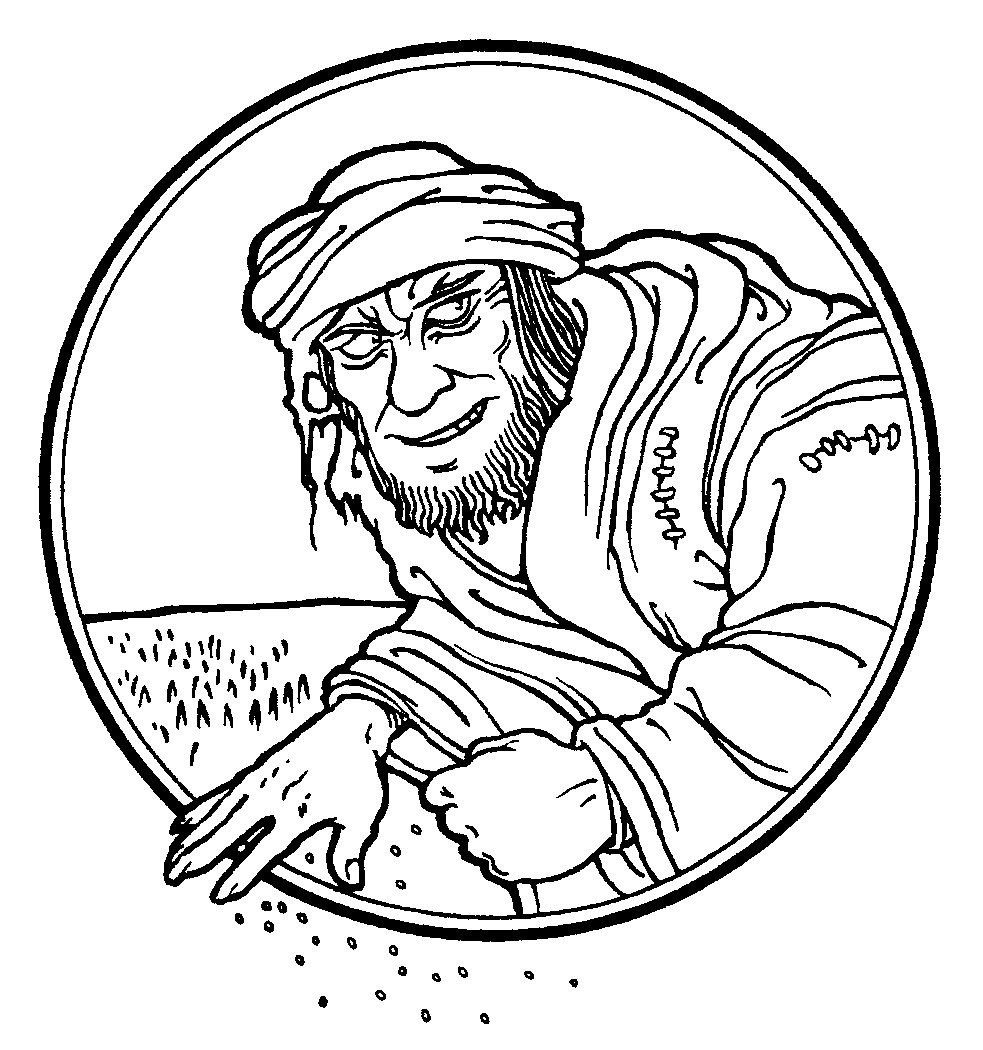
Last week, we heard the parable of the sower who sowed seeds on four types of soil. The four types of soil represented four types of hearts. There was the hard path that represented the hard heart that didn’t hear the Word of God at all. There was the rocky soil that represented the heart that heard the Word of God, but rejected the opportunity to study the Word of God more deeply. There was the weedy soil that represented the heart that heard the Word of God, but allowed the things of this world to become more important than studying God’s Word. Finally, there was the good soil where the Word of God put its roots deep into the heart.
In today’s Gospel Jesus tells another story dealing with seeds. This time, there are two sowers and two different seeds. The agricultural back ground of the story is sinister. The evil seed is actually a specific weed called “darnel”. It used to be known as “false wheat”. Darnel looks and grows just like wheat. It takes a very skillful farmer to notice the difference and the difference is only made clear late in the growth cycle when the heads appear. The seeds of the darnel are not only worthless. In fact, they are dangerous. They are toxic to people. It’s Latin name Lolium temulentum comes from the Latin meaning “drunk.” It refers to the drunken nausea which would occur from eating the infected plant, which can be fatal. If you depended on the wheat to feed your family and you harvested a crop of darnel instead, it would be a disaster.
This purposeful planting of darnel is a scheme of long-range diabolical hatred. The enemy would have had to divert some of his own resources to harvesting the worthless seeds of the darnel during the previous season. Then he would have to set aside storage for the darnel until the following planting season. Even then, the enemy would have to wait for the end of the growing season to witness the full destructive effect of the bad seed. The enemy might have to wait two years or more for his plan to come to completion. This is cowardly, dishonorable, cruel, and an extreme expression of hatred: all characteristics that accurately describe our enemy: the devil.
Again, this is one of those parables where Jesus Himself provides the explanation: “The one who sows the good seed is the Son of Man. The field is the world, and the good seed is the sons of the kingdom. The weeds are the sons of the evil one, and the enemy who sowed them is the devil.” The sower is the same as the previous parable, the Son of Man. The seed in the previous parable put its roots down deep into the good soil and produced a yield. In today’s parable, we see that the yield is sons of the kingdom. The good Word of God puts its roots down deep into the heart of man and produces Christians.
The exact opposite happens with the bad seed. It puts its roots into the heart and produces sons of the evil one … the hypocrites that plague every congregation. Those that look and maybe even act somewhat like Christians, but then they cause trouble, taking an emotional, spiritual, and often numerical toll upon the rest of the congregation or synod. But if this is the nature of “false wheat”, this explains one of the puzzling behaviors of human beings in the church here on earth. People will often strongly disagree with the teachings of an organization, but still want to be a member of the organization. They could join an organization with which they agree, but they don’t. Maybe they have always been a member of that church body but their ideals and faith have changed or they find a church that they disagree with and join it specifically to try to change it from within. This is diabolical.
Pick any Biblical teaching that causes controversy. The Bible teaches that Jesus is the one and only way of salvation … that no one can contribute in any way to all or part of their salvation. The Bible teaches that the Holy Spirit works through the external Word and not through internal feelings. The Bible teaches that marriage is between one man and one woman. It teaches that men and women should not have a physical relationship unless they are married. The Bible teaches that all life is sacred … even the life that is not yet born and the life that suffers near the end of its days. The Bible teaches that men are to serve in the office of the holy ministry and that both men and women are to receive that service with joy. The Bible teaches that it is dangerous to give the Lord’s Supper to people who refuse to repent of their sin, who refuse to forgive others, or who cannot examine themselves.
Many of these teachings and others disturb people in our culture. In fact, there are plenty of denominations today who find these teachings so offensive that they simply ignore what the Bible has to say and do what they want to do anyway. “Well, it’s a free country.” If they want to disobey God’s Word, no one will stop them. Instead, the day will come when they must answer to God.
But here’s the point to make today. If someone disagrees with the Bible in some way, they can find plenty of denominations to join, but they don’t. Many, many of these people insist on joining faithful denominations. Then they scheme and struggle in an effort to get that faithful denomination to fall away from the clear teaching of the Bible. They are not satisfied when they break the Word of God, but they want everyone else to break the Word of God with them. Then, even though they are the most divisive people in the congregation, they accuse the faithful of being divisive. Sooner or later people begin asking, “Why don’t these people join a denomination with which they agree? Why do they have to cause all these tears, griefs, and divisions when all we want to do is remain faithful to God’s Word?” Jesus has the answer in today’s parable. The devil intentionally sows his bad seed in the field of the Son of Man.
It is a very sad truth that Jesus teaches in today’s Gospel. He teaches that even the most faithful congregation will probably have unbelievers planted within in it. The devil will sow his lies in every congregation if he can. Some of you may be darnel instead of wheat. Some of you are Christians but some of you may not be, some may just be faking it. (Pastor Kangas writes: I pray that none of us are darnel but all true wheat.)
Of course, the problem is that there are times when all of us have acted like darnel. We often try to get what we want without checking the Bible to see what God wants. We often complain that we don’t feel heard, when, in fact, we do not listen to God in His Word. Instead of loving God above all things, we love ourselves. Instead of loving our neighbor, we seek to exploit our neighbor. When God’s Word specifically teaches something that we don’t like, we try to find a work-around that will let us do what we want instead of what God wants.
That part of us that acts like darnel should terrify us. Jesus’ teaching in today’s Gospel is clear. He said, “The harvest is the end of the age, and the reapers are angels. Just as the weeds are gathered and burned with fire, so will it be at the end of the age. The Son of Man will send His angels, and they will gather out of His kingdom all causes of sin and all law-breakers, and throw them into the fiery furnace. In that place there will be weeping and gnashing of teeth.” Jesus very clearly teaches that hypocrites in congregations will suffer an eternal fate that is like a fiery furnace … a place of weeping and gnashing of teeth.
Fortunately for us, our Savior Himself became the good seed for us. He became the ultimate grain of wheat for us. As was quoted in last weeks’ sermon: Jesus said: “The hour has come for the Son of Man to be glorified. 24 Truly, truly, I say to you, unless a grain of wheat falls into the earth and dies, it remains alone; but if it dies, it bears much fruit.” John 12:23–24 When Jesus took our human flesh upon Himself, He became a seed just like us. But He was the seed that Adam and Eve were supposed to be. He was the Seed of God. He was the true wheat. He never acted like darnel. That is, He never sinned. Never the less, He took the punishment of darnel upon Himself for your sake. He was crucified and then buried just like a seed. While He hung on the cross, He suffered the fiery furnace. He endured the weeping and the gnashing of teeth. He endured it all so that the darnel of this world could be converted into wheat.
When the servants wanted to pull the darnel from the field, the owner said, ‘No, lest in gathering the weeds you root up the wheat along with them. Let both grow together until the harvest.’ This is the Lord waiting … giving time for the Holy Spirit to work through the proclamation of the good seed of God’s Word and convert the darnel, the sons of the evil one, into wheat, the sons of the kingdom. For “God our Savior … desires all people to be saved and to come to the knowledge of the truth.” 1 Timothy 2:3–4
When He rose from the dead and ascended into heaven, Jesus poured out the Holy Spirit. The Holy Spirit comes to us darnel plants and offers to convert us into wheat by the forgiveness of sins which Jesus Christ has earned for us. The Holy Spirit calls and converts us by His Word of Law and Gospel. In Holy Baptism we die to being darnel, and are raised again in Jesus Christ to become God’s wheat. Then we grow up in Him by faith, and receive His strength and continued implanting by His Word. We are daily transformed in the remembrance of His promise in Baptism, in receiving His Absolution and when it is offered, we are joined to the whole wheat loaf as we received the Bread of life, Jesus Christ with His body and blood in the Sacrament of the Altar. As His wheat our faith is in Him and not our worthiness. We live in the peace given under His true teaching. By the power of God we become righteous for the sake of Jesus Christ and are saved, Therefore, as we live by faith, we know that the fiery furnace is not our destination. God will preserve and strengthen all believers until the day that they are gathered in the “barns”. Jesus said, “The righteous will shine like the sun in the kingdom of their Father.” And so all believers will. There we and all the saints shall reflect the glory of our God and Redeemer and shine in His righteousness and joy forevermore. God grant it for Jesus’ sake, Amen.
Pr. Aaron Kangas